Wildlife Guide · New Guinea & Moluccas, Timor and the Solomon Islands
Grey Cuscus
Phalanger orientalis (Pallas, 1766) — family Phalangeridae
A marsupial that people keep mistaking for a monkey, a sloth and a possum — and it is the third of those.
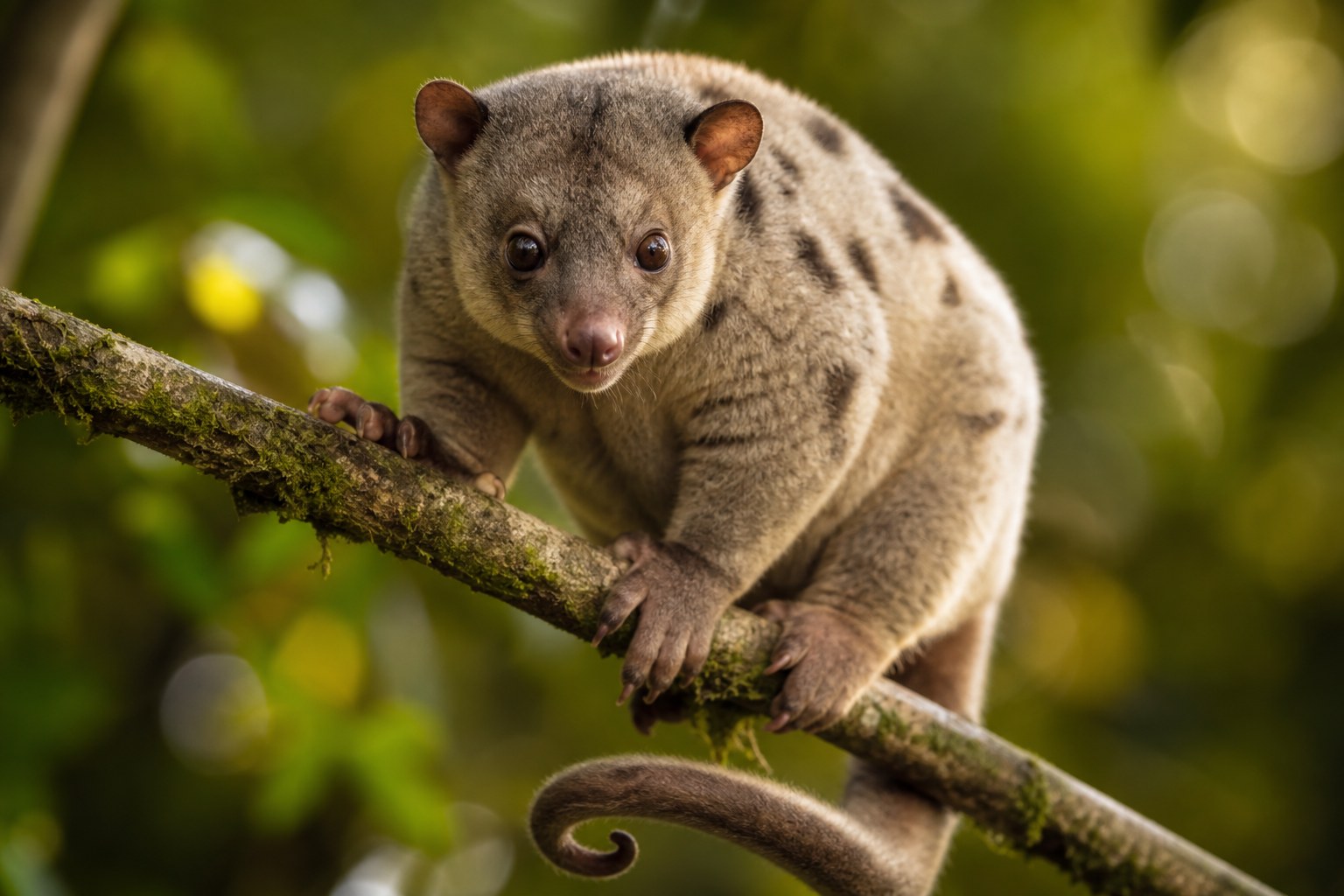
AI-generated educational wildlife portrait — World Animal Rescue Network · AI visualisation, not a photograph
In brief
The grey cuscus (Phalanger orientalis) is a slow, nocturnal, tree-dwelling marsupial of New Guinea and nearby islands; it is a possum rather than a primate, and archaeological evidence shows people were deliberately moving it between islands around 20,000 years ago.
Also in Animals A to Z · Animals that start with G
By WARN Research & Conservation Team Last updated
The grey cuscus is a slow, nocturnal, tree-dwelling marsupial of New Guinea and the surrounding islands, and it is misidentified more consistently than almost any animal in the region. Its round face, forward-set eyes and deliberate climbing suggest a primate; its pace suggests a sloth. It is neither. Cuscuses are possums, in the family Phalangeridae, and their nearest relatives are the brushtail possums of Australia. It also carries an unusual distinction in archaeology. Grey cuscus remains appear on islands the species could not have reached alone, in deposits dating back roughly 20,000 years — evidence that people were deliberately moving animals between islands in the Pleistocene. That makes this unremarkable-looking marsupial one of the earliest documented cases of humans translocating a mammal anywhere in the world.
~20,000 yr
Age of the earliest evidence of humans moving cuscuses between islands
35–45 cm
Head and body length, with a tail about as long again
Prehensile
Tail, with a bare scaly tip for grip
Nocturnal
Active at night, sleeping curled in dense foliage by day
Figures sourced from IUCN Red List — Phalanger orientalis, Australian Museum — cuscus and possum family .
Grey Cuscus: Quick Facts
| Head and body length | 35–45 cm |
|---|---|
| Tail | Prehensile, roughly as long as the body, with a bare gripping tip |
| Activity | Nocturnal |
| Diet | Leaves, fruit and flowers |
| Group | Marsupial — family Phalangeridae, the possums |
| Main threat | Hunting for meat and fur; logging and forest conversion |
Scientific Classification
| Kingdom | Animalia |
|---|---|
| Phylum | Chordata |
| Class | Mammalia |
| Order | Diprotodontia |
| Family | Phalangeridae |
| Genus | Phalanger |
| Species | Phalanger orientalis |
Conservation Status
- IUCN Status
- Least Concern
- Population
- No reliable estimate exists
- Trend
- Unknown; declining near settlements and logging roads
- Assessed
- 2016
- CITES
- Not listed
The listing reflects range size rather than security. Hunting pressure is intense in accessible areas, and a slow arboreal marsupial is among the easiest large animals in the forest to catch.
Did you know?
Cuscus bones on islands the animal could never have swum to are around 20,000 years old — meaning people were deliberately stocking islands with a food species thousands of years before anyone planted a crop.
Key Facts: Grey Cuscus
- The grey cuscus is a marsupial possum in the family Phalangeridae, not a primate and not a sloth — its closest relatives are Australian brushtail possums.
- It has a prehensile tail with a bare, roughened tip that grips like a fifth limb while climbing.
- Like other possums it shows syndactyly: the second and third toes of the hind foot are fused inside a shared skin sheath, with the claws left separate, and are used for grooming.
- Cuscus remains on islands the species could not have colonised unaided date to roughly 20,000 years ago — among the earliest known human translocations of any mammal.
- It is nocturnal and slow-moving, feeding mainly on leaves, fruit and flowers, with the low-energy lifestyle a leaf diet forces.
- The IUCN lists it as Least Concern, but that reflects a wide range rather than security: it is hunted intensively for meat across much of New Guinea and is easy to catch precisely because it moves slowly.
Why is a cuscus not a monkey?
The resemblance is convergent evolution, not relatedness. A cuscus has a round head, forward-facing eyes, grasping hands and a prehensile tail — the standard toolkit for an animal that makes a living moving carefully through a forest canopy, and one that primates arrived at independently on other continents. New Guinea has no native monkeys. The niche was there, and marsupials filled it.
The giveaways are marsupial. Females have a forward-opening pouch in which the young complete their development after a very short gestation. The hind foot shows syndactyly, with two toes fused within a single sheath of skin, an arrangement found across the diprotodont marsupials. And the front teeth are the paired procumbent lower incisors that give the group its name. A cuscus is a possum that has taken on a primate's job.
The 20,000-year-old translocation
Grey cuscus bones turn up in archaeological deposits on islands including New Ireland, in layers dated to roughly 20,000 years ago. The species is not native there and could not have crossed the water unaided. The only plausible explanation is that people carried it, deliberately, and released it.
That matters well beyond this animal. It pushes the record of humans intentionally moving a mammal into a new environment back into the Pleistocene, thousands of years before agriculture. The likely motive is straightforward: a slow, edible, easily caught arboreal marsupial is a portable food supply, and stocking an island with one is a rational thing to do if you intend to return. It is also, in modern terms, the introduction of a non-native species — the same process that has since driven island extinctions worldwide, carried out by people who had no framework for thinking about it that way.
Living slowly on a leaf diet
Leaves are abundant and nutritionally poor. Animals that rely on them tend to be slow, to rest for long periods, and to run low metabolic rates — the pattern that produces sloths in South America, koalas in Australia and cuscuses in New Guinea, none of them related.
The grey cuscus eats leaves, fruit and flowers, sleeps through the day curled in dense foliage or a tree hollow, and moves at night with a deliberateness that has nothing to do with caution. Its digestive system ferments plant material slowly, which sets a ceiling on how much energy it can extract per hour and therefore on how fast it can afford to move. Every part of the animal follows from that constraint.
Why 'Least Concern' understates the pressure
The grey cuscus occupies a large range across New Guinea and neighbouring islands, and that breadth is what earns the Least Concern listing. Range size is not the same as safety.
Cuscuses are among the most heavily hunted animals in New Guinea, taken for meat and for fur, and their slowness makes them exceptionally easy to catch — with dogs, at night, by hand. In areas near settlements and along new logging roads, local populations have been thinned or removed entirely, and a species can be locally absent across large areas while a range map still shows it as widespread. Logging and conversion to oil palm remove canopy connectivity that an animal reluctant to descend to the ground depends on. The listing describes the species as a whole; it does not describe the forest nearest to any given village.
What WARN Does
WARN publishes free, sourced species education, including for animals that receive almost no coverage in English. New Guinea holds roughly 5% of global biodiversity on under 1% of the world's land area and is among the least documented major rainforest regions, which means basic accurate information about its animals is genuinely scarce rather than merely repetitive.
If this guide helps you understand wildlife and the pressures it faces, a gift to WARN supports habitat protection and free public education in our partner countries.
Grey Cuscus: Frequently Asked Questions
What is a cuscus?
Is a cuscus a monkey or a sloth?
Where do grey cuscuses live?
What do cuscuses eat?
Are grey cuscuses endangered?
Why is the grey cuscus important to archaeology?
Are northern common cuscus dangerous?
How long do northern common cuscus live?
How big is a northern common cuscus?
Sources & References
Population figures, conservation status and biological facts on this page are drawn from authoritative scientific and intergovernmental sources.
Terms used on this page
Plain-English definitions, from our wildlife and conservation glossary.
Explore more animals
Discover more animals, their habitats and their conservation status in the WARN wildlife-guide library.
Enjoyed this Grey Cuscus guide?
Receive appeal updates, animal-welfare news and published funding reports. Unsubscribe any time.
We only use your address for WARN updates. See our privacy policy.