Wildlife Guide · Sulawesi, Indonesia & Wallacea — primary and secondary forest
Spectral Tarsier
Tarsius tarsier (Erxleben, 1777) — family Tarsiidae
Each eye weighs more than its brain — and it sings in ultrasound humans cannot hear.
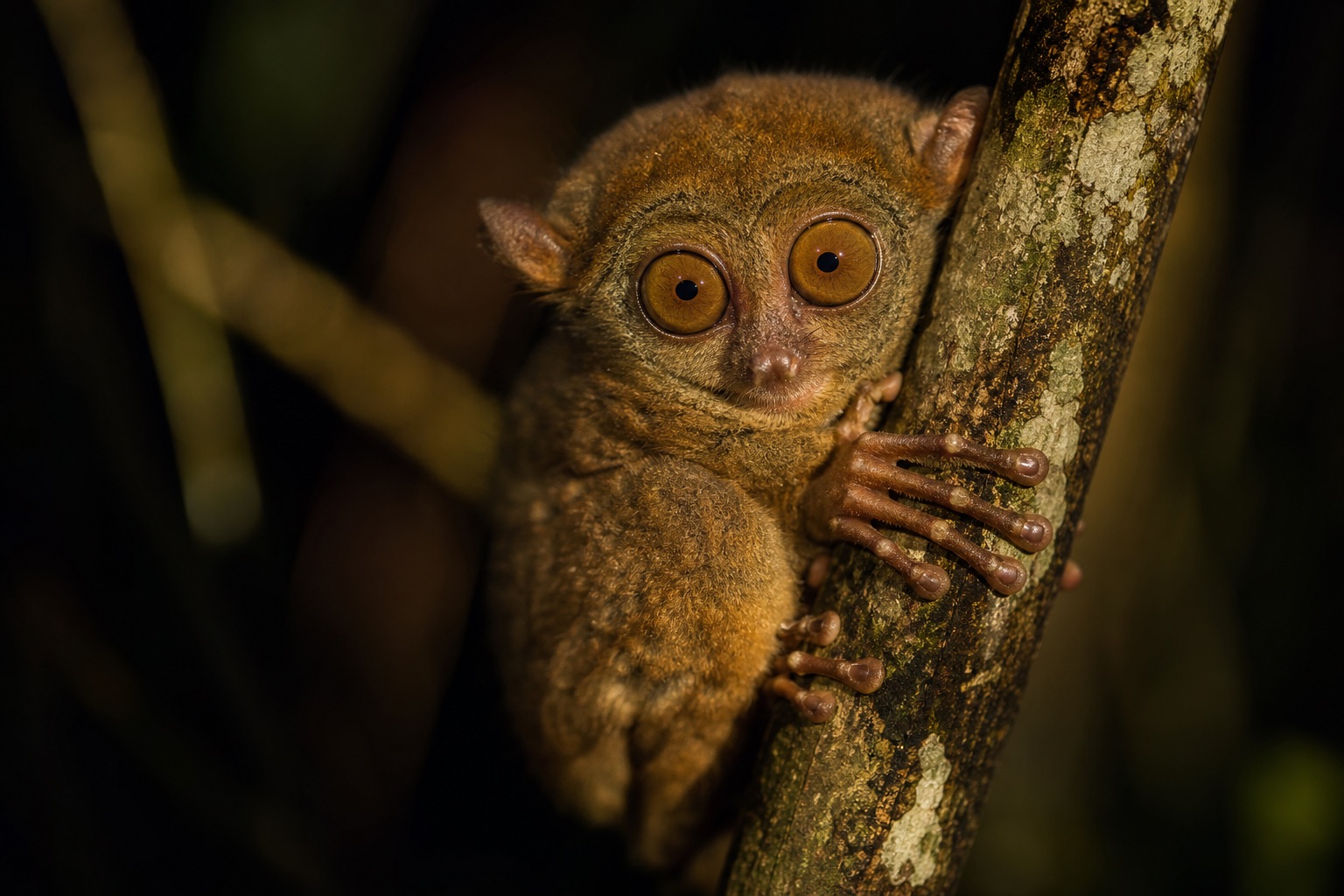
AI-generated educational wildlife portrait — World Animal Rescue Network · AI visualisation, not a photograph
In brief
The spectral tarsier (Tarsius tarsier) is a tiny nocturnal primate of Sulawesi with eyes larger than its brain, head rotation of nearly 180 degrees, and ultrasonic vocalisations; it is listed Vulnerable as forest is lost across Wallacea.
Also in Animals A to Z · Animals that start with S
How you can help
You can support the related appeal — read its purpose, recipient status and fund terms first — or give once to where it is needed most. Sharing accurate information helps too.
By WARN Research & Conservation Team Last updated
The spectral tarsier is a tiny primate of Sulawesi — one of the island's several tarsier species — with enormous eyes, elongated hind legs for vertical clinging and leaping, and a head that can rotate nearly 180 degrees in each direction like an owl. Each eye is larger than the brain by volume, an adaptation for nocturnal hunting of insects and small vertebrates. Spectral tarsiers communicate with vocalisations that include ultrasonic calls above the range of human hearing — recorded in research on Sulawesi tarsiers and used in social contact and territory defence. They are strictly nocturnal, sleeping in tree holes by day and emerging at dusk. Forest loss across Sulawesi reduces the hollow-bearing trees and continuous canopy they need.
Eyes > brain
Each eye larger than the brain by volume
~180°
Head rotation — nearly owl-like
Ultrasound
Vocalisations above human hearing range
Vertical
Clings and leaps on trunks and branches
Figures sourced from IUCN Red List — Tarsius tarsier, Primate Info Net — tarsiers .
Spectral Tarsier: Quick Facts
| Eyes | Each larger than the brain |
|---|---|
| Head rotation | Nearly 180° each direction |
| Vocalisations | Includes ultrasonic calls |
| Activity | Strictly nocturnal |
| IUCN status | Vulnerable |
| Main threats | Forest loss; capture for pet trade |
Scientific Classification
| Kingdom | Animalia |
|---|---|
| Phylum | Chordata |
| Class | Mammalia |
| Order | Primates |
| Family | Tarsiidae |
| Genus | Tarsius |
| Species | Tarsius tarsier |
Conservation Status
- IUCN Status
- Vulnerable
- Population
- Unknown — locally common in some forest blocks
- Trend
- Decreasing
- Assessed
- 2016
- CITES
- Appendix II
Forest conversion on Sulawesi removes hollow roost trees. Capture for the pet trade affects accessible populations.
Did you know?
Spectral tarsiers sing in ultrasound — social calls above the frequency range human ears detect, alongside their enormous nocturnal eyes.
Key Facts: Spectral Tarsier
- Spectral tarsiers have the largest eyes relative to body size of any mammal — each eye is larger than the brain.
- The head can rotate nearly 180 degrees in either direction, aiding nocturnal scanning without moving the body.
- They produce ultrasonic vocalisations used in social communication — above the frequency range humans hear.
- Tarsiers are haplorhine primates — more closely related to monkeys and apes than to lemurs — but leap vertically like frogs rather than walking on all fours.
- Spectral tarsiers are strictly nocturnal, roosting in tree holes by day and hunting insects at night.
- Listed Vulnerable, with forest conversion on Sulawesi removing hollow trees and canopy continuity they require.
Eyes larger than the brain
Nocturnal hunting demands light capture. Tarsiers cannot move their eyes in the socket as owls do, so they evolved both huge eyes and a neck that rotates almost 180 degrees each way — compensating for a fixed gaze with head movement.
Each eye is heavier than the brain. The trade-off is cognitive volume versus visual sensitivity in dim forest. Tarsiers catch insects and small vertebrates by leaping from vertical supports, guided by vision rather than echolocation — unlike bats, they are silent hunters apart from their social calls.
Ultrasound in the forest
Research on Sulawesi tarsiers recorded vocalisations extending into ultrasonic frequencies — above about 20 kilohertz, the upper limit of human hearing. These calls function in mate attraction, territorial defence and group cohesion.
Ultrasound travels poorly through dense vegetation compared with lower frequencies, but it may reduce detection by predators or competitors that do not hear in the same range. Tarsiers also produce audible lower-frequency calls; the full repertoire varies among Sulawesi species, several of which were split from the former Tarsius tarsier complex.
Vertical clinging and leaping
Tarsiers cling upright to vertical trunks and branches, supported by elongated tarsal bones that give the group its name. Hind limbs are much longer than forelimbs; they leap several metres between supports to catch prey.
They do not nest-build or move on the ground willingly. Sleeping sites are tree holes or dense vine tangles. Loss of large hollow-bearing trees — from logging, fire or clearance — removes roost sites directly. Fragmented forest forces ground crossing, where cats and other predators kill tiny primates easily.
Sulawesi forest pressure
Sulawesi shares the Wallacea endemism pattern: many species occur nowhere else and lose forest to the same drivers — conversion for agriculture and plantations, logging, and hunting where primates are taken for bushmeat or the pet trade.
The spectral tarsier is listed Vulnerable. It remains locally common in some protected forest blocks, but those blocks are isolated. Without connectivity and enforcement against capture, populations in accessible forest decline even where the species persists in reserves on paper.
What WARN Does
WARN publishes free, sourced species education for primates beyond the usual great-ape headlines. Spectral tarsiers combine enormous eyes, ultrasonic calls and vertical leaping on an island — Sulawesi — where forest conversion continues across the same landscapes as anoa and crested macaques.
If this guide helps you understand wildlife and the pressures it faces, a gift to WARN supports habitat protection and free public education in our partner countries.
How can I help save the spectral tarsier?
Explore practical ways to support the spectral tarsier, from everyday choices and sharing reliable information to reviewing a related appeal before giving.
Explore ways to support
Read the related appeal’s purpose, recipient status and fund terms. Choose an affordable gift after checking what is proposed and what has been reported.
Ease the pressures
Avoid the wildlife trade and souvenirs, never buy wild animals as pets, and choose sustainable, habitat-friendly products — the threats behind the spectral tarsier's decline fall when demand does.
Spread the word
Share accurate, sourced information about the spectral tarsier. Wider awareness is what turns concern into lasting protection.
Spectral Tarsier: Frequently Asked Questions
How can I help save the spectral tarsier?
Why are tarsier eyes so big?
Do spectral tarsiers use ultrasound?
What is a spectral tarsier?
Are tarsiers related to lemurs?
Where do spectral tarsiers live?
Are spectral tarsiers dangerous?
How long do spectral tarsiers live?
How big is a spectral tarsier?
What do spectral tarsiers eat?
Sources & References
Population figures, conservation status and biological facts on this page are drawn from authoritative scientific and intergovernmental sources.
Terms used on this page
Plain-English definitions, from our wildlife and conservation glossary.
Explore more animals
Discover more animals, their habitats and their conservation status in the WARN wildlife-guide library.
Enjoyed this Spectral Tarsier guide?
Receive appeal updates, animal-welfare news and published funding reports. Unsubscribe any time.
We only use your address for WARN updates. See our privacy policy.