Wildlife Guide · Domesticated worldwide — sericulture centres in China, India, Brazil and elsewhere & Wild ancestor native to northern China
Silkworm
Bombyx mori (Linnaeus, 1758) — family Bombycidae; domesticated from the wild silk moth Bombyx mandarina
Fully domesticated — flightless, dependent on people, and the other fully domesticated insect beside the honey bee.
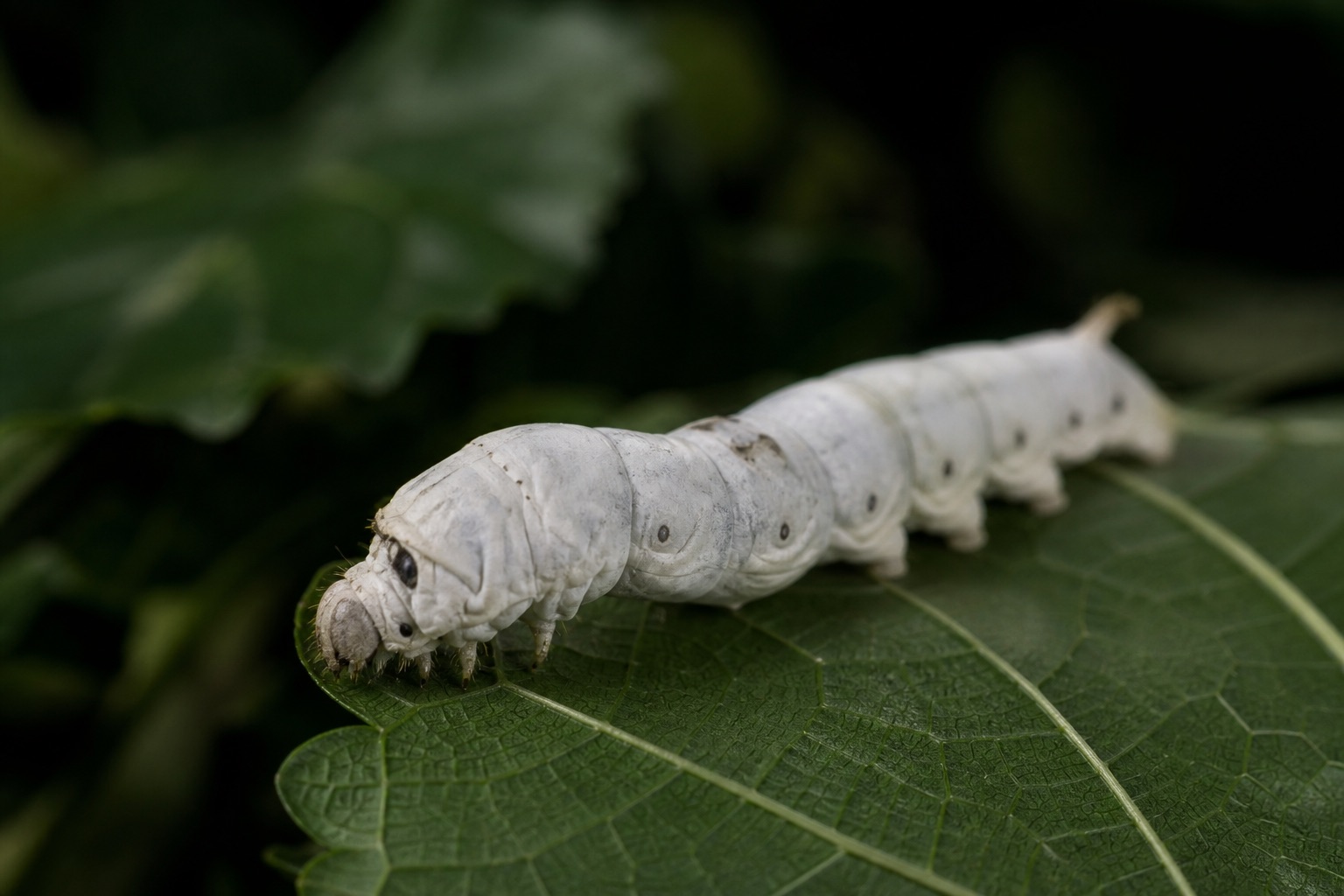
AI-generated educational wildlife portrait — World Animal Rescue Network · AI visualisation, not a photograph
In brief
The silkworm (Bombyx mori) is the domesticated larva of a flightless silk moth bred for millennia in sericulture; it eats mulberry leaves, spins a silk cocoon, and cannot survive without human husbandry — one of only two fully domesticated insects alongside the honey bee.
Also in Animals A to Z · Animals that start with S
By WARN Research & Conservation Team Last updated
The silkworm is the larva of Bombyx mori, a moth domesticated in China thousands of years ago for silk production. Adults have reduced mouthparts and do not feed; wings are vestigial and bodies too heavy for flight. The caterpillar eats mulberry leaves almost exclusively, spins a continuous silk fibre to form a cocoon, and is killed in most sericulture lines before emerging so the filament stays intact. Bombyx mori cannot survive in the wild. It has lost the camouflage, behaviour and genetic diversity needed to evade predators and find food without people planting mulberry and tending trays. Alongside the honey bee, it is one of the two insects fully domesticated — bred for a human product across so many generations that the wild type is a different species, Bombyx mandarina. WARN's honey bee guide covers the other domesticated insect at equivalent depth.
~5,000 yr
Sericulture in China — archaeological silk from roughly this age
1 km+
Single silk filament length from one cocoon — continuous fibre
Flightless
Adult moth — domestication removed flight ability
2 insects
Fully domesticated — silkworm and honey bee
Figures sourced from FAO — sericulture overview, IUCN Red List .
Silkworm: Quick Facts
| Larval length | Roughly 7–9 cm at final instar |
|---|---|
| Diet | Mulberry leaves |
| Habitat | Human sericulture only |
| Silk | Single continuous filament per cocoon |
| Adult | Flightless, non-feeding moth |
| Domestication pair | Honey bee — other fully domesticated insect |
Scientific Classification
| Kingdom | Animalia |
|---|---|
| Phylum | Arthropoda |
| Class | Insecta |
| Order | Lepidoptera |
| Family | Bombycidae |
| Species | Bombyx mori |
| Wild ancestor | Bombyx mandarina |
Conservation Status
- IUCN Status
- Domesticated — Not Evaluated
- Population
- Billions reared annually in sericulture — not a wild population
- Trend
- Stable as agricultural livestock
- Assessed
- N/A — domesticated
- CITES
- Not listed
Conservation frameworks do not apply to Bombyx mori as they do to wild species. Genetic diversity is maintained in research strains and some ancestral crosses with Bombyx mandarina.
Did you know?
One silkworm cocoon unravels into a single continuous silk fibre commonly around 900 m long — a kilometre of thread from one larva spinning for days without breaking the strand.
Key Facts: Silkworm
- Bombyx mori is a domesticated moth — the silkworm is its larval stage.
- Adults cannot feed effectively and do not fly; the species depends on humans for mulberry and protection.
- One cocoon yields a single continuous silk filament up to about a kilometre long.
- Wild ancestor Bombyx mandarina still occurs in China; domesticated lines are genetically distinct.
- Most commercial cocoons are stifled before the moth emerges to preserve filament continuity.
- Sericulture welfare — killing pupae for silk — is a legitimate ethical topic alongside honey bee management.
Domestication and what was lost
Selection over thousands of years enlarged the silk gland, accelerated cocoon spinning, and reduced the adult to a brief egg-laying stage. Bombyx mori larvae are sluggish, pale and dependent on mulberry (Morus) leaves provided by growers. Adults emerge with degenerate mouthparts, mate quickly, and die within days.
They lack fear responses and predator avoidance adequate for wild survival. Releases do not establish feral populations except where they can interbreed with wild Bombyx mandarina — a concern for genetic integrity of the ancestor. The domesticated insect is a livestock product, not a biodiversity asset in the conservation sense.
From mulberry leaf to silk thread
A larva moults four times through five instars, eating continuously. In the final instar it spins a cocoon from a single fibre extruded through spinnerets — a pair of modified salivary glands secreting fibroin coated in sericin. The fibre is pulled off the cocoon in reeling baths for commercial silk, or brushed off for spun silk from shorter fragments.
Quality depends on leaf diet, temperature and humidity control in rearing houses. China and India dominate production; Brazil and other countries also farm at scale. Silk is protein fibre, biodegradable and long-lasting — properties that kept sericulture economically relevant long after synthetic polymers arrived.
Ethics, welfare and alternatives
Conventional sericulture kills pupae inside cocoons — by heat or steam — before the moth cuts the filament emerging. Ahimsa or peace silk allows adult emergence but produces shorter, tangled fibre. Animal welfare debates treat silkworms as sentient enough to matter in ethical silk marketing; scientific consensus on insect pain is still evolving, but the economic default remains stifling.
Research into recombinant spider silk in bacteria and yeast aims to bypass silkworms entirely. Until that scales, silk remains an insect agriculture product with the same husbandry and welfare questions as honey production — different animal, same domestication logic.
The honey bee parallel
Honey bees were domesticated for honey and pollination services; silkworms for fibre. Both are insects whose wild-type ecology has been replaced by human-managed lifecycles. Conservation messaging that lumps all insects together misses that distinction — Bombyx mori is not declining in the wild because it does not exist in the wild as a self-sustaining population.
Readers comparing domesticated silkworms to threatened wild Lepidoptera should separate sericulture from butterfly conservation. Planting mulberry for silk is agriculture; planting native host plants for endangered swallowtails is ecology.
What WARN Does
WARN publishes free education that separates domesticated livestock insects from wild pollinator decline. Silkworms and honey bees share full domestication; conflating them with threatened wild insects distorts both sericulture ethics and conservation priorities.
If this guide helps you understand wildlife and the pressures it faces, a gift to WARN supports habitat protection and free public education in our partner countries.
Silkworm: Frequently Asked Questions
What do silkworms eat?
Where do silkworms live?
Are silkworms dangerous?
How long do silkworms live?
How big are silkworms?
How is a silkworm different from a honey bee?
Sources & References
Population figures, conservation status and biological facts on this page are drawn from authoritative scientific and intergovernmental sources.
Terms used on this page
Plain-English definitions, from our wildlife and conservation glossary.
Explore more animals
Discover more animals, their habitats and their conservation status in the WARN wildlife-guide library.
Enjoyed this Silkworm guide?
Receive appeal updates, animal-welfare news and published funding reports. Unsubscribe any time.
We only use your address for WARN updates. See our privacy policy.