Wildlife Guide · Sub-Saharan Africa & Open savanna and grassland
Secretary Bird
Sagittarius serpentarius (Miller, 1779) — family Sagittariidae
A raptor that walks rather than soars — and kills snakes by stamping them at a speed the eye can barely follow.
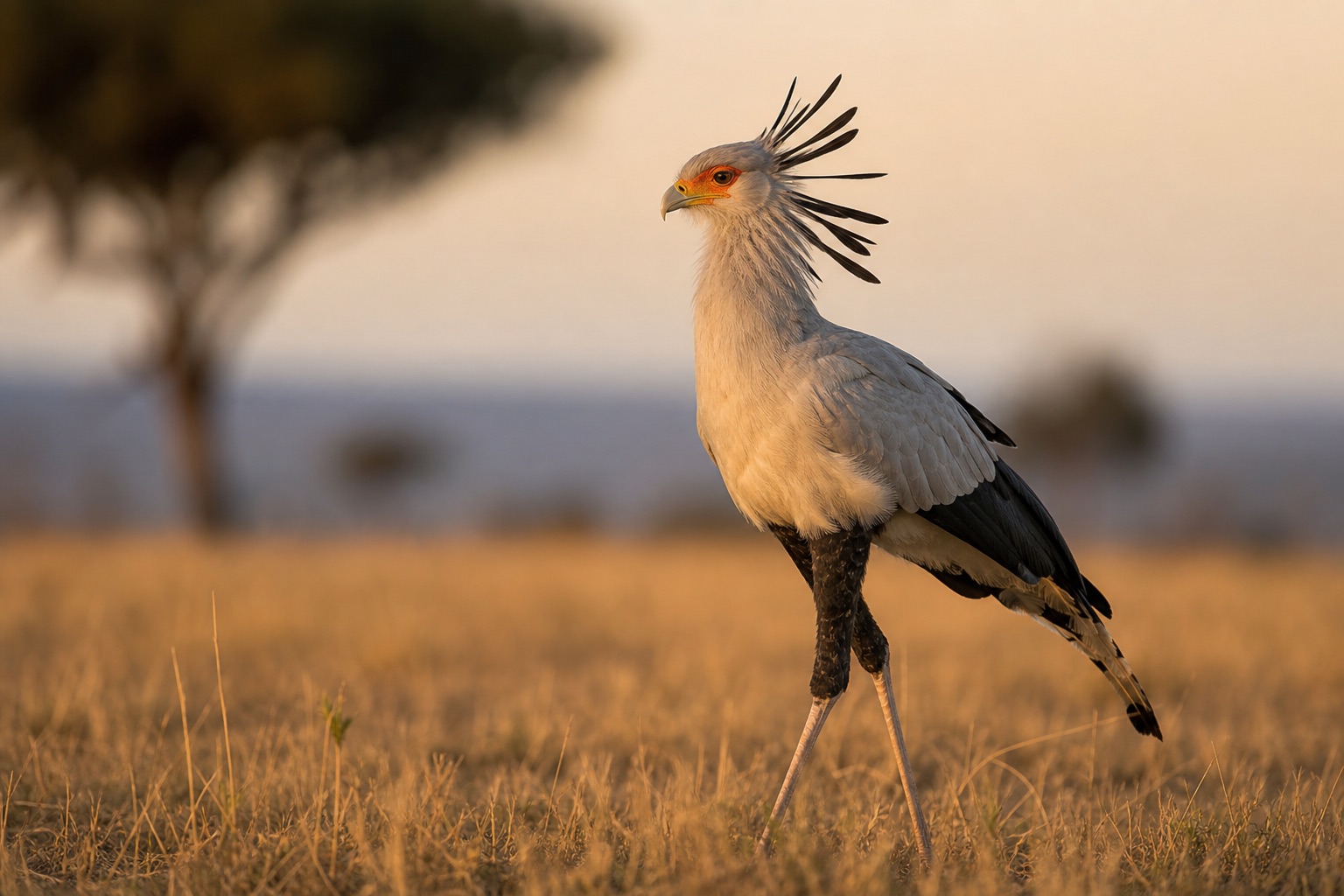
AI-generated educational wildlife portrait — World Animal Rescue Network · AI visualisation, not a photograph
In brief
The secretary bird (Sagittarius serpentarius) is an Endangered African raptor that hunts on foot across savanna, killing snakes and other prey with rapid stamping blows delivered in about 15 milliseconds at force several times its body weight.
Also in Animals A to Z · Animals that start with S
How you can help
You can support the related appeal — read its purpose, recipient status and fund terms first — or give once to where it is needed most. Sharing accurate information helps too.
By WARN Research & Conservation Team Last updated
The secretary bird is a long-legged raptor of African savannas, instantly recognisable by its crest of head feathers, grey body, black wing and tail feathers, and bare orange or pink skin on the face. Unlike most birds of prey, it hunts on foot, covering kilometres of grassland each day. It takes insects, small mammals, lizards and birds, but its reputation rests on snake killing: it seizes serpents with its feet and delivers rapid stomps with force several times its own body weight. High-speed filming shows strikes landing in about 15 milliseconds — faster than a human blink. The bird's long legs keep its body away from bites while precise foot blows disable prey. The IUCN lists the secretary bird as Endangered, with a decreasing population across much of sub-Saharan Africa. Habitat loss, pesticide impacts on prey, collision with power infrastructure and secondary poisoning from rodenticides all contribute. A bird built to walk open country needs open country to remain.
Endangered
IUCN Red List status — population decreasing
~15 ms
Duration of a stamping strike on snake prey
1.2–1.5 m
Height when standing — taller than most raptors
On foot
Hunts by walking — rarely pursues prey in flight
Figures sourced from IUCN Red List — Sagittarius serpentarius, Current Biology — secretary bird strike biomechanics, BirdLife International — Secretarybird factsheet .
Secretary Bird: Quick Facts
| Height | Roughly 1.2–1.5 m standing |
|---|---|
| Hunting method | Walking hunt; foot stamping |
| Nest | Large stick platform in acacia or thorn tree |
| Diet | Snakes, insects, rodents, lizards, small birds |
| IUCN status | Endangered |
| Distinctive mark | Crest of long head feathers; bare facial skin |
Scientific Classification
| Kingdom | Animalia |
|---|---|
| Phylum | Chordata |
| Class | Aves |
| Order | Accipitriformes |
| Family | Sagittariidae |
| Genus | Sagittarius |
| Species | Sagittarius serpentarius |
Conservation Status
- IUCN Status
- Endangered
- Population
- No precise global estimate — declining across range
- Trend
- Decreasing
- Assessed
- 2020
- CITES
- Appendix II
Grassland conversion and poisoning reduce prey and kill birds directly; power infrastructure adds collision mortality for a species that travels long distances on foot.
Did you know?
Secretary birds can cover more than 30 km in a day on foot while hunting — a raptor that behaves like a long-distance pedestrian.
Key Facts: Secretary Bird
- The secretary bird is a terrestrial raptor in its own family, Sagittariidae — related to hawks and vultures but adapted for walking hunt.
- It kills snakes by stamping with precise, high-speed foot blows while keeping the body raised on long legs.
- Research using high-speed video measured strike durations of about 15 milliseconds and forces several times the bird's body weight.
- Secretary birds nest in acacia trees, building large stick platforms used for years and often visible from a distance across savanna.
- The IUCN lists the species as Endangered; range-wide declines track habitat conversion, poisoning and infrastructure collision.
- Juveniles have shorter crest feathers and yellowish facial skin; adults develop the full quill-like head plumes used in display.
How snake stamping works
Secretary birds do not peck snakes like a heron spears fish. They grasp, pin and strike with the feet — the same taloned tools other raptors use in flight, applied in a rapid series of blows delivered while standing over prey. High-speed video analysis published in the journal Current Biology measured strike times of about 15 milliseconds and peak forces of several times the bird's body weight — enough to disable venomous snakes quickly enough to reduce bite risk.
Long bare legs increase the reach and create distance between fangs and vital organs. The bird's scales and thick leg skin provide additional protection, though not immunity — bites occur and can kill. Stamping is not reserved for snakes; the same technique subdues lizards, rodents and small birds. The behaviour is innate enough that captive-reared birds stamp unfamiliar elongated objects, suggesting a built-in target response refined by experience.
Life on the savanna floor
Secretary birds are diurnal and walk methodically through grass, flushing prey by disturbance. Pairs or family groups maintain territories that can span several square kilometres in poor habitat and less where food is abundant. They fly well despite their terrestrial habit — long wings carry them to roosts and nests in thorn trees — but pursuit hunting is rare.
Breeding produces one to three eggs in a stick nest high in a tree, often an acacia. Incubation lasts around six weeks; chicks fledge after roughly twelve weeks but may remain dependent for months. The species is slow to replace losses, which amplifies the impact of adult mortality from power-line collision and poisoning.
Why Endangered status matters
The IUCN upgraded the secretary bird to Endangered as surveys showed range contraction and declining reporting rates across southern and eastern Africa. Converting savanna to cropland removes hunting ground. Intensive pesticide use reduces the insect and rodent base juveniles rely on. Rodenticides and poison baits aimed at predators percolate through scavenged carcasses. Power lines and fences add collision and entanglement mortality for a bird that travels on foot across open terrain.
Protected areas help where they preserve grassland rather than allowing thick bush encroachment — secretary birds need a mosaic of grass and scattered trees, not closed-canopy forest. Listing alone does not restore habitat; it signals that a distinctive African raptor is moving from common savanna scenery toward fragmented strongholds.
Name and taxonomy
The English name may derive from nineteenth-century clerks — the crest feathers resemble quill pens behind the ear — though other etymologies exist and none is certain. Scientifically the bird sits in Sagittariidae, placed within Accipitriformes alongside hawks and Old World vultures, but its long legs and terrestrial ecology set it apart visually from any eagle or buzzard.
Single-species families are unusual but not unique; they flag evolutionary distinctiveness. The secretary bird is Africa's only member. Its snake-killing behaviour appears in African folklore and on national emblems — Sudan's coat of arms formerly featured the species — which raises the stakes when populations fall: cultural visibility does not automatically translate into habitat protection.
What WARN Does
WARN publishes free education on threatened species worldwide. The secretary bird combines unmistakable field character with documented decline — exactly the profile where accurate status and threat listing matter more than repeated clips of snake stamping without context.
If this guide helps you understand wildlife and the pressures it faces, a gift to WARN supports habitat protection and free public education in our partner countries.
How can I help save the secretary bird?
Explore practical ways to support the secretary bird, from everyday choices and sharing reliable information to reviewing a related appeal before giving.
Explore ways to support
Read the related appeal’s purpose, recipient status and fund terms. Choose an affordable gift after checking what is proposed and what has been reported.
Ease the pressures
Avoid the wildlife trade and souvenirs, never buy wild animals as pets, and choose sustainable, habitat-friendly products — the threats behind the secretary bird's decline fall when demand does.
Spread the word
Share accurate, sourced information about the secretary bird. Wider awareness is what turns concern into lasting protection.
Secretary Bird: Frequently Asked Questions
How can I help save the secretary bird?
What do secretary birds eat?
Where do secretary birds live?
Are secretary birds dangerous to humans?
How long do secretary birds live?
How big is a secretary bird?
How does a secretary bird kill snakes?
Sources & References
Population figures, conservation status and biological facts on this page are drawn from authoritative scientific and intergovernmental sources.
Terms used on this page
Plain-English definitions, from our wildlife and conservation glossary.
Latest Secretary Bird Stories
Quick, fact-checked reads on the secretary bird — amazing facts, key questions and the threats it faces.
Species
Tiger vs Lion: 7 Key Differences Between the Two Biggest Cats
Tigers are bigger, stripier and solitary; lions are social and live in prides. Here's how the two largest cats really differ in size, habitat and behaviour.
Read the storySpecies
12 Astonishing Facts About the Pangolin, the World's Only Scaly Mammal
From a tongue anchored near its pelvis to scales that weigh a fifth of its body, the pangolin is one of nature's strangest mammals. Here are 12 facts that explain why.
Read the storySpecies
How Big Is a Pangolin — and How Long Is Its Tongue?
Pangolins range from house-cat size to over 30 kg, and the largest have a tongue longer than their entire body. Here are the real numbers.
Read the storyExplore more animals
Discover more animals, their habitats and their conservation status in the WARN wildlife-guide library.
Enjoyed this Secretary Bird guide?
Receive appeal updates, animal-welfare news and published funding reports. Unsubscribe any time.
We only use your address for WARN updates. See our privacy policy.