Wildlife Guide · Sahara Desert & Arabian Peninsula
Sand Cat
Felis margarita (Harrison, 1968) — family Felidae
A cat that does not need to drink, burrows to escape heat, and leaves almost no trace on the dunes.
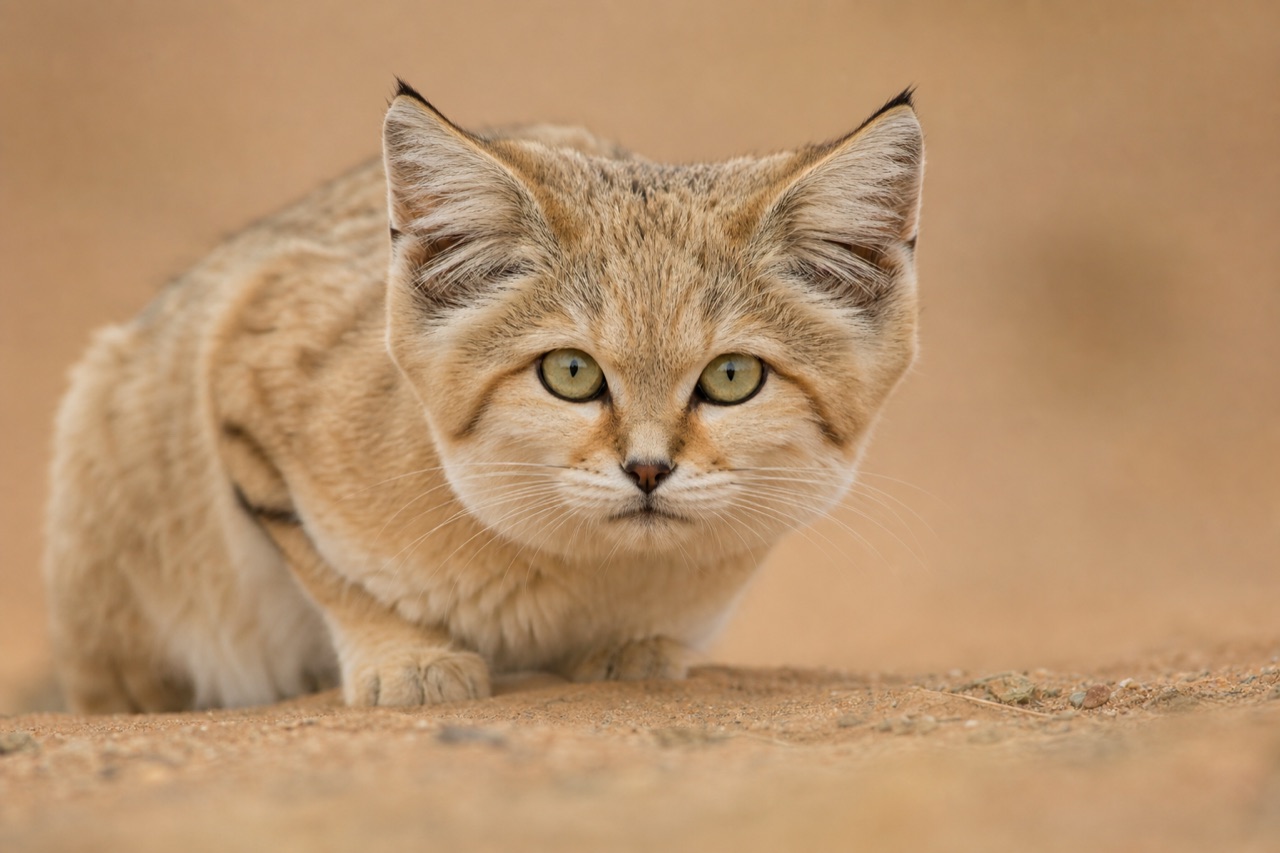
AI-generated educational wildlife portrait — World Animal Rescue Network · AI visualisation, not a photograph
In brief
The sand cat (Felis margarita) is a small pale desert felid of the Sahara, Arabian Peninsula and Central Asia, adapted to extreme aridity with fur-covered footpads, large ears for heat dissipation and the ability to survive without drinking free water.
Also in Animals A to Z · Animals that start with S
By WARN Research & Conservation Team Last updated
The sand cat is a small wild felid specialised for life in true desert — not semi-arid scrub, but the open sand and gravel of the Sahara, the Arabian Peninsula and parts of Central Asia. It is pale, compact and remarkably difficult to study: low density, nocturnal habits and a habitat that erases tracks within hours mean most of what is known comes from scattered camera-trap records and captive observations. Desert cats face a binding constraint on water. The sand cat's response is physiological and behavioural: kidneys that produce highly concentrated urine, a diet of rodents and reptiles that supplies metabolic water, and burrowing that avoids the worst daytime heat. Individuals can survive without drinking free water, though they will use it when it is available. Despite its name, the sand cat is not exclusively a dune specialist. It occupies a range of arid habitats including gravel plains, dry riverbeds and sparse desert scrub, wherever small prey and burrow shelter exist. Its pale coat, broad head and oversized ears give it a distinctive appearance that has made it a sought-after subject for camera-trap studies across North Africa and the Middle East — studies that are slowly filling in a natural history that remained largely blank for decades.
No free water
Can survive on moisture from prey alone
Fur-lined paws
Insulate against hot sand and improve traction
Burrows
Shelter in abandoned fox or rodent burrows by day
Low density
Difficult to survey — population data are sparse
Figures sourced from IUCN Red List — Felis margarita, CITES Appendices .
Sand Cat: Quick Facts
| Weight | 1.5–3.4 kg |
|---|---|
| Habitat | True desert — sand and gravel plains |
| Water | Can survive without drinking free water |
| Paws | Fur-covered pads for hot sand |
| Activity | Nocturnal; shelters in burrows by day |
| Diet | Desert rodents, birds, reptiles, insects |
| Main threats | Habitat disturbance, prey reduction, pet trade |
Scientific Classification
| Kingdom | Animalia |
|---|---|
| Phylum | Chordata |
| Class | Mammalia |
| Order | Carnivora |
| Family | Felidae |
| Genus | Felis |
| Species | Felis margarita |
Conservation Status
- IUCN Status
- Least Concern
- Population
- Unknown; presumed large across the Sahara and Arabia
- Trend
- Unknown — insufficient monitoring data
- Assessed
- 2016
- CITES
- Appendix II
Survey data are sparse across most of the range. The Least Concern listing reflects a wide distribution rather than confirmed abundance.
Did you know?
Sand cats leave almost no lasting trace on the dunes — wind erases their tracks within hours, which is one reason they were so poorly known for so long.
Key Facts: Sand Cat
- Sand cats are small desert specialists found in the Sahara, Arabian Peninsula and Central Asian deserts.
- They can survive without drinking free water, obtaining moisture from prey and producing highly concentrated urine.
- Fur covers the footpads, insulating against hot sand and improving grip on loose surfaces.
- They shelter from daytime heat in burrows — usually abandoned ones dug by foxes or rodents.
- Large ears help dissipate heat as well as detect prey moving beneath the sand.
- They are Least Concern but poorly surveyed; habitat disturbance and reduced prey are the main concerns.
Living without drinking
Sand cats face the same water problem as other desert mammals: evaporation is relentless and standing water is absent for months or years. Their kidneys concentrate urine to an extreme degree, minimising water loss with each excretion. Prey — mainly small rodents such as jirds and gerbils, but also birds, reptiles and insects — supplies metabolic water directly through digestion and oxidation.
Between kidney function, nocturnal activity and burrow shelter, a sand cat can complete its life without ever drinking. This is not unique among desert carnivores, but the sand cat is one of the few felids that occupies exclusively arid dune and gravel desert rather than the semi-arid margins where water occasionally appears. Captive sand cats will drink when water is offered, confirming that the behaviour is facultative rather than obligatory.
The metabolic cost of desert life is high. Sand cats must hunt nightly to meet energy and water demands, and prey availability tracks rainfall — rodent populations boom after desert rains and crash during drought. A sand cat's condition in any given year reflects the rodent crop, which means population density is likely far more variable than the Least Concern listing implies. In drought years, sand cats range further and hunt longer, exposing themselves to predators and traffic on the desert margins.
Feet, ears and the problem of hot sand
Sand cat fur extends between the toes and covers the footpads — an adaptation shared with other desert species such as the fennec fox. The fur insulates against surface temperatures that would burn bare pads and spreads the animal's weight slightly on loose sand, reducing sinking on dune slopes.
The ears are large relative to the head, carrying a dense network of blood vessels that dump heat at night when the cat is active. During the day, sand cats retreat to burrows — typically abandoned fox or rodent tunnels — where temperature is far lower than at the surface. A sand cat in its burrow during a Saharan midday is experiencing conditions radically different from those above ground.
Sand cats also bark. Unlike most felids, which meow, purr or chuff, sand cats produce a short, sharp bark — particularly when startled or during territorial disputes. The vocalisation is audible and has been recorded in both wild and captive animals. Combined with insulated feet, heat-radiating ears and underground shelter, the sand cat's desert toolkit is comprehensive, even if the animal itself remains rarely seen.
A cat that is hard to count
Sand cats occur at low density across enormous areas, are active mainly at night, and leave few lasting signs in habitat that wind erases daily. Camera traps have improved detection considerably — projects in Morocco, Algeria, Israel and the UAE have confirmed sand cat presence in areas where the species was previously unrecorded — but systematic surveys remain rare across much of the range.
The IUCN lists the species as Least Concern based on a presumed large population across the Sahara and Arabia, but acknowledges that the estimate is uncertain. What is clearer is the direction of pressure: habitat degradation from off-road traffic and development, reduced prey from rodent control programmes, and capture for the exotic pet trade in some regions all affect local populations without yet triggering a global status change.
Three subspecies are recognised — *Felis margarita margarita* in the Sahara, *F. m. harrisoni* in the Arabian Peninsula and *F. m. thinobia* in the Karakum and Kyzylkum deserts of Central Asia — and their status may differ locally even if the species-level listing does not reflect that. A sand cat in the Moroccan Sahara and one in the Arabian Empty Quarter face different pressures, and treating them as a single homogeneous population obscures local declines.
Why desert cats matter
Desert ecosystems receive a fraction of the conservation attention given to forests or coral reefs, partly because they appear empty and partly because they are hard to work in. Sand cats are a useful indicator: if a desert supports a breeding population of a specialist carnivore, the rodent community and burrow systems it depends on are intact.
Protecting sand cats is largely about protecting desert habitat from fragmentation — keeping dune systems connected, controlling off-road disturbance, and avoiding broad-scale rodenticide programmes that remove both prey and poison predators through secondary exposure. In the Arabian Peninsula, where rapid development has transformed much of the desert landscape, sand cat records from camera traps in protected areas are among the few data points confirming that specialist desert wildlife persists.
The sand cat also illustrates a broader point about felid conservation: the small cats of arid habitats are almost universally less studied and less funded than tigers, lions or leopards, despite facing comparable habitat loss. Accurate information about what sand cats need — burrows, rodents, connected desert — is a prerequisite for keeping them, even as a Least Concern species, from declining quietly across a range too vast to monitor effectively.
What WARN Does
WARN publishes free, sourced species education for animals in habitats the public rarely visits. Desert species like the sand cat are Least Concern on paper and almost invisible in practice — which is exactly why accurate free information about them is worth publishing.
If this guide helps you understand wildlife and the pressures it faces, a gift to WARN supports habitat protection and free public education in our partner countries.
Sand Cat: Frequently Asked Questions
Where do sand cats live?
Do sand cats need to drink water?
Why do sand cats have fur on their paws?
Are sand cats endangered?
What do sand cats eat?
Can sand cats be kept as pets?
Are sand cats dangerous?
How long do sand cats live?
How big is a sand cat?
Sources & References
Population figures, conservation status and biological facts on this page are drawn from authoritative scientific and intergovernmental sources.
Terms used on this page
Plain-English definitions, from our wildlife and conservation glossary.
Explore more animals
Discover more animals, their habitats and their conservation status in the WARN wildlife-guide library.
Enjoyed this Sand Cat guide?
Receive appeal updates, animal-welfare news and published funding reports. Unsubscribe any time.
We only use your address for WARN updates. See our privacy policy.