Wildlife Guide · Kazakhstan & Russia
Saiga Antelope
Saiga tatarica (Linnaeus, 1766) — family Bovidae
A prehistoric face, a nose that filters desert dust, and a population that can halve in a week.
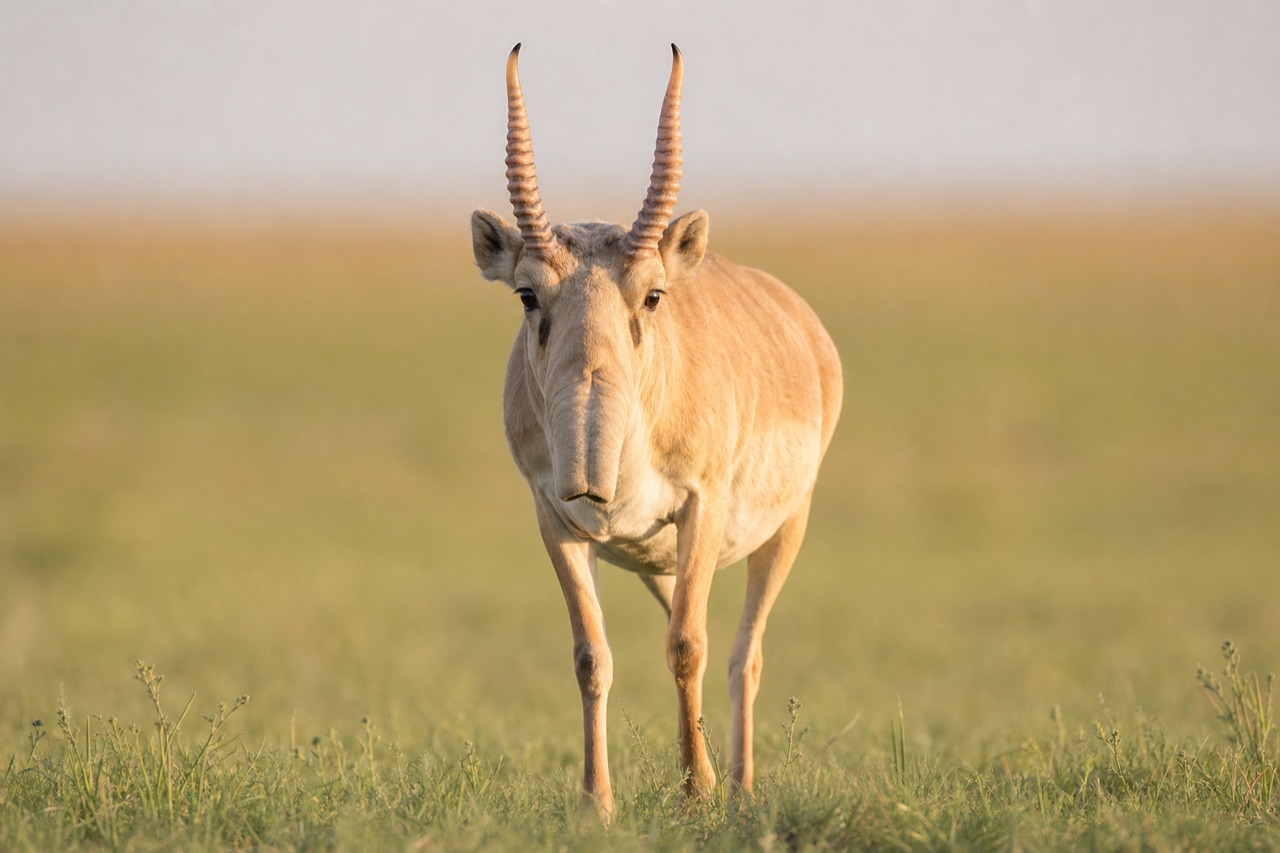
AI-generated educational wildlife portrait — World Animal Rescue Network · AI visualisation, not a photograph
In brief
The saiga antelope (Saiga tatarica) is a Central Asian steppe ungulate with a distinctive trunk-like nose, downlisted to Near Threatened in 2023 after recovery from Critically Endangered, with Kazakhstan holding around 1.9 million animals but remaining vulnerable to mass disease die-offs.
Also in Animals A to Z · Animals that start with S
How you can help
You can support the related appeal — read its purpose, recipient status and fund terms first — or give once to where it is needed most. Sharing accurate information helps too.
By WARN Research & Conservation Team Last updated
The saiga is one of the most distinctive ungulates alive: a compact antelope with a swollen, trunk-like nose that droops over its mouth. The nose warms and humidifies frigid winter air and filters dust in summer — a dual-purpose organ for life on the open steppe. Saiga have existed in roughly this form since the Pleistocene, alongside mammoths and woolly rhinos, and they remain one of the great spectacles of Central Asian grassland. Their conservation history is dramatic. Saiga were Critically Endangered after the collapse of the Soviet era, when poaching for horns and meat reduced Kazakhstan's population from over a million to tens of thousands. Protection and anti-poaching work brought a remarkable recovery — Kazakhstan alone now holds around 1.9 million animals — and the IUCN downlisted the species to Near Threatened in December 2023. The recovery is real. So is the vulnerability. Saiga are also animals of mass movement. Herds that numbered in the hundreds of thousands migrated across open steppe in a spectacle comparable to the wildebeest of the Serengeti — and the same openness that made those migrations possible makes saiga extraordinarily vulnerable to fences, roads and disease outbreaks that can sweep through a concentrated population in days.
~1.9M
Saiga in Kazakhstan following recent recovery
Dec 2023
Downlisted from Critically Endangered to Near Threatened
Mass die-offs
Pasteurellosis outbreaks can kill tens of thousands in days
Pleistocene
Saiga have existed in roughly this form since the Ice Age
Figures sourced from IUCN Red List — Saiga tatarica, CITES Appendices .
Saiga Antelope: Quick Facts
| Weight | 26–69 kg |
|---|---|
| Nose | Trunk-like — warms winter air, filters summer dust |
| IUCN status | Near Threatened (downlisted Dec 2023) |
| Kazakhstan population | Around 1.9 million |
| Migration | Long seasonal movements across open steppe |
| Key vulnerability | Mass disease die-offs |
| Main threats | Disease outbreaks, poaching, habitat fragmentation |
Scientific Classification
| Kingdom | Animalia |
|---|---|
| Phylum | Chordata |
| Class | Mammalia |
| Order | Artiodactyla |
| Family | Bovidae |
| Genus | Saiga |
| Species | Saiga tatarica |
Conservation Status
- IUCN Status
- Near Threatened
- Population
- Around 1.9 million in Kazakhstan; a few thousand in Mongolia
- Trend
- Increasing overall following major recovery; vulnerable to sudden crashes
- Assessed
- 2023
- CITES
- Appendix II
Downlisted from Critically Endangered in December 2023 after one of the most significant ungulate recoveries in recent decades. Mass pasteurellosis die-offs remain a catastrophic risk.
Did you know?
Saiga have existed in roughly their current form since the Pleistocene — they once shared the steppe with mammoths and woolly rhinos.
Key Facts: Saiga Antelope
- Saiga are Central Asian steppe antelope with a distinctive swollen nose that filters dust and warms cold air.
- They recovered from Critically Endangered to Near Threatened in December 2023, with Kazakhstan holding around 1.9 million animals.
- Mass die-offs from pasteurellosis and other disease outbreaks can kill tens of thousands in a single event.
- Poaching for horns — used in traditional medicine — was the main historical threat and remains a risk.
- Saiga undertake long seasonal migrations across open steppe that require unobstructed range.
- Fence construction, road building and agricultural conversion fragment the migration routes they depend on.
- The recovery is one of the most significant ungulate comebacks in recent decades, but it is not irreversible.
The nose that built a species
The saiga's most striking feature is its nose — enlarged, flexible and trunk-like, with complex nasal passages that serve two functions. In winter, the convoluted airways warm frigid incoming air before it reaches the lungs, reducing heat loss on the open steppe where shelter is absent. In summer, the same structure filters dust and cools the air inhaled across open, dry grassland where wind carries fine particles for weeks at a time.
Saiga are small for antelope — roughly the size of a large dog — with a compact body built for long-distance travel across flat grassland. Both sexes have horns; males' are larger and amber-coloured, used in rutting contests each December. They exist in two subspecies: *Saiga tatarica tatarica* on the steppes of Kazakhstan, Russia and Uzbekistan, and the smaller, more endangered *Saiga tatarica mongolica* in western Mongolia, where fewer than a thousand animals persist.
Saiga calves are born in late spring, timed to coincide with the flush of steppe vegetation. Females gather in dense calving aggregations — a strategy that overwhelms predators through numbers — and the sight of thousands of newborn saiga on the Betpak-Dala steppe is one of the great wildlife events of Central Asia, when conditions allow. The same aggregation behaviour that protects calves from wolves creates the conditions for catastrophic disease die-offs when bacteria proliferate in crowded herds.
Collapse and recovery
After the Soviet Union dissolved, saiga populations collapsed. Unregulated poaching for horns — sold for use in traditional medicine — and meat reduced Kazakhstan's herd from well over a million to fewer than 50,000 by the early 2000s. The species was Critically Endangered, and extinction within a decade was a realistic prospect.
Strict protection, anti-poaching enforcement and international attention reversed the trajectory. By the early 2020s, Kazakhstan's population had recovered to around 1.9 million animals — one of the most dramatic ungulate recoveries on record. The IUCN downlisted saiga to Near Threatened in December 2023, acknowledging the recovery while noting that the species remains vulnerable to disease outbreaks and habitat fragmentation.
The recovery is not uniform. The Mongolian subspecies remains critically small. Russian populations are recovering but from a lower base. Uzbekistan holds a remnant population. The Kazakhstan story dominates the narrative because the numbers are largest there, but saiga conservation is a multi-country problem requiring coordinated protection of migration routes that cross national borders — routes that fences, roads and political boundaries increasingly obstruct.
Die-offs that erase years of recovery
Saiga are extraordinarily vulnerable to mass mortality events. In 2015, a pasteurellosis outbreak linked to a bacterium normally harmless in the saiga gut killed more than 200,000 animals — over half the Betpak-Dala population — in roughly two weeks. Similar events have occurred before in the twentieth century. The mechanism appears to involve environmental triggers — humidity and temperature — that allow normally benign bacteria to proliferate fatally when saiga are gathered in dense calving or rutting aggregations.
These die-offs are the reason Near Threatened, not Least Concern. A population of nearly two million can lose half its animals in a fortnight. No other antelope faces this specific combination of recovery potential and catastrophic disease vulnerability. Monitoring, veterinary research and maintaining genetic diversity across subpopulations are the main responses, but there is no vaccine or prophylactic that eliminates the risk.
The 2015 die-off occurred during a period of recovery, demonstrating that population size alone does not confer safety. Saiga biology — dense aggregations, a gut microbiome vulnerable to environmental triggers, and open steppe that offers no refuge from disease spread — creates a structural vulnerability that no amount of anti-poaching success can remove. Future die-offs remain possible whenever environmental conditions align.
Steppe that must stay open
Saiga migrate seasonally across enormous distances on open steppe, and they require unobstructed range to do so. Fence construction — particularly along national borders — blocks migration routes and has caused documented mortality as animals tangle in wire or pile up at barriers they cannot cross. The Kazakhstan-Uzbekistan border fence and internal fencing for livestock management both fragment saiga range.
Road building, railway lines and agricultural conversion fragment the landscape further. Saiga can cross roads but not always safely — vehicle collisions are a growing source of mortality as infrastructure expands across the steppe. Oil and gas development in western Kazakhstan brings roads, traffic and disturbance into previously quiet calving areas.
Protecting saiga means protecting steppe connectivity: keeping migration corridors open, managing border fencing to allow passage, and resisting the conversion of semi-arid grassland to cropland. The Mongolian subspecies, numbering only a few thousand, faces these pressures acutely in a range that is already small and isolated. For saiga, open steppe is not a preference but a requirement — and open steppe is what Central Asia is converting fastest. Every fence, road and ploughed field is a piece of the migration route that saiga cannot afford to lose.
What WARN Does
WARN publishes free, sourced species education for species whose conservation status changed recently enough that public understanding lags behind the data. Saiga were Critically Endangered within living memory and are Near Threatened now — a genuine recovery that still carries catastrophic vulnerability.
If this guide helps you understand wildlife and the pressures it faces, a gift to WARN supports habitat protection and free public education in our partner countries.
How can I help save the saiga antelope?
Explore practical ways to support the saiga antelope, from everyday choices and sharing reliable information to reviewing a related appeal before giving.
Explore ways to support
Read the related appeal’s purpose, recipient status and fund terms. Choose an affordable gift after checking what is proposed and what has been reported.
Ease the pressures
Avoid the wildlife trade and souvenirs, never buy wild animals as pets, and choose sustainable, habitat-friendly products — the threats behind the saiga antelope's decline fall when demand does.
Spread the word
Share accurate, sourced information about the saiga antelope. Wider awareness is what turns concern into lasting protection.
Saiga Antelope: Frequently Asked Questions
How can I help save the saiga antelope?
Why does the saiga have such a strange nose?
Are saiga antelope endangered?
What killed so many saiga in 2015?
Why were saiga poached?
Are saiga antelopes dangerous?
How long do saiga antelopes live?
How big is a saiga antelope?
Sources & References
Population figures, conservation status and biological facts on this page are drawn from authoritative scientific and intergovernmental sources.
Terms used on this page
Plain-English definitions, from our wildlife and conservation glossary.
Latest Saiga Antelope Stories
Quick, fact-checked reads on the saiga antelope — amazing facts, key questions and the threats it faces.
Species
12 Amazing Facts About Sea Otters (The Densest Fur on Earth, and Tool Use)
A million hairs per square inch, a favourite rock kept in a pouch, and a keystone role holding kelp forests together.
Read the storySpecies
12 Amazing Facts About Narwhals (The Tusk Is a Tooth, and It Can Sense)
A left canine that grows through the lip, ten million nerve endings, and dives past 1,500 metres. Twelve narwhal facts.
Read the storyExplore more animals
Discover more animals, their habitats and their conservation status in the WARN wildlife-guide library.
Enjoyed this Saiga Antelope guide?
Receive appeal updates, animal-welfare news and published funding reports. Unsubscribe any time.
We only use your address for WARN updates. See our privacy policy.