Wildlife Guide · Central America & Cloud forest
Quetzal
Pharomachrus mocinno (de la Llave, 1832) — family Trogonidae
The cloud-forest bird whose tail streamers and captivity history became a symbol of liberty — though the biology is more nuanced than the legend.
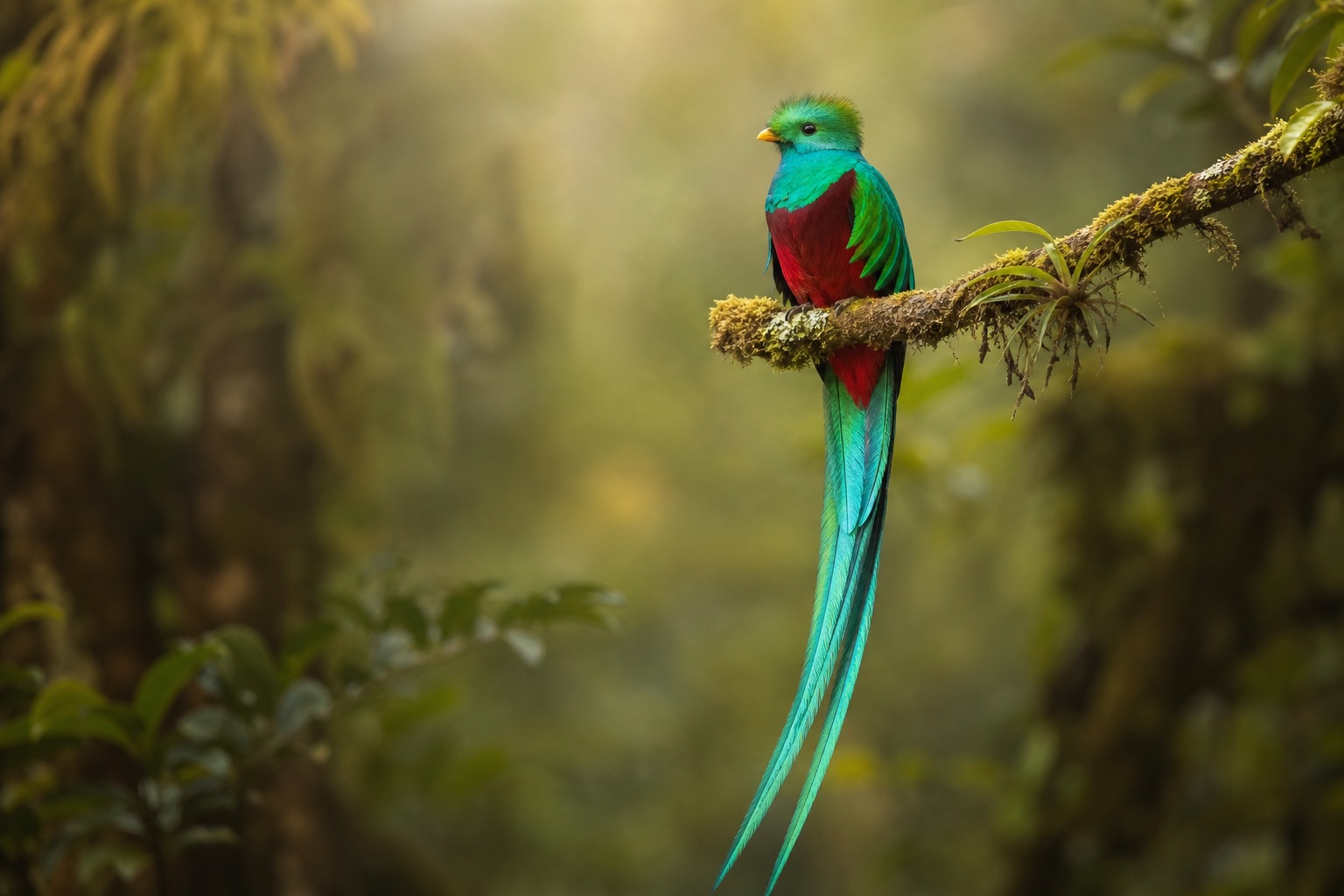
AI-generated educational wildlife portrait — World Animal Rescue Network · AI visualisation, not a photograph
In brief
The resplendent quetzal (Pharomachrus mocinno) is a Near Threatened cloud-forest trogon of Central America whose males carry iridescent green plumage and long tail streamers; revered in Maya and Aztec culture, it is difficult to maintain in captivity but has been bred successfully in modern facilities.
Also in Animals A to Z · Animals that start with Q
How you can help
You can support the related appeal — read its purpose, recipient status and fund terms first — or give once to where it is needed most. Sharing accurate information helps too.
By WARN Research & Conservation Team Last updated
The resplendent quetzal is a trogon of Central American cloud forest — high, cool, moss-draped woodland from southern Mexico through Guatemala, Honduras, El Salvador, Nicaragua, Costa Rica and Panama. The male is one of the most vivid birds in the Americas: iridescent green upperparts, a red breast, a helmet-like crest and two elongated upper tail coverts that can extend well beyond the body, giving a total length approaching a metre in display though the bird itself is far smaller. Maya and Aztec cultures revered the quetzal; killing one was forbidden in some accounts and tail plumes adorned rulers. A persistent claim holds that quetzals die in captivity and therefore symbolise freedom. The claim is partly rooted in real difficulty — nineteenth- and early twentieth-century attempts to keep quetzals often failed because diet and stress were poorly understood — but modern zoos and aviaries in range countries have achieved captive breeding, including fledging chicks. The symbolism outran the biology; the species still faces habitat loss and fragmentation, which is the clearer threat today.
Near Threatened
IUCN Red List status — population decreasing
~1 m
Total length of displaying male including tail streamers
Cloud forest
Cool, wet montane habitat — highly fragmented
Wild avocado
Key food — swallowed whole, seed dispersed
Figures sourced from IUCN Red List — Pharomachrus mocinno, Cornell Lab of Ornithology — Resplendent Quetzal, CITES Appendices .
Quetzal: Quick Facts
| Body length | Roughly 35–40 cm |
|---|---|
| Male display length | Up to about 1 m including tail streamers |
| Habitat | Montane cloud forest |
| Diet | Fruit — especially wild avocado — plus insects |
| Nesting | Cavity in rotting tree snag |
| IUCN status | Near Threatened |
Scientific Classification
| Kingdom | Animalia |
|---|---|
| Phylum | Chordata |
| Class | Aves |
| Order | Trogoniformes |
| Family | Trogonidae |
| Genus | Pharomachrus |
| Species | Pharomachrus mocinno |
Conservation Status
- IUCN Status
- Near Threatened
- Population
- No global estimate — localised and declining in parts of range
- Trend
- Decreasing
- Assessed
- 2020
- CITES
- Appendix I
Cloud-forest loss and nest-snag removal are the primary wild threats; captivity difficulty is real but does not replace habitat protection for wild populations.
Did you know?
Quetzals swallow wild avocados whole and regurgitate the pits intact — one of the few dispersers for cloud-forest trees with large seeds.
Key Facts: Quetzal
- The resplendent quetzal is a trogon of Central American cloud forest, listed Near Threatened with a decreasing population trend.
- Males carry elongated upper tail coverts that can double apparent length; females are greener and lack the extreme streamers.
- Quetzals eat fruit — especially wild avocados and other laurels — plus insects; they swallow fruit whole and regurgitate pits, acting as seed dispersers.
- Maya and Aztec cultures treated the quetzal as sacred; tail plumes were used in regalia while live birds were sometimes released after plucking.
- Early captivity attempts often failed, feeding the legend that quetzals cannot survive confinement; selected modern breeding programmes have succeeded under specialist care.
- Cloud-forest clearance for agriculture and pasture removes both nesting cavities in rotting trees and the fruiting trees quetzals depend on.
The captivity legend — and what is true
Popular accounts claim quetzals die rather than live in cages. Historical attempts often did fail: wild-caught birds refused food, crashed in small aviaries and succumbed to stress. Their diet of specific wild fruits and low tolerance of heat made them poor candidates for nineteenth-century menageries.
That is not the same as a biological inability to survive captivity. Facilities in Costa Rica, Guatemala and elsewhere have kept quetzals in large planted aviaries, fed on appropriate fruit and insects, and produced fledglings — the first widely reported captive breeding success at Nashville Zoo in 2004 marked a turning point. The bird remains sensitive and is not a pet-trade species, but the absolute rule of instant death in confinement is a myth. What persists legitimately is that wild quetzals need intact cloud forest and cannot be replaced by cage populations for conservation.
Ecology of the cloud forest
Quetzals nest in rotting tree snags, excavating or using existing woodpecker holes. They require old-growth or mature secondary forest with standing dead wood — a structure slow to regenerate after logging. Breeding season aligns with fruit abundance; wild avocados in the Lauraceae family are a staple, swallowed whole so the bird regurgitates the seed intact, linking quetzals to forest regeneration.
They are largely frugivorous but take insects, small vertebrates and frogs when feeding chicks. Adults are strong fliers in canopy gaps but avoid long open-country crossing, which makes forest fragments into islands. Populations in Mexico's Chiapas highlands, Guatemala's biospheres and Costa Rica's montane reserves are flagship tourism draws — birders travel specifically to see males at nest holes — which gives local incentive to protect forest but also concentrates disturbance if trails are mismanaged.
Cultural weight
The name quetzal connects to the Nahuatl word for tail feather. Aztec ruler Moctezuma II wore quetzal plumes; Maya nobility used green feathers in ceremonial dress. Some colonial accounts describe live birds plucked and released — whether universal or symbolic is debated by historians, but the association with liberty through non-capture runs deep in Central American iconography.
Guatemala names its currency the quetzal and displays the bird on the flag and coat of arms. That visibility does not automatically protect habitat, but it frames the species as national identity rather than bushmeat — a different conservation conversation from anonymous forest birds. Tourism revenue from quetzal watching in Monteverde and similar sites is an economic argument for keeping cloud forest standing.
Conservation pressure
The IUCN lists the resplendent quetzal as Near Threatened. Range-wide deforestation for coffee, pasture and settlement removes montane forest. Climate change pushes cloud-base altitude upward, potentially compressing suitable habitat on mountain slopes. Nest snag loss is particularly slow to reverse — a dead tree large enough for a quetzal hole may take decades to form.
Protected areas help where enforcement prevents clearance and maintains fruiting trees. Captive breeding supplements display and research but has not restored wild populations at scale. The practical conservation levers are forest connectivity, snag retention in managed woodland, and tourism practices that limit playback and nest approach during breeding.
What WARN Does
WARN publishes free education on species that carry cultural weight as well as ecological roles. Quetzal pages fail when they repeat the captivity myth without correction or ignore the cloud-forest habitat that wild birds actually require.
If this guide helps you understand wildlife and the pressures it faces, a gift to WARN supports habitat protection and free public education in our partner countries.
How can I help save the quetzal?
Explore practical ways to support the quetzal, from everyday choices and sharing reliable information to reviewing a related appeal before giving.
Explore ways to support
Read the related appeal’s purpose, recipient status and fund terms. Choose an affordable gift after checking what is proposed and what has been reported.
Ease the pressures
Avoid the wildlife trade and souvenirs, never buy wild animals as pets, and choose sustainable, habitat-friendly products — the threats behind the quetzal's decline fall when demand does.
Spread the word
Share accurate, sourced information about the quetzal. Wider awareness is what turns concern into lasting protection.
Quetzal: Frequently Asked Questions
How can I help save the quetzal?
What do quetzals eat?
Where do quetzals live?
Are quetzals dangerous to humans?
How long do quetzals live?
How big is a quetzal?
Do quetzals die in captivity?
Sources & References
Population figures, conservation status and biological facts on this page are drawn from authoritative scientific and intergovernmental sources.
Terms used on this page
Plain-English definitions, from our wildlife and conservation glossary.
Latest Quetzal Stories
Quick, fact-checked reads on the quetzal — amazing facts, key questions and the threats it faces.
Explore more animals
Discover more animals, their habitats and their conservation status in the WARN wildlife-guide library.
Enjoyed this Quetzal guide?
Receive appeal updates, animal-welfare news and published funding reports. Unsubscribe any time.
We only use your address for WARN updates. See our privacy policy.