Wildlife Guide · Great Plains of North America & Short-grass and mixed-grass prairie from Canada to Mexico
Prairie Dog
Genus Cynomys — five species of North American ground squirrel
Keystone burrowers of the Great Plains — eaten, plague-hit and shot as pests.
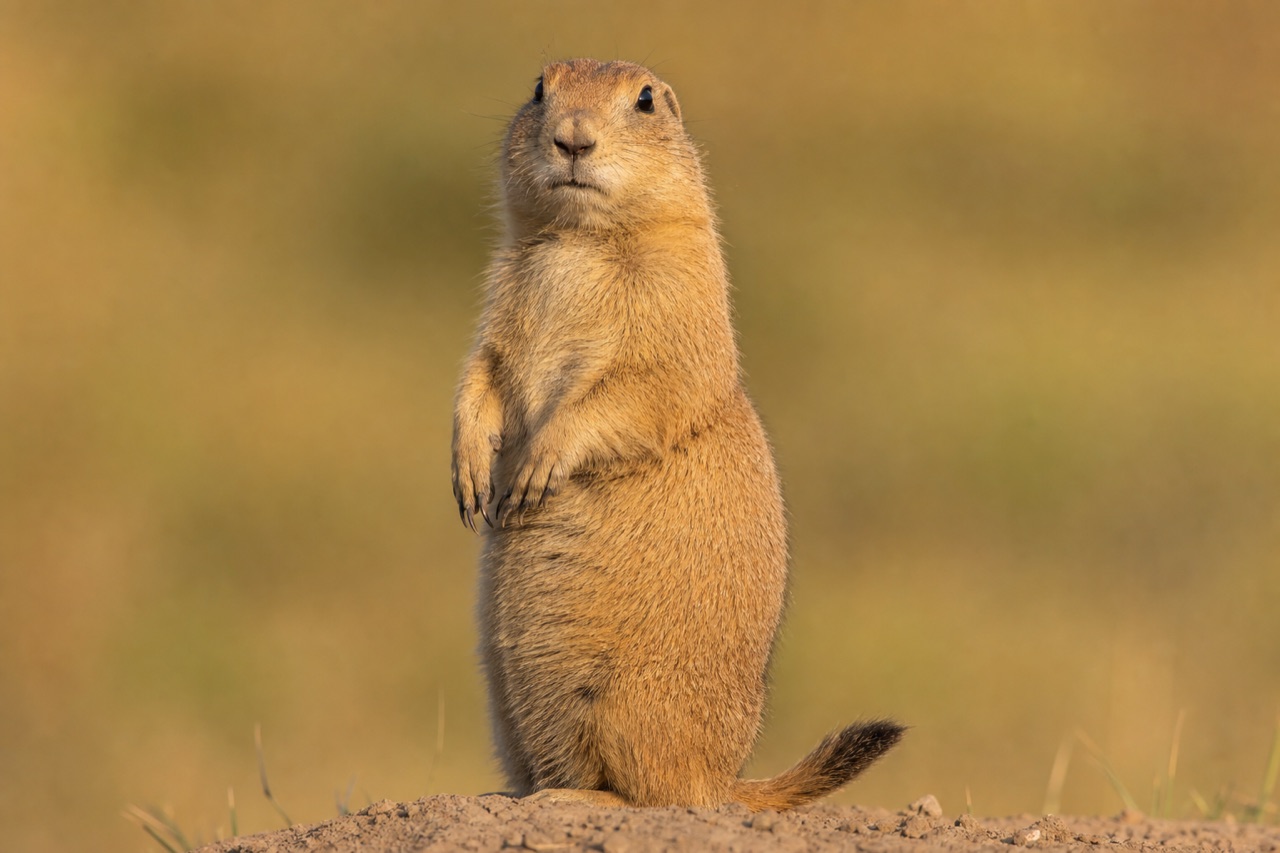
AI-generated educational wildlife portrait — World Animal Rescue Network · AI visualisation, not a photograph
In brief
Prairie dogs (genus Cynomys) are five species of social North American ground squirrel whose colony burrows keystone the Great Plains prairie — reduced to a fraction of historic range by poisoning, plague and habitat loss.
Also in Animals A to Z · Animals that start with P
By WARN Research & Conservation Team Last updated
Prairie dogs are not dogs. They are ground squirrels of the genus Cynomys — five species occupying short-grass and mixed-grass prairie from southern Canada through the United States to northern Mexico. They are highly social, living in colonies called towns that once covered hundreds of kilometres and contained millions of animals. Black-tailed prairie dogs (Cynomys ludovicianus) are the most widespread; white-tailed, Gunnison's, Utah and Mexican prairie dogs occupy more restricted ranges. Colonies structure the prairie ecosystem. Burrows aerate soil, capture rainfall and provide homes for burrowing owls, rattlesnakes, tortoises and invertebrates. Grazing by prairie dogs keeps vegetation short, creating heterogeneity that benefits bison, pronghorn and diverse grassland birds. The keystone label is justified: remove prairie dogs and the community changes comprehensively. Human history with prairie dogs is mostly hostile. Ranchers view them as competitors for grass; settlers poisoned towns across the twentieth century. Sylvatic plague — introduced Yersinia pestis — kills colonies wholesale. Black-footed ferrets, specialist predators of prairie dogs, were nearly lost when dog towns vanished. Conservation today is species-by-species: some prairie dogs are Least Concern, others Near Threatened or Vulnerable, all dependent on plague management and landowner tolerance. Historical photographs from the early twentieth century show prairie dog towns stretching to the horizon — a grassland architecture bulldozed within generations, leaving fragmented colonies where millions once lived. National grassland parks in the United States that protect black-tailed prairie dog towns also protect burrowing owls and ferret reintroduction sites — one management decision serving multiple species because the burrow engineer sits at the centre of the community. Urban expansion in Colorado and Texas removes prairie dog towns from plains edges permanently — conversion to suburb is irreversible in ways that ranch conflict sometimes is not, because pavement does not revert to grass.
5
Species — black-tailed most widespread
Keystone
Colony burrows support owls, ferrets, snakes
Plague
Sylvatic plague can wipe out entire towns
<5%
Rough estimate — remaining area of historic range
Figures sourced from IUCN Red List — Cynomys ludovicianus, US Fish and Wildlife — black-footed ferret .
Prairie Dog: Quick Facts
| Species | Five in genus Cynomys |
|---|---|
| Habitat | Short-grass and mixed-grass prairie |
| Social | Colonial towns with alarm calls |
| Historic range loss | Over 95% in many estimates |
| Keystone role | Burrows, grazing, prey for ferrets |
| Main threats | Poisoning, plague, habitat loss |
Scientific Classification
| Kingdom | Animalia |
|---|---|
| Phylum | Chordata |
| Class | Mammalia |
| Order | Rodentia |
| Family | Sciuridae |
| Genus | Cynomys — five species |
Conservation Status
- IUCN Status
- Varies by species — Least Concern to Endangered
- Population
- Millions remain; a fraction of pre-settlement billions
- Trend
- Decreasing overall; plague epizootics cause local crashes
- Assessed
- Varies by species
- CITES
- Not listed
Genus-level generalisation misleads. Utah and Mexican prairie dogs are Endangered; black-tailed is widespread but range-reduced. Plague management is central to recovery efforts.
Did you know?
Prairie dogs have a complex alarm-call system — including descriptions specific enough that researchers debate whether it constitutes vocabulary rather than generic alarm barks.
Key Facts: Prairie Dog
- Prairie dogs are ground squirrels, not canids — five species in genus Cynomys.
- Colony burrows benefit bison, burrowing owls, black-footed ferrets and many other species.
- Historic range reduced by poisoning, shooting, agriculture and urban sprawl.
- Sylvatic plague — introduced disease — kills colonies rapidly.
- Black-footed ferrets depend on prairie dog towns; ferret recovery requires dog recovery.
- IUCN status varies by species from Least Concern to Endangered (Mexican prairie dog).
Keystone of the short-grass prairie
Prairie dog towns increase plant diversity at small scales by creating mosaics of clipped and unclipped vegetation. Bison and pronghorn prefer grazing near towns where new growth is nutritious. Burrowing owls nest exclusively in abandoned or usurped burrows. Black-footed ferrets hunt prairie dogs in their own tunnels — essentially obligate on large towns.
Rattlesnakes, box turtles, salamanders and insects use burrows for shelter and thermoregulation. Remove prairie dogs and the burrow infrastructure empties over seasons as entrances collapse. The cascade is slower than plague wipeout but ends at the same place — a simplified grassland without the engineer species.
Historically, prairie dog towns occupied a vast area of the Great Plains. Estimates suggest more than 95 percent loss since European settlement, primarily deliberate eradication rather than accidental habitat change.
Plague, poisoning and the ferret connection
Sylvatic plague arrived in North America with fleas on imported rodents. Yersinia pestis kills prairie dogs rapidly — whole towns can die within days. Fleas persist in surviving carriers; epizootics recur. Dusting burrows with flea control agents and oral plague vaccine baits are management tools used in black-footed ferret recovery areas.
Twentieth-century poisoning campaigns used zinc phosphide and gas cartridges across millions of hectares to protect ranching forage. Many states still classify prairie dogs as pests. The ecological cost — lost ferrets, owls, raptors — was largely uncounted until towns were already gone.
Black-footed ferrets were rediscovered in 1981 when a Wyoming dog town held the last wild population. Captive breeding and reintroduction depend on plague-managed prairie dog colonies large enough to support ferret territories. Saving ferrets means saving towns means controlling plague and changing landowner incentives — a chain no single species plan can ignore.
Species status and coexistence with ranching
IUCN assessments differ by species. Black-tailed prairie dog: Least Concern but massively reduced in range. White-tailed prairie dog: Near Threatened. Gunnison's prairie dog: Near Threatened. Utah prairie dog: Endangered under US federal law. Mexican prairie dog: Endangered. The genus is not one conservation story.
Modern coexistence tools include relocation rather than poisoning where development encroaches, compensation for forage loss where towns persist on public land, and tourism — prairie dog towns in national parks are visitor attractions that reframe the animal from pest to heritage. Ranching advocacy remains mixed; some producers tolerate towns, others demand eradication.
Climate change adds drought stress to grassland carrying capacity — prairie dogs already live on marginal arid plains. The compound of heat, drought, plague and persecution is why species once numbering in the billions now survive as fragments — and why Least Concern on paper can mean Vulnerable on the ground for specific species and regions.
Alarm calls and what prairie dogs say
Research on black-tailed prairie dog alarm calls suggested that different calls encode predator type — aerial versus terrestrial — and in some experiments, human observers with different shirt colours. Whether this constitutes language-level complexity is debated, but the capacity for graded, context-specific signalling is well established. Neighbouring towns can have call dialects that differ enough that immigrants take time to respond correctly.
For conservation, the social sophistication matters because it implies that fragmented small colonies may lose behavioural efficiency — fewer sentinels, weaker alarm networks, higher per-capita predation. Rebuilding towns is not only a numbers game but a social one: releases work better when groups are moved together rather than as isolated pairs.
Public engagement with prairie dog towns in national parks reframes the animal from vermin to heritage. Visitors who watch sentinel behaviour and hear alarm barks leave with a different category in mind — not pest, but engineer of a grassland that existed before the plough.
What WARN Does
WARN publishes free, sourced species education for keystone species eliminated as pests before their ecological role was understood. Prairie dogs are engineers of the Great Plains — losing them was never only about losing a squirrel.
If this guide helps you understand wildlife and the pressures it faces, a gift to WARN supports habitat protection and free public education in our partner countries.
Prairie Dog: Frequently Asked Questions
Are prairie dogs related to dogs?
Why are prairie dogs important?
What killed most prairie dogs?
Are prairie dogs endangered?
What do prairie dogs eat?
Where do prairie dogs live?
Are prairie dogs dangerous?
How long do prairie dogs live?
How big is a prairie dog?
Sources & References
Population figures, conservation status and biological facts on this page are drawn from authoritative scientific and intergovernmental sources.
Terms used on this page
Plain-English definitions, from our wildlife and conservation glossary.
Explore more animals
Discover more animals, their habitats and their conservation status in the WARN wildlife-guide library.
Enjoyed this Prairie Dog guide?
Receive appeal updates, animal-welfare news and published funding reports. Unsubscribe any time.
We only use your address for WARN updates. See our privacy policy.