Wildlife Guide · Australia & New Guinea and nearby islands
Peacock Spider
Genus Maratus — family Salticidae (jumping spiders); roughly 100 described species, mostly Australian
Five millimetres of iridescent fan and leg-waving — the spider that went viral and still lacks a proper field guide.
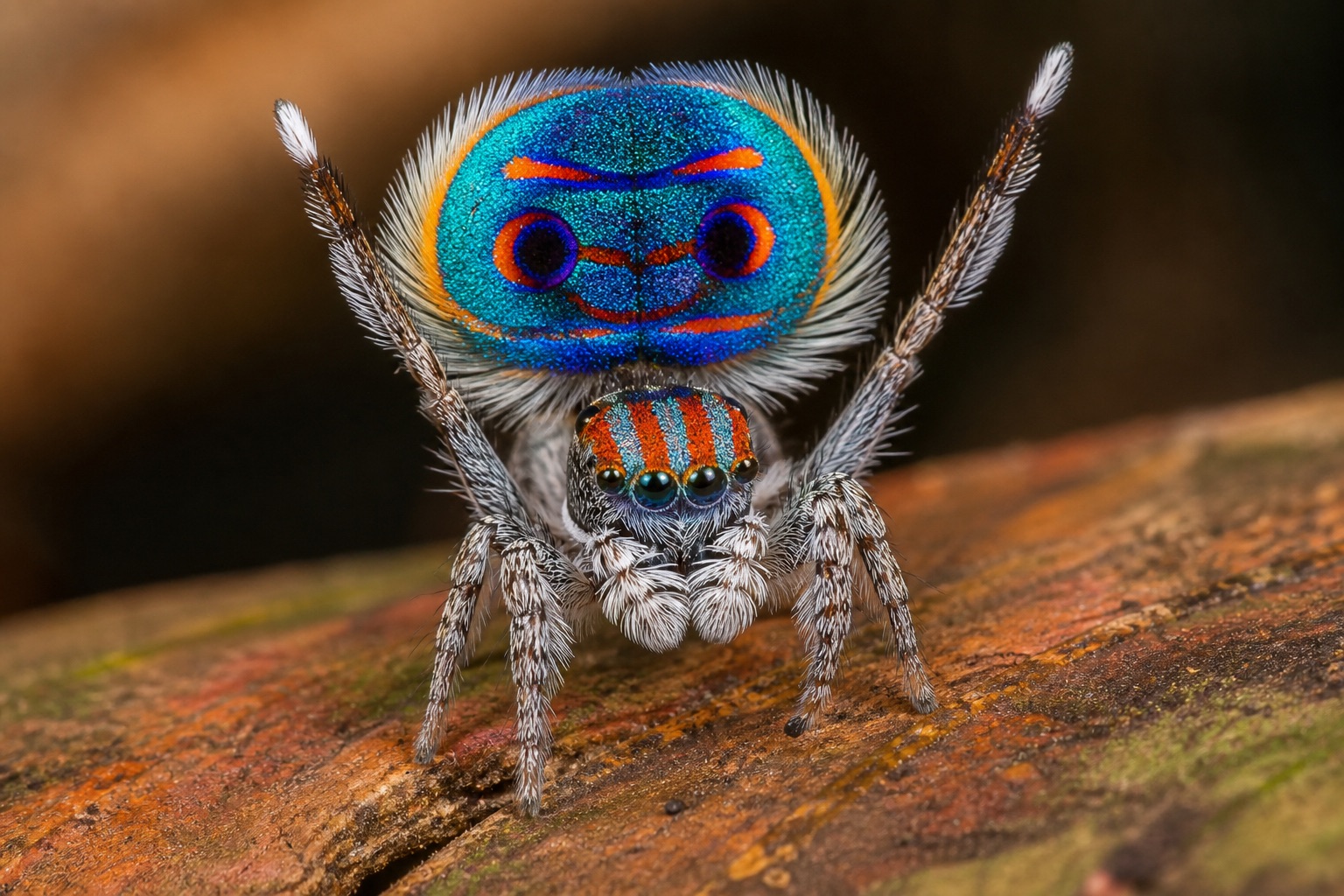
AI-generated educational wildlife portrait — World Animal Rescue Network · AI visualisation, not a photograph
In brief
Peacock spiders (genus Maratus) are tiny Australian jumping spiders, typically a few millimetres long, whose males display an iridescent abdominal fan and waved legs during courtship; they are harmless to humans and most species have no IUCN assessment.
Also in Animals A to Z · Animals that start with P
By WARN Research & Conservation Team Last updated
Peacock spiders are jumping spiders in the genus Maratus, named for the males' habit of raising a brightly coloured abdominal flap and waving their third pair of legs in a courtship dance that looks improbably choreographed for an animal a few millimetres long. Most species live in leaf litter and low vegetation in Australia, where the genus is most diverse, though related forms occur in New Guinea and parts of Asia. They became a global internet phenomenon through macro video: the fan spreads like a miniature peacock tail, the legs drum and wave, and a receptive female either accepts or drives the male off. Behind the spectacle sits ordinary jumping-spider biology — acute vision, calculated leaps, and venom tuned for small insects rather than mammals. The gap between their fame and the amount of sober reference material available in English is unusually wide, which is why a dedicated guide matters.
~5 mm
Typical male body length in the best-known species
~100
Described Maratus species, with more awaiting naming
8 eyes
Jumping-spider vision — among the sharpest in arachnids
Fan + legs
Male courtship kit — colour, vibration and movement combined
Figures sourced from World Spider Catalog — Salticidae, IUCN Red List, Australian Museum — jumping spiders .
Peacock Spider: Quick Facts
| Body length | About 3–5 mm in typical males |
|---|---|
| Diet | Small insects and arthropods |
| Habitat | Leaf litter, heath and low vegetation |
| Web | No prey-capture web — active hunter |
| Courtship | Iridescent fan and leg-waving display |
| Human risk | Harmless — too small to bite meaningfully |
Scientific Classification
| Kingdom | Animalia |
|---|---|
| Phylum | Arthropoda |
| Class | Arachnida |
| Order | Araneae |
| Family | Salticidae |
| Genus | Maratus |
| Species | Roughly 100 described; Maratus volans among the best known |
Conservation Status
- IUCN Status
- Not Evaluated
- Population
- No estimate for most species
- Trend
- Unknown; narrow-range endemics likely declining with habitat loss
- Assessed
- Most species unassessed
- CITES
- Not listed
Fame does not substitute for Red List data. Many Maratus species occupy small geographic ranges and have never been formally assessed.
Did you know?
Male peacock spiders wave their third legs and spread an iridescent abdominal fan while a female decides whether to mate or attack — a courtship small enough to fit on a thumbnail and complex enough to drive millions of video views.
Key Facts: Peacock Spider
- Peacock spiders belong to Maratus, a genus of jumping spiders (Salticidae) found mainly in Australia.
- Males are a few millimetres long and court females by raising an iridescent abdominal fan and waving their third legs.
- Jumping spiders have excellent vision and stalk prey with calculated leaps rather than building capture webs.
- Peacock spiders eat small insects and other arthropods; they are harmless to people.
- Most Maratus species are narrow-range endemics with no IUCN Red List assessment.
- Macro video made the genus famous worldwide long before most species had published natural-history accounts.
Why the display looks so deliberate
Male Maratus invest heavily in ornament because females choose mates on the strength of the performance. The abdominal fan — an extension of the opisthosoma edged with iridescent scales — is spread to expose colour patches that shift with viewing angle. The third pair of legs, often contrasting in colour, is waved and tapped in a fixed sequence while the male vibrates the substrate. A female watches from close range; if she is unreceptive she may attack, and males of many species abort quickly when the signal turns hostile.
The display is not decorative excess. It is honest advertising under predation risk: a male must be visible, mobile and coordinated to be chosen, which filters out weak or parasitised individuals. That is standard sexual selection, compressed into an animal small enough to sit on a fingernail.
Vision and hunting without a web
Peacock spiders share the jumping-spider body plan: compact cephalothorax, relatively large anterior median eyes giving acute resolution, and the ability to plan jumps many times body length. They do not build prey-capture webs. They patrol leaf litter and low plants, pouncing on springtails, flies, ants and other small prey.
Silk is still used — for draglines, retreats and egg sacs — but not as a trap. The same visual acuity that makes them successful hunters lets them assess a mate's display at close quarters. Filming the courtship only became routine once affordable macro video matched the scale of the animal.
Where peacock spiders live
Most Maratus species are Australian, with diversity concentrated in the south-west and south-east where Mediterranean and temperate habitats produce rich leaf-litter communities. Some occur in New Guinea and a handful extend into China and mainland Southeast Asia. They are ground and litter specialists rather than house spiders — the animals in viral clips were filmed in situ, not in captivity, though some species tolerate brief observation in the field.
Because many species have small ranges — a single mountain, a patch of heath, one sandplain — local habitat loss matters even when the genus as a whole is not Red-Listed. A species can be common on one headland and unknown ten kilometres away.
Conservation and the fame gap
Almost no Maratus species has a formal IUCN assessment. That reflects limited survey work on invertebrates, not security. Narrow-range endemics face the same pressures as other small habitat specialists: land clearing, fire regime change, and trampling of heath and litter habitats.
The genus illustrates a recurring problem in invertebrate conservation: animals can be globally famous while remaining scientifically under-described. Naming, mapping ranges and publishing basic natural history are prerequisites for protection, and peacock spiders are only partway through that pipeline despite their audience.
What WARN Does
WARN publishes free, sourced invertebrate education for animals people search for but rarely find explained accurately. Peacock spiders are a textbook case — enormous public interest, almost no consolidated reference material in plain English, and narrow-range species that could disappear before they are assessed.
If this guide helps you understand wildlife and the pressures it faces, a gift to WARN supports habitat protection and free public education in our partner countries.
Peacock Spider: Frequently Asked Questions
What do peacock spiders eat?
Where do peacock spiders live?
Are peacock spiders dangerous to humans?
How long do peacock spiders live?
How big are peacock spiders?
Why are they called peacock spiders?
Sources & References
Population figures, conservation status and biological facts on this page are drawn from authoritative scientific and intergovernmental sources.
Terms used on this page
Plain-English definitions, from our wildlife and conservation glossary.
Latest Peacock Spider Stories
Quick, fact-checked reads on the peacock spider — amazing facts, key questions and the threats it faces.
Species
Why Are Dugongs Disappearing — and What's Being Done to Save Them?
Dugongs are vanishing from waters where they once thrived, declared functionally extinct in China and critically endangered in East Africa. Here's why — and the work that offers hope.
Read the storySpecies
12 Amazing Facts About Koalas (They Are Not Bears, and They Have Fingerprints)
Fingerprints indistinguishable from ours, 20 hours of sleep a day, and a diet that would poison most animals. Twelve koala facts.
Read the storySpecies
12 Amazing Facts About Kangaroos (They Cannot Walk Backwards)
Tendons that work like springs, a tail used as a fifth leg, and the ability to pause a pregnancy. Twelve verified kangaroo facts.
Read the storyExplore more animals
Discover more animals, their habitats and their conservation status in the WARN wildlife-guide library.
Enjoyed this Peacock Spider guide?
Receive appeal updates, animal-welfare news and published funding reports. Unsubscribe any time.
We only use your address for WARN updates. See our privacy policy.