Wildlife Guide · Central Asian steppe and semi-desert & From the Caspian region through Mongolia to western China
Pallas's Cat
Otocolobus manul (Pallas, 1776) — family Felidae
A house-cat-sized feline with the face of a stuffed toy and a life spent low to the ground.
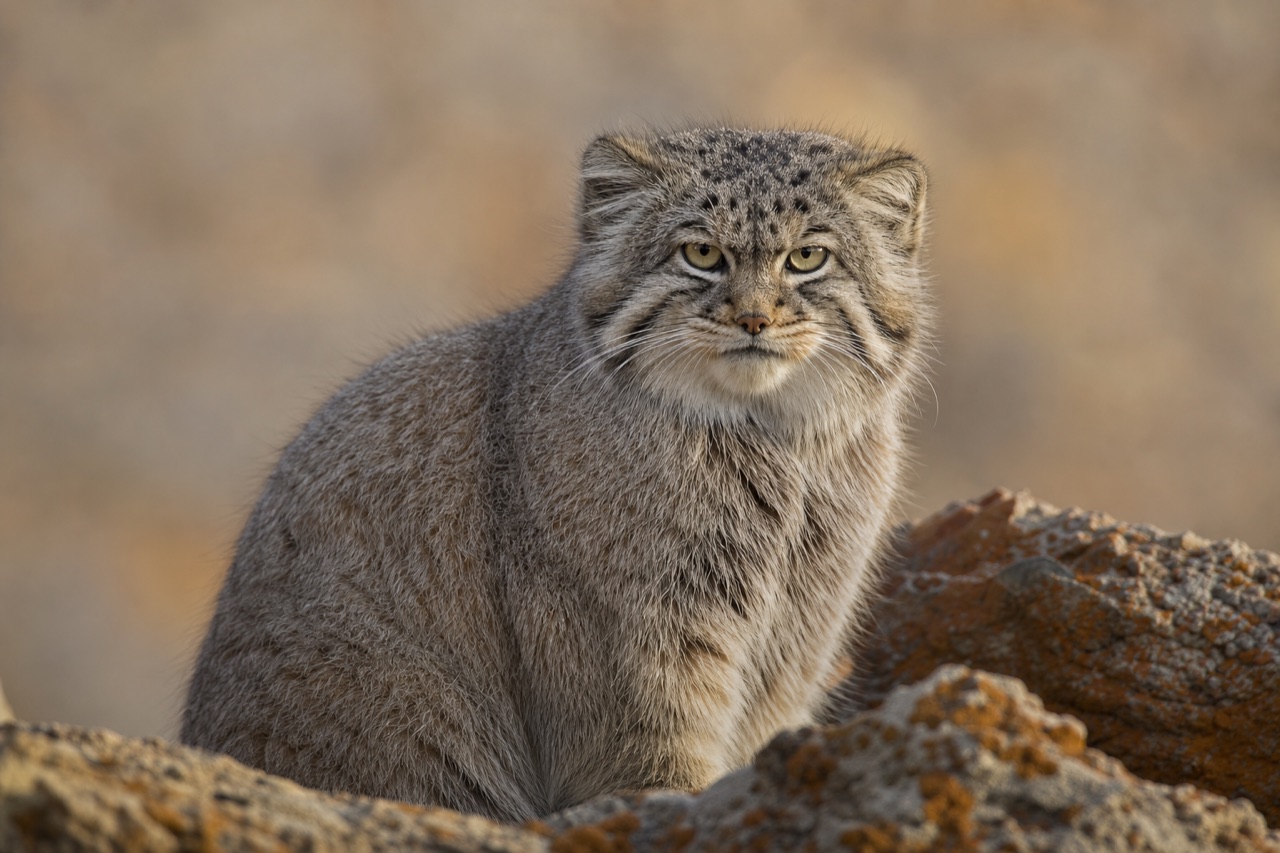
AI-generated educational wildlife portrait — World Animal Rescue Network · AI visualisation, not a photograph
In brief
Pallas's cat (Otocolobus manul) is a small, densely furred wild cat of Central Asian steppe and semi-desert, with a flat round face, circular pupils and an ambush-hunting lifestyle focused on pikas and small rodents.
Also in Animals A to Z · Animals that start with P
By WARN Research & Conservation Team Last updated
Pallas's cat, or manul, is a small wild cat of the cold steppes and semi-deserts of Central Asia — roughly the size of a domestic cat but built entirely differently. Its body is compact and low, its legs short, its fur extraordinarily dense, and its face unusually flat and round, which gives the species the slightly cartoonish look that has made it an internet favourite. That appearance is functional. Pallas's cats hunt almost exclusively from ambush, crouching low in rocky cover or burrows and pouncing on pikas, voles and ground squirrels at close range. They rarely run anything down. Their pupils contract to small circles rather than slits — unusual among felids — and their low profile keeps them below the sightline of both prey and larger predators. The species is also one of the least studied wild cats. Camera traps have improved detection, but Pallas's cats occur at low density across a vast, harsh range spanning Mongolia, western China, Kazakhstan and the Tibetan Plateau fringe. Most of what is known about their breeding, diet and territorial behaviour comes from a handful of long-term field studies and captive observations rather than systematic survey.
~2–4 kg
Adult weight — similar to a house cat
Circular
Pupils — unusual among cats, which usually have vertical slits
Ambush
Hunts from cover; rarely chases prey
Low profile
Short legs keep the body close to the ground
Figures sourced from IUCN Red List — Otocolobus manul, CITES Appendices .
Pallas's Cat: Quick Facts
| Weight | 2–4 kg |
|---|---|
| Habitat | Cold steppe, rocky outcrops, semi-desert |
| Range | Central Asia from the Caspian region to Mongolia and western China |
| Hunting | Ambush — mainly pikas and small rodents |
| Pupils | Circular, not vertical slits |
| Fur | Among the densest of any wild cat |
| Main threats | Habitat degradation, rodent control, secondary poisoning |
Scientific Classification
| Kingdom | Animalia |
|---|---|
| Phylum | Chordata |
| Class | Mammalia |
| Order | Carnivora |
| Family | Felidae |
| Genus | Otocolobus |
| Species | Otocolobus manul |
Conservation Status
- IUCN Status
- Least Concern
- Population
- Unknown; suspected to be over 10,000 mature individuals but poorly surveyed
- Trend
- Decreasing in some areas; insufficient data overall
- Assessed
- 2020
- CITES
- Appendix II
The Least Concern listing reflects a wide range and presumed large population, but survey data are sparse. Steppe degradation and rodenticide use are the main documented pressures.
Did you know?
Pallas's cats have pupils that contract to small circles rather than the vertical slits typical of most cats — one reason their face looks so unlike a domestic cat's.
Key Facts: Pallas's Cat
- Pallas's cat is a small Central Asian wild cat, roughly house-cat sized but with a compact, low-slung build and extremely dense fur.
- Its flat, round face and circular pupils are unusual among felids and contribute to its distinctive appearance.
- It hunts almost exclusively by ambush, preying mainly on pikas, voles and ground squirrels.
- The species is secretive and patchily distributed, making population estimates unreliable.
- Habitat degradation, rodent control programmes and secondary poisoning are the main documented threats.
- It is Least Concern globally, but data quality is poor and local declines are suspected.
Built for cold and concealment
Pallas's cats inhabit some of the harshest cat country on Earth: high steppe, rocky outcrops and semi-desert from the Caspian region through Mongolia and into western China, at elevations that bring severe winters and thin air. Their coat is among the densest in the felid family — long, thick and grey with faint banding — and the fur extends onto the belly and between paw pads for insulation on frozen ground. A Pallas's cat in full winter pelage appears almost spherical, the fur adding apparent bulk to an already compact frame.
The body is deliberately low. Short legs, a stocky trunk and a flattened face keep the cat below the visual horizon of prey and reduce its silhouette against rocks. Unlike most cats, which have vertical slit pupils, Pallas's cats have pupils that contract to small circles. The functional reason is debated — some researchers suggest it relates to the flat facial structure rather than to a specific visual adaptation — but the result is an eye that looks distinctly unlike a typical cat's.
Pallas's cats are poor long-distance runners. Their short legs and heavy build suit a life spent crouching, stalking and pouncing at close range rather than chasing prey across open steppe. When threatened, they flatten themselves against the ground or retreat into burrows rather than climbing trees or sprinting — a response that reflects both their morphology and the open, treeless habitat they occupy.
An ambush specialist
Pallas's cats are not pursuit hunters. They spend long periods concealed in rocky crevices, old burrows or hollows, emerging to stalk pikas and voles at close range before a short rush and pounce. Pikas — small, diurnal lagomorphs of Central Asian steppe — are the primary prey across much of the range, and a Pallas's cat's hunting success depends on pika colonies being within a few hundred metres of its den.
Because the cat depends on rodent populations that fluctuate with grazing pressure, climate and disease, its own numbers likely track prey abundance closely. When pika colonies are suppressed — whether by habitat change, overgrazing or deliberate control programmes aimed at protecting pasture — Pallas's cats lose food directly. The hunting style also means the species is rarely seen: a cat that does not move across open ground is a cat that camera traps miss, and population estimates remain extrapolations rather than counts.
Breeding appears timed to prey abundance. Females give birth in sheltered dens — usually burrows dug by marmots or foxes — and raise litters of two to six kittens. The breeding season is brief, and kitten survival depends on the rodent crop in that year. In poor prey years, entire litters may fail, which is one reason Pallas's cat populations can fluctuate sharply even without direct human pressure.
Secretive enough to hide in plain sight
Pallas's cats are listed Least Concern, but that assessment rests on a thin evidence base. They are difficult to survey, occur at low density, and occupy a vast but fragmented range across countries where systematic monitoring is limited. Most population figures are extrapolations rather than counts, and the IUCN assessment itself notes that the species may be more threatened than the listing suggests.
What is better documented is the threat profile. Steppe degradation from overgrazing by domestic livestock reduces both vegetative cover and prey populations. Rodenticide use and secondary poisoning — where a cat eats a poisoned rodent — kill cats directly. Herding infrastructure, road building and mining disturb den sites in rocky terrain and bring traffic into previously quiet steppe. Domestic dogs accompanying herders may also harass or kill Pallas's cats near camps.
None of these pressures necessarily threaten the species everywhere, but together they explain why a Least Concern listing comes with significant uncertainty. In Mongolia, which holds a substantial share of the global population, steppe conditions have deteriorated in some regions as livestock numbers have increased and pasture management has weakened. Protecting Pallas's cats in practice means protecting pikas, controlling rodenticide use, and maintaining the rocky steppe mosaic the species requires.
The internet cat that is not a pet
Pallas's cats have become widely shared online, which has raised awareness but also distorted expectations. They are not domesticated, not available as pets, and poorly suited to captivity — they are highly stress-prone, frequently fail to breed in zoos, and many institutions have abandoned attempts to maintain them. Their flat faces, dense fur and grumpy expressions photograph well, but the animal behind the image is a wild predator of Central Asian steppe.
The useful outcome of their visibility is attention to steppe ecosystems that otherwise receive little public interest. Steppe is among the most converted and least protected habitat types globally — cleared for cropland, overgrazed by livestock, and fragmented by roads and mining. Pallas's cats depend on steppe remaining steppe, with pika colonies intact and rocky cover undisturbed.
Protecting Pallas's cats means protecting pikas, controlling rodenticide use, and maintaining the rocky steppe mosaic the species requires — conservation goals that benefit a wider community of Central Asian grassland wildlife, including corsac foxes, steppe eagles and argali sheep. The cat's internet fame is worth something if it directs attention to a habitat that desperately needs it.
What WARN Does
WARN publishes free, sourced species education for animals that are widely recognised but poorly understood. Pallas's cat is a clear example: an internet-famous face attached to a secretive steppe predator whose conservation needs are almost entirely about habitat and prey, not about captive breeding.
If this guide helps you understand wildlife and the pressures it faces, a gift to WARN supports habitat protection and free public education in our partner countries.
Pallas's Cat: Frequently Asked Questions
What is a Pallas's cat?
Why does Pallas's cat look so round?
What do Pallas's cats eat?
Can you keep a Pallas's cat as a pet?
Are Pallas's cats endangered?
Where do Pallas's cats live?
Are Pallas's cats dangerous?
How long do Pallas's cats live?
How big is a pallas's cat / manul?
Sources & References
Population figures, conservation status and biological facts on this page are drawn from authoritative scientific and intergovernmental sources.
Terms used on this page
Plain-English definitions, from our wildlife and conservation glossary.
Explore more animals
Discover more animals, their habitats and their conservation status in the WARN wildlife-guide library.
Enjoyed this Pallas's Cat guide?
Receive appeal updates, animal-welfare news and published funding reports. Unsubscribe any time.
We only use your address for WARN updates. See our privacy policy.