Wildlife Guide · Worldwide except polar extremes & Gardens and woodland across Britain and Europe
Orb-Weaver
Family Araneidae — over 3,000 described species worldwide
The spider that builds the classic wagon-wheel web — and rebuilds it every day.
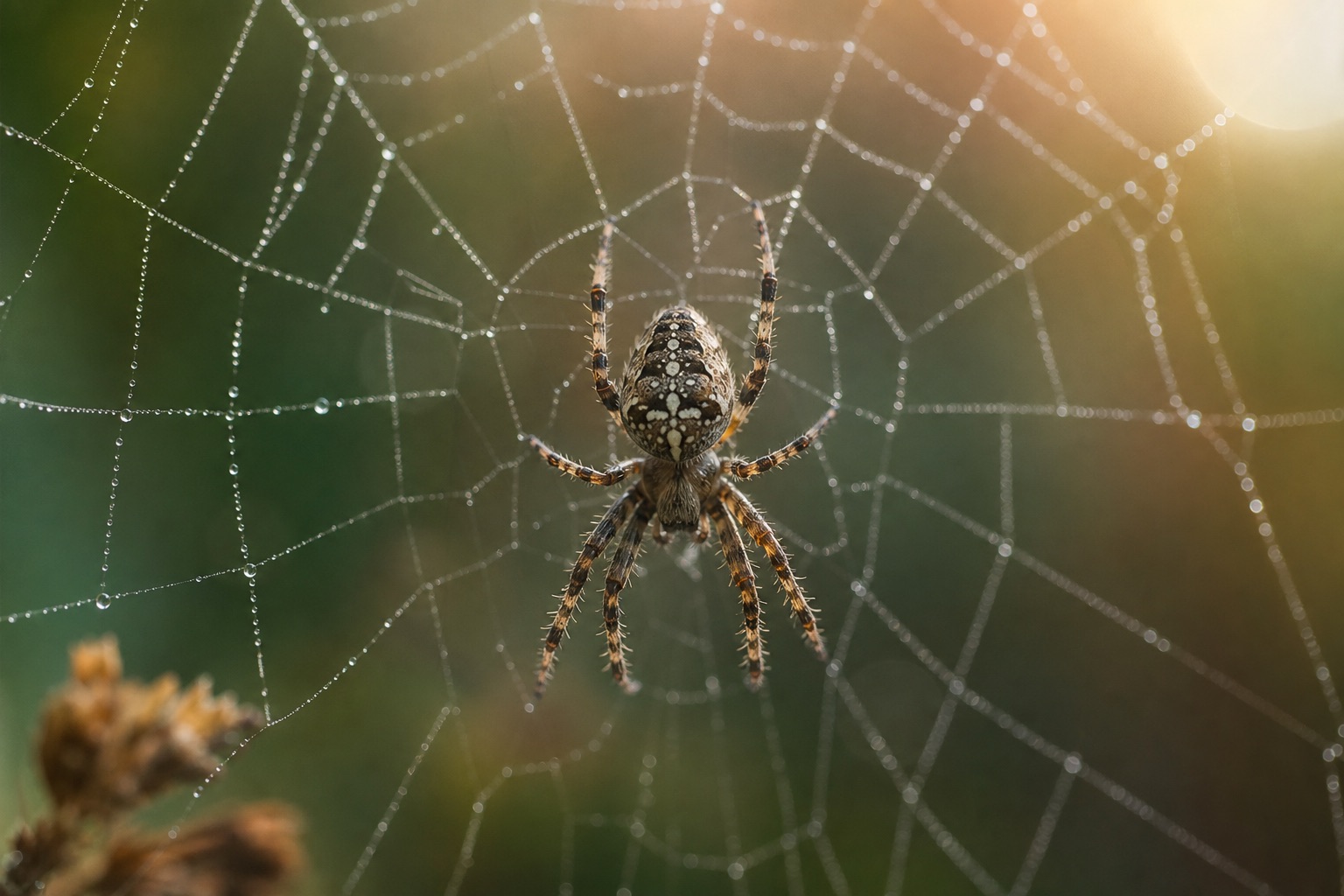
AI-generated educational wildlife portrait — World Animal Rescue Network · AI visualisation, not a photograph
In brief
Orb-weaver spiders (family Araneidae) build the classic circular wagon-wheel webs, include the European garden spider Araneus diadematus, rebuild webs frequently, and are harmless to humans — over 3,000 species worldwide, most not individually assessed on the IUCN Red List.
Also in Animals A to Z · Animals that start with O
By WARN Research & Conservation Team Last updated
Orb-weavers are the spiders behind the circular webs people picture when they think 'spider web'. Family Araneidae contains more than 3,000 species worldwide, including the European garden spider Araneus diadematus — the cross-shaped spider on a dewy wheel web in autumn hedgerows. Orb-weavers sit head-down in the hub or in a retreat off to the side, running out when vibration signals prey. Many species rebuild the web daily, eating the old silk to recycle protein before spinning a fresh spiral overnight. Orb-weavers are not medically significant to humans; bites are rare and comparable to a mild bee sting when they occur. They are among the most visible spider family in temperate gardens and a useful counterweight to undifferentiated spider fear.
3,000+
Described species in family Araneidae
Daily
Many species rebuild the web each night
Harmless
Bites rare; not medically significant for most people
Autumn
Peak visibility for garden orb-weavers in Britain
Figures sourced from Natural History Museum — Garden spider, Buglife — Orb-weaver spiders, World Spider Catalog — Araneidae .
Orb-Weaver: Quick Facts
| Web type | Circular orb with sticky capture spiral |
|---|---|
| Example | Garden spider Araneus diadematus |
| Female size | Roughly 14–20 mm body in garden spider |
| Diet | Flying insects trapped in web |
| Human risk | Harmless in practice — bites rare and mild |
| Season | Autumn peak for garden orb-weavers in Britain |
| IUCN status | Not Evaluated for most species |
Scientific Classification
| Kingdom | Animalia |
|---|---|
| Phylum | Arthropoda |
| Class | Arachnida |
| Order | Araneae |
| Family | Araneidae |
| Example species | Araneus diadematus — European garden spider |
| Described species | Over 3,000 in the family |
Conservation Status
- IUCN Status
- Not Evaluated
- Population
- Not applicable at family level; locally abundant in gardens
- Trend
- Stable for common species; pesticides reduce biomass locally
- Assessed
- Most species not assessed
- CITES
- Not listed
Common garden orb-weavers need no special listing to be ecologically valuable as aerial insect predators.
Did you know?
Many orb-weavers eat their own web each night and spin a new one by morning — recycling the silk protein instead of wasting it.
Key Facts: Orb-Weaver
- Orb-weavers (Araneidae) construct the stereotypical circular orb web with radiating spokes and a sticky capture spiral.
- The European garden spider Araneus diadematus is a familiar British orb-weaver with a white cross on the abdomen.
- Many species eat the old web and spin a new one daily, recycling silk protein.
- Orb-weavers sit in the web hub or a nearby retreat and run out when prey vibrates the silk.
- Bites to humans are uncommon and not medically significant for healthy adults in temperate species.
- They are major aerial insect predators in gardens, reducing flies, moths and other flying prey.
Engineering the orb web
Construction follows a stereotyped sequence: a bridge line, radii like spokes, a temporary spiral scaffold, then replacement with sticky capture silk in the final spiral. Non-sticky radii support the structure; the capture spiral holds glue droplets that snare flying insects.
Different orb-weaver genera modify the plan — some add stabilimenta, visible zigzag bands whose function is debated (camouflage, prey attraction or bird avoidance). Web orientation catches prevailing insect drift; many garden orb-weavers rebuild at dusk because day webs accumulate damage and debris.
Garden spider life cycle
Araneus diadematus illustrates the temperate pattern. Spiderlings balloon on silk threads in spring, grow through summer moults, and mature in autumn when webs appear across hedgerows. Males seek females cautiously — females are larger and may cannibalise mates. Females lay hundreds of eggs in a silk cocoon attached to vegetation; adults die with frost, eggs overwinter.
The visible autumn females are the life stage people photograph. They are feeding heavily before egg production, which is why webs seem suddenly everywhere in September and October.
Orb-weavers versus other web types
Not every circular-looking web is an orb. Cobwebs of house spiders (Theridiidae) are tangle webs without radial geometry. Funnel webs and sheet webs belong to other families. Orb-weavers are defined by the orb architecture and Araneidae membership — though a few related families build similar webs.
For the site's broader spider guide, orb-weavers are one architecture among many. They happen to be the most photogenic and the least dangerous large spider most Europeans encounter regularly.
Conservation and the value of garden webs
No family-level IUCN assessment exists for Araneidae; individual rare species on islands or in caves may be threatened while garden orb-weavers remain abundant. Pesticide spraying and habitat simplification reduce spider biomass broadly.
Leaving hedgerows, avoiding indiscriminate garden spraying, and tolerating autumn webs supports free pest control. Orb-weavers remove large numbers of flying insects that would otherwise enter homes and crops.
What WARN Does
WARN publishes free arachnid education that separates harmless garden orb-weavers from the small set of species warranting caution. Visible autumn webs are a sign of functioning garden predation, not a hygiene failure.
If this guide helps you understand wildlife and the pressures it faces, a gift to WARN supports habitat protection and free public education in our partner countries.
Orb-Weaver: Frequently Asked Questions
What do orb-weaver spiders eat?
Where do orb-weaver spiders live?
Are orb-weaver spiders dangerous?
How long do orb-weaver spiders live?
How big are orb-weaver spiders?
Why do orb-weavers rebuild their webs?
Are orb-weaver spiders endangered?
Sources & References
Population figures, conservation status and biological facts on this page are drawn from authoritative scientific and intergovernmental sources.
Terms used on this page
Plain-English definitions, from our wildlife and conservation glossary.
Explore more animals
Discover more animals, their habitats and their conservation status in the WARN wildlife-guide library.
Enjoyed this Orb-Weaver guide?
Receive appeal updates, animal-welfare news and published funding reports. Unsubscribe any time.
We only use your address for WARN updates. See our privacy policy.