Wildlife Guide · Democratic Republic of the Congo — Ituri and adjacent rainforest only
Okapi
Okapia johnstoni (Sclater, 1901) — family Giraffidae
The giraffe's only living relative: striped legs, a purple tongue and a range of exactly one country.
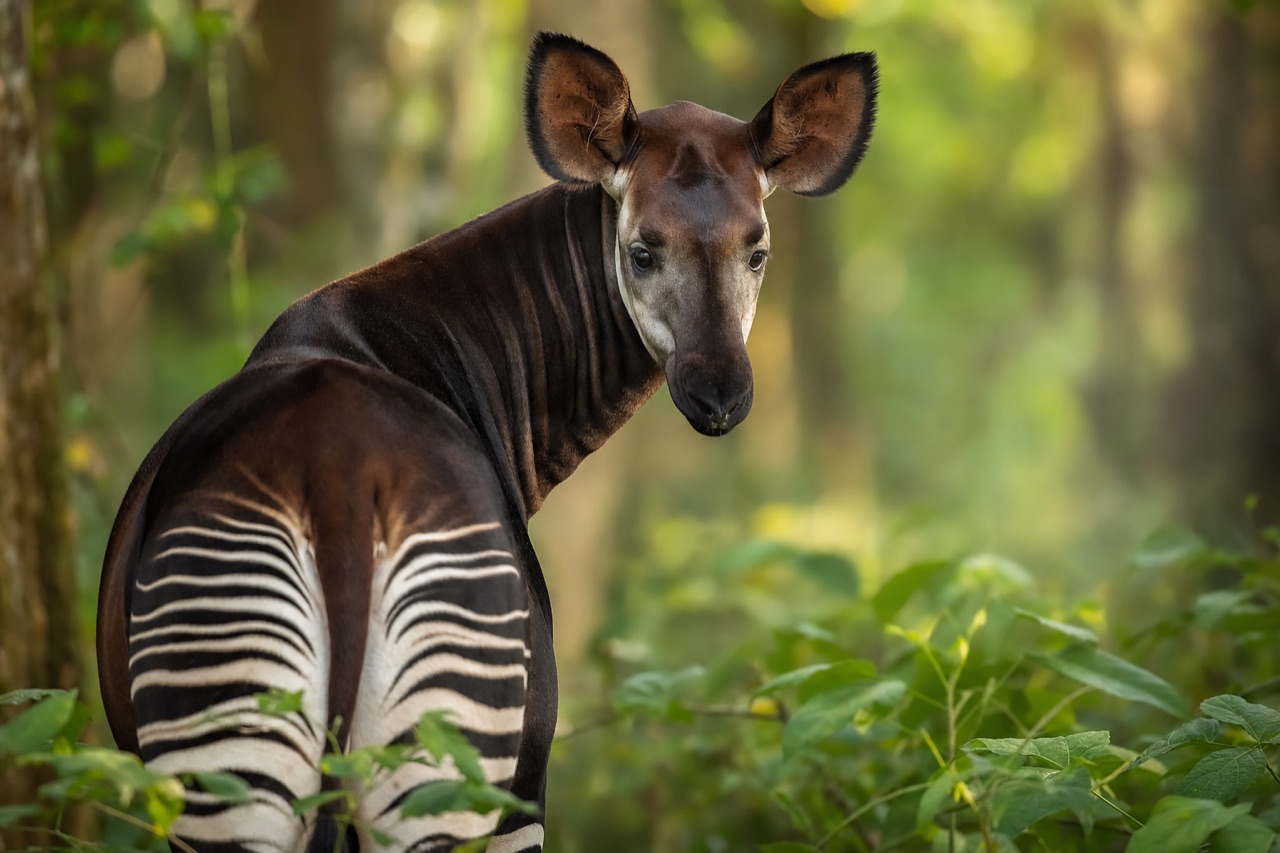
AI-generated educational wildlife portrait — World Animal Rescue Network · AI visualisation, not a photograph
In brief
The okapi (Okapia johnstoni) is the giraffe's only living relative, a solitary rainforest herbivore found exclusively in the Democratic Republic of the Congo, with striped hindquarters for camouflage and a long dark prehensile tongue.
Also in Animals A to Z · Animals that start with O
How you can help
You can support the related appeal — read its purpose, recipient status and fund terms first — or give once to where it is needed most. Sharing accurate information helps too.
By WARN Research & Conservation Team Last updated
The okapi looks assembled from other animals — striped hindquarters like a zebra, a body like a large antelope, and the long dark prehensile tongue and ossicones of a giraffe. The last of those is the giveaway: the okapi is the giraffe's only living relative, the sole other member of the family Giraffidae. It lives in the dense rainforests of the north-eastern Democratic Republic of the Congo and nowhere else. Solitary, quiet and superbly camouflaged, it went undescribed by Western science until 1901, which is late for a large mammal and reflects how hard it is to see.
1
Country of occurrence — the DRC only
~30 cm
Tongue length; long enough to clean its own eyes
1901
Year formally described by Western science
Infrasound
Mothers and calves communicate below human hearing
Figures sourced from IUCN Red List — Okapia johnstoni, CITES Appendices .
Okapi: Quick Facts
| Shoulder height | ~1.5 m |
|---|---|
| Weight | 200–350 kg |
| Closest relative | Giraffe — the only other giraffid |
| Range | DR Congo only |
| Communication | Infrasound between mothers and calves |
| Main predator | Leopard |
Scientific Classification
| Kingdom | Animalia |
|---|---|
| Phylum | Chordata |
| Class | Mammalia |
| Order | Artiodactyla |
| Family | Giraffidae |
| Genus | Okapia |
| Species | Okapia johnstoni |
Conservation Status
- IUCN Status
- Endangered
- Population
- Unknown; substantial decline documented since the 1990s
- Trend
- Decreasing
- Assessed
- 2015
- CITES
- Appendix I
Armed conflict across the range is both a direct threat and the principal obstacle to survey work, so population estimates carry wide uncertainty.
Did you know?
Okapi mothers and calves call to each other in infrasound below human hearing — quiet enough that a leopard nearby hears nothing.
Key Facts: Okapi
- The okapi is the only living relative of the giraffe, in the family Giraffidae.
- It occurs in the wild only in the Democratic Republic of the Congo.
- Striped hindquarters break up its outline in dappled forest light.
- Its tongue is long enough to clean its own eyes and ears.
- Mothers and calves communicate using infrasound below the range of human hearing.
- It is Endangered, threatened by logging, mining, hunting and armed conflict.
A giraffe that stayed in the forest
Okapi and giraffe share defining giraffid traits: ossicones on the skull of males, a long dark prehensile tongue, and the same distinctive lobed canine teeth. The okapi kept the ancestral forest habits while the giraffe lineage moved onto open savanna and stretched.
At around 1.5 m at the shoulder, the okapi is built for pushing through dense undergrowth rather than reaching into acacias. Its tongue does the same job as a giraffe's — stripping leaves and buds — and is long enough that the animal can clean its own eyes and ears with it.
Camouflage and secrecy
The horizontal white stripes on the hindquarters and upper legs break up the body's outline in the shifting, dappled light of the forest floor. They may also help a calf follow its mother visually through dense vegetation.
Okapi are solitary, largely silent to human ears, and use scent-marking to communicate. Mothers and calves exchange infrasonic calls below the range of human hearing — likely an adaptation to communicate without alerting leopards, their main natural predator. All of this is why a large mammal remained unknown to Western science until 1901.
Why it is Endangered
The okapi's entire range lies within one country, much of which has experienced prolonged armed conflict. That single fact drives most of the threat picture.
Logging and agricultural clearance remove forest. Artisanal mining, particularly for coltan and gold, brings people, roads and bushmeat hunting deep into previously inaccessible forest. Armed groups occupy okapi habitat and hunt directly. In 2012 the Okapi Wildlife Reserve headquarters was attacked and captive okapi were killed — an unusually direct illustration of how conservation and conflict intersect here.
What conservation looks like in a conflict zone
Protecting okapi is mostly about protecting people who protect okapi. Ranger patrols in the Okapi Wildlife Reserve operate under genuine danger, and the practical work is ranger support, community engagement around reserve boundaries, and reducing the bushmeat trade that supplies mining camps.
Captive breeding maintains an insurance population in zoos worldwide, but there is no realistic reintroduction pathway while the habitat is insecure. As with many species in conflict zones, the limiting factor is not biology.
What WARN Does
WARN publishes free, sourced species education including the species whose fate is decided by conflict rather than by ecology. The okapi is a reminder that in some places the binding constraint on conservation is security, and that rangers are the people carrying that risk.
If this guide helps you understand wildlife and the pressures it faces, a gift to WARN supports habitat protection and free public education in our partner countries.
How can I help save the okapi?
Explore practical ways to support the okapi, from everyday choices and sharing reliable information to reviewing a related appeal before giving.
Explore ways to support
Read the related appeal’s purpose, recipient status and fund terms. Choose an affordable gift after checking what is proposed and what has been reported.
Ease the pressures
Avoid the wildlife trade and souvenirs, never buy wild animals as pets, and choose sustainable, habitat-friendly products — the threats behind the okapi's decline fall when demand does.
Spread the word
Share accurate, sourced information about the okapi. Wider awareness is what turns concern into lasting protection.
Okapi: Frequently Asked Questions
How can I help save the okapi?
Is the okapi related to the zebra?
Where do okapi live?
Why was the okapi discovered so late?
Are okapi endangered?
How long is an okapi's tongue?
Are okapi / forest giraffes dangerous?
How long do okapi / forest giraffes live?
How big is an okapi / forest giraffe?
What do okapi / forest giraffes eat?
Sources & References
Population figures, conservation status and biological facts on this page are drawn from authoritative scientific and intergovernmental sources.
Terms used on this page
Plain-English definitions, from our wildlife and conservation glossary.
Explore more animals
Discover more animals, their habitats and their conservation status in the WARN wildlife-guide library.
Enjoyed this Okapi guide?
Receive appeal updates, animal-welfare news and published funding reports. Unsubscribe any time.
We only use your address for WARN updates. See our privacy policy.