Wildlife Guide · South-western Western Australia & Reintroduced sites in South Australia and New South Wales
Numbat
Myrmecobius fasciatus (Waterhouse, 1836) — family Myrmecobiidae
Western Australia's mammal emblem eats almost nothing but termites — and was down to roughly 300 animals before recovery work began.
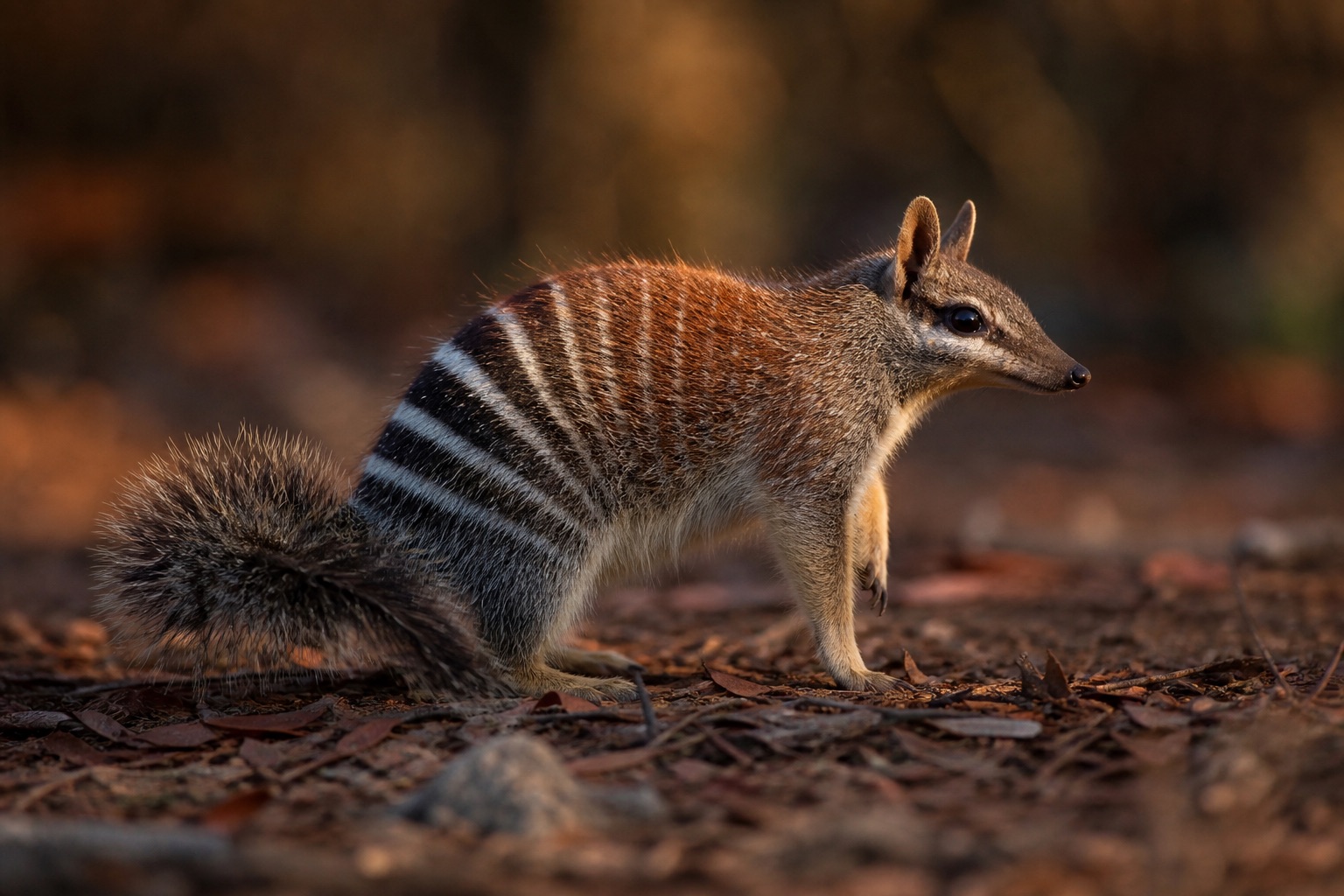
AI-generated educational wildlife portrait — World Animal Rescue Network · AI visualisation, not a photograph
In brief
The numbat (Myrmecobius fasciatus) is a diurnal marsupial of south-western Australia that eats almost exclusively termites using a long sticky tongue; after falling to roughly 300 animals in the 1970s, recovery efforts have raised numbers to an estimated 2,000–3,000 and the IUCN downlisted it to Near Threatened in 2026.
Also in Animals A to Z · Animals that start with N
How you can help
You can support the related appeal — read its purpose, recipient status and fund terms first — or give once to where it is needed most. Sharing accurate information helps too.
By WARN Research & Conservation Team Last updated
The numbat is the only marsupial that feeds almost exclusively on termites, and one of the very few mammals active by day rather than night. It is a small, striped dasyuromorph — not an anteater despite the old name 'banded anteater' — with a long sticky tongue, a sensitive pointed snout and claws built for scratching open shallow termite galleries in soil and rotting wood. By the late 1970s the numbat had collapsed to around 300 individuals, confined to a handful of remnant eucalypt woodlands in south-western Australia after foxes, cats, habitat loss and changed fire regimes removed it from most of its former range across southern Australia. Decades of predator control, fenced sanctuaries, captive breeding at Perth Zoo and translocations have raised the population to an estimated 2,000–3,000 mature animals — enough for the IUCN to downlist the species from Endangered to Near Threatened in July 2026. That improvement is real, but numbats still occupy a tiny fraction of their historical range and depend on ongoing fox and cat management.
2,000–3,000
Estimated mature individuals after decades of recovery
~20,000
Termites eaten per day
Diurnal
Active by day — unusual among marsupials
0.04%
Rough share of the numbat's original range still occupied
Figures sourced from IUCN Red List — Myrmecobius fasciatus, IUCN press release — numbat downlisting (July 2026), Western Australian Department of Biodiversity, Conservation and Attractions — numbat fact sheet .
Numbat: Quick Facts
| Head and body length | About 20–29 cm |
|---|---|
| Weight | About 300–750 g |
| Diet | Almost exclusively termites |
| Activity | Diurnal |
| Lifespan | Up to about five years in the wild |
| IUCN status | Near Threatened (2026) |
| Main threats | Foxes, feral cats, habitat loss and fire |
Scientific Classification
| Kingdom | Animalia |
|---|---|
| Phylum | Chordata |
| Class | Mammalia |
| Order | Dasyuromorphia |
| Family | Myrmecobiidae |
| Genus | Myrmecobius |
| Species | Myrmecobius fasciatus |
Conservation Status
- IUCN Status
- Near Threatened
- Population
- Roughly 2,000–3,000 mature individuals (IUCN, 2026)
- Trend
- Increasing with sustained management; vulnerable without predator control
- Assessed
- 2026
- CITES
- Not listed
The July 2026 downlisting reflects recovery from roughly 300 animals in the late 1970s, but numbats occupy about 0.04% of their original range and remain Endangered under Australian federal law.
Did you know?
The numbat's tongue can extend to about 10 cm — nearly half the length of its body — and is coated with sticky saliva used solely for lapping termites from narrow galleries.
Key Facts: Numbat
- The numbat is the sole living member of the family Myrmecobiidae and one of the few strictly diurnal marsupials.
- Its diet is almost entirely termites — up to roughly 20,000 per day — extracted from shallow galleries with a sticky tongue up to about 10 cm long.
- Foxes and feral cats drove the collapse; predator baiting, fencing and translocations underpin the recovery.
- The IUCN downlisted the numbat from Endangered to Near Threatened in July 2026, with an estimated 2,000–3,000 mature individuals.
- Numbats remain listed as Endangered under Australia's federal EPBC Act despite the global downlisting.
- Western Australia declared the numbat its mammal emblem in 1973.
- Activity follows termite availability in the upper soil layers, which warm through the day.
A marsupial built around termites
Most insect-eating mammals take a broad menu. The numbat does not. Field studies and dietary analyses show a diet consisting almost exclusively of termites, with the occasional ant swallowed by accident while foraging. That specialisation shapes everything about the animal: the elongated snout for probing galleries, the reduced peg-like teeth that do not chew prey, the enlarged salivary glands that produce sticky saliva, and the sharp foreclaws for shallow excavations in soil and rotting logs.
Numbats locate termites by scent and vibration, then lap them up with a vermiform tongue that can extend well beyond the snout. Daily intake is enormous relative to body size — commonly quoted figures range from about 15,000 to 20,000 termites per day, roughly 10% of an adult's body weight. Because termites retreat deeper when the surface cools, numbats are diurnal: they forage when termites move into shallow tunnels and chambers warmed by the sun. That schedule is the opposite of most marsupial predators and is dictated entirely by prey biology — the WARN termite guide covers the insects that define this animal's existence.
From near extinction to a cautious recovery
At European settlement the numbat ranged across much of southern Australia. Introduced red foxes and feral cats, together with land clearing and altered fire regimes, removed it from almost everywhere. By the late 1970s only around 300 individuals survived in remnant eucalypt woodland in Western Australia — among the lowest points for any Australian mammal.
Research in the 1980s identified predation as the primary driver and led to a recovery plan in 1994. Western Australia's government, Perth Zoo, Australian Wildlife Conservancy and community volunteers combined fox and cat control, predator-proof fencing, captive breeding and translocations. Several self-sustaining populations now exist beyond the original range fragments. The IUCN's July 2026 assessment estimated 2,000–3,000 mature individuals and moved the species to Near Threatened — a milestone, not a finish line. Numbats still occupy about 0.04% of their original range, and feral predators remain on the landscape throughout.
Why diurnal life suits a termite specialist
Termites thermoregulate within their mounds and galleries. As the upper soil warms through the morning, worker termites move into shallow tunnels where numbats can reach them. By late afternoon the surface cools and termites retreat; numbats return to hollow logs or burrows to sleep. In winter the active window narrows to a mid-morning to mid-afternoon peak when soil temperatures suit both termites and foragers.
The numbat's bold black-and-white rump stripes and dark eye stripe break up its outline against bark and litter — useful for an animal that must feed in open woodland rather than hunt from cover like a nocturnal dasyurid. Females lack a permanent pouch; instead the belly folds into a shallow depression where young attach to a teat for much of their development, then ride on the mother's back before independence at about a year old.
What WARN Does
WARN publishes free, sourced species education for threatened Australian mammals whose recovery depends on predator control the public rarely sees. The numbat's downlisting only holds if fox and cat management continues — accurate guides keep that requirement visible.
If this guide helps you understand wildlife and the pressures it faces, a gift to WARN supports habitat protection and free public education in our partner countries.
How can I help save the numbat?
Explore practical ways to support the numbat, from everyday choices and sharing reliable information to reviewing a related appeal before giving.
Explore ways to support
Read the related appeal’s purpose, recipient status and fund terms. Choose an affordable gift after checking what is proposed and what has been reported.
Ease the pressures
Avoid the wildlife trade and souvenirs, never buy wild animals as pets, and choose sustainable, habitat-friendly products — the threats behind the numbat's decline fall when demand does.
Spread the word
Share accurate, sourced information about the numbat. Wider awareness is what turns concern into lasting protection.
Numbat: Frequently Asked Questions
How can I help save the numbat?
Where do numbats live?
Are numbats dangerous to humans?
How long do numbats live?
How big is a numbat?
Are numbats still endangered?
Why is the numbat active during the day?
What do numbats eat?
Sources & References
Population figures, conservation status and biological facts on this page are drawn from authoritative scientific and intergovernmental sources.
Terms used on this page
Plain-English definitions, from our wildlife and conservation glossary.
Explore more animals
Discover more animals, their habitats and their conservation status in the WARN wildlife-guide library.
Enjoyed this Numbat guide?
Receive appeal updates, animal-welfare news and published funding reports. Unsubscribe any time.
We only use your address for WARN updates. See our privacy policy.