Wildlife Guide · Indo-Pacific coral reefs and slopes & Philippines, Papua New Guinea, Australia and neighbouring waters
Nautilus
Nautilus pompilius (Linnaeus, 1758) — family Nautilidae; genus Nautilus among six living nautiloid species
The only living cephalopod with an external shell — pinhole eyes, ancient lineage, modern trade pressure.
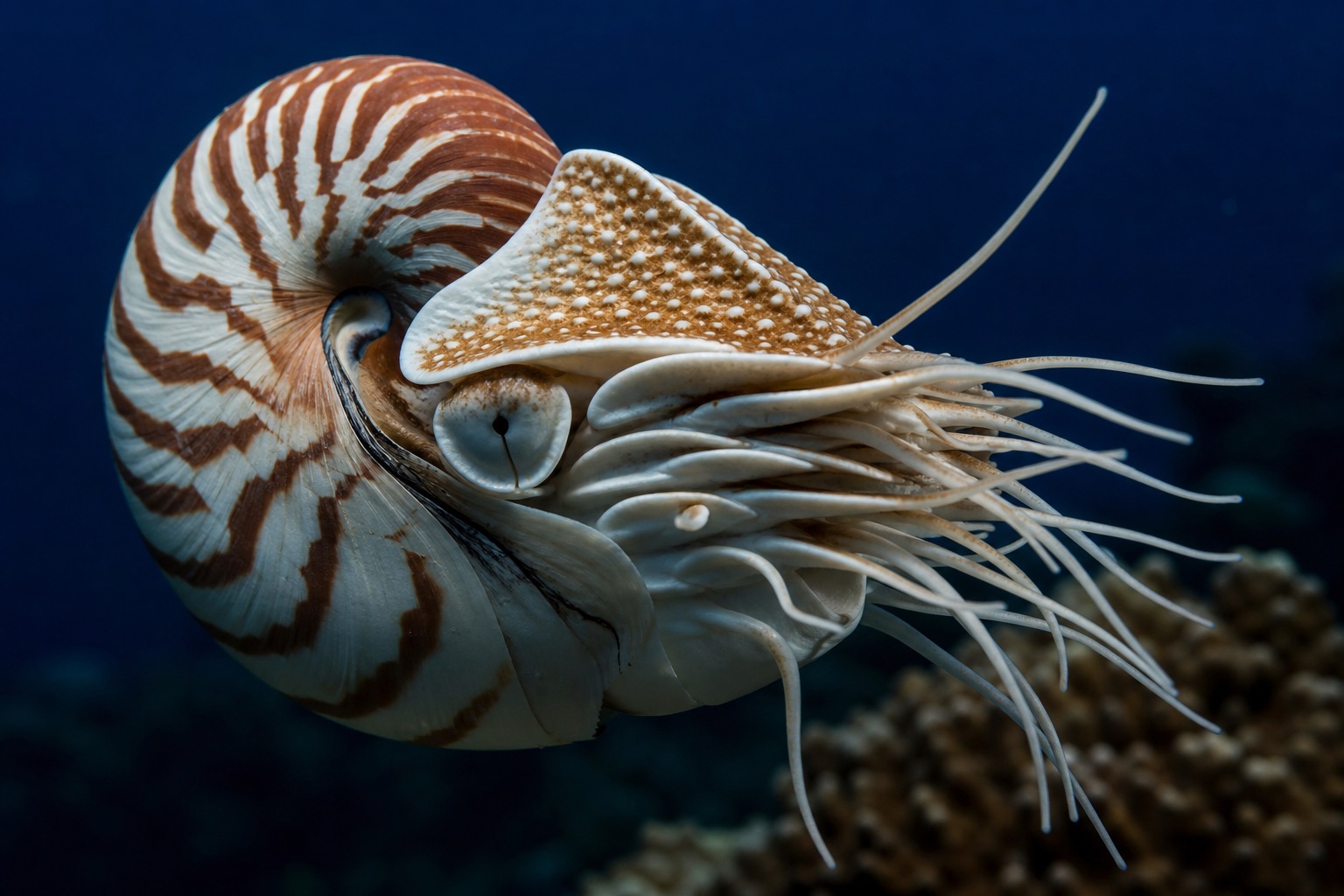
AI-generated educational wildlife portrait — World Animal Rescue Network · AI visualisation, not a photograph
In brief
The chambered nautilus (Nautilus pompilius) is a nocturnal Indo-Pacific cephalopod with an external coiled shell and pinhole eyes; it adjusts buoyancy with gas-filled chambers, is listed Vulnerable due to shell trade and slow reproduction, and represents an ancient nautiloid lineage.
Also in Animals A to Z · Animals that start with N
How you can help
You can support the related appeal — read its purpose, recipient status and fund terms first — or give once to where it is needed most. Sharing accurate information helps too.
By WARN Research & Conservation Team Last updated
Nautiluses are cephalopods that retained an external coiled shell while octopuses and squids lost theirs. The chambered nautilus Nautilus pompilius fills the shell with gas-filled chambers to control buoyancy, swimming by jet propulsion and adjusting depth like a submarine. Eyes are pinholes without a lens — functional but coarse compared with the camera eyes of other cephalopods. The lineage extends back hundreds of millions of years; nautiloids dominated Palaeozoic seas long before ammonites appeared. Today's survivors are slow breeders — females lay few eggs over years — and that makes them vulnerable to shell collection for the curio and jewellery trade. Nautilus pompilius is listed Vulnerable on the IUCN Red List, and several countries restrict harvest and export.
Vulnerable
IUCN status for Nautilus pompilius (2018)
Pinhole
Eye — no lens, unlike octopus and squid
500 Myr+
Nautiloid fossil lineage — predates ammonites
90+
Chambers in a mature shell — buoyancy control
Figures sourced from IUCN Red List — Nautilus pompilius, CITES Appendices .
Nautilus: Quick Facts
| Shell diameter | Roughly 20–25 cm in large N. pompilius |
|---|---|
| Diet | Scavenging and small prey at night |
| Habitat | Deep Indo-Pacific reef slopes |
| Eye | Pinhole — no lens |
| IUCN status | Vulnerable (Nautilus pompilius) |
| Trade | CITES Appendix II |
Scientific Classification
| Kingdom | Animalia |
|---|---|
| Phylum | Mollusca |
| Class | Cephalopoda |
| Subclass | Nautiloidea |
| Family | Nautilidae |
| Genus | Nautilus |
| Species | Nautilus pompilius |
Conservation Status
- IUCN Status
- Vulnerable
- Population
- No reliable global estimate — declining in heavily fished areas
- Trend
- Decreasing
- Assessed
- 2018
- CITES
- Appendix II
Shell collection for curio and jewellery trade is the primary documented threat. Slow reproduction limits recovery.
Did you know?
The nautilus eye has no lens — just a pinhole aperture — yet it belongs to the same cephalopod class as octopuses with camera eyes ranked among the sharpest in the animal kingdom.
Key Facts: Nautilus
- Nautiluses are cephalopods with external coiled shells — the only living group to retain one.
- Nautilus pompilius is listed Vulnerable, threatened by shell collection and slow life history.
- Eyes are pinholes without lenses — adequate for low light but not comparable to octopus vision.
- Buoyancy is controlled by gas and fluid in shell chambers connected to the living chamber.
- They are nocturnal scavengers on deep reef slopes, rising toward shallower water at night.
- CITES Appendix II listing restricts international trade in nautilus shells.
Shell, chambers and buoyancy
The nautilus shell is a logarithmic spiral divided by septa into chambers. The animal occupies only the outermost chamber; earlier chambers are sealed and filled with gas and fluid regulated through a siphuncle tube. Adding gas or removing liquid changes buoyancy without constant swimming effort — a solution octopuses abandoned when they internalised or lost the shell entirely.
The shell is also armour. Predators include sharks and large fish; the hard exterior survives attacks that would finish a soft-bodied octopus. Trade demand for that same shell is now the primary human threat.
Pinhole eyes in a cephalopod class built for vision
Octopuses and cuttlefish evolved camera eyes with lenses capable of forming sharp images. Nautiluses did not. Their eye is a simple pinhole aperture — no lens, no cornea — producing a fuzzy image adequate for detecting contrast and movement in dim reef light at depth.
Because they are nocturnal scavengers rather than diurnal hunters of fast prey, that may be sufficient. It is also a window into deep time: nautiloid eyes represent an earlier stage before cephalopod vision escalated. Living nautiluses are not primitive — they are successful survivors — but they carry ancestral traits side by side with modern ones.
Slow life history meets shell trade
Nautiluses mature late and lay few eggs — often a dozen or fewer per year in some species, attached to hard substrate in deep water. Population recovery from fishing is slow. Harvest for shells — whole specimens for the curio trade, polished sections for jewellery — removes breeding adults directly.
IUCN assessed Nautilus pompilius as Vulnerable in 2018, citing trade-driven declines in the Philippines and other range states. CITES Appendix II regulates international export. Enforcement and bycatch in deep reef fisheries remain ongoing problems. A shell on a shelf is often a removed adult that will not be replaced quickly.
Ancient lineage, modern ocean
Nautiloids appear in the fossil record roughly 500 million years ago and were major predators of Palaeozoic seas. Ammonites — extinct relatives with more elaborate sutures — dominated the Mesozoic until the end-Cretaceous extinction. Nautilus is the familiar living remnant of that radiation, not an ammonite itself but a cousin that persisted.
Deep slopes and night feeding kept nautiluses off many human radars until scuba and trade demand exposed them. Climate change and ocean acidification may weaken shell formation over time, stacking pressure on a group already hit by direct harvest.
What WARN Does
WARN publishes free marine species education for animals traded as souvenirs without buyers understanding life history. Nautilus shells in shops represent slow-reproducing adults removed from reef slopes — the Vulnerable listing is a direct response to that market.
If this guide helps you understand wildlife and the pressures it faces, a gift to WARN supports habitat protection and free public education in our partner countries.
How can I help save the nautilus?
Explore practical ways to support the nautilus, from everyday choices and sharing reliable information to reviewing a related appeal before giving.
Explore ways to support
Read the related appeal’s purpose, recipient status and fund terms. Choose an affordable gift after checking what is proposed and what has been reported.
Ease the pressures
Avoid the wildlife trade and souvenirs, never buy wild animals as pets, and choose sustainable, habitat-friendly products — the threats behind the nautilus's decline fall when demand does.
Spread the word
Share accurate, sourced information about the nautilus. Wider awareness is what turns concern into lasting protection.
Nautilus: Frequently Asked Questions
How can I help save the nautilus?
What do nautiluses eat?
Where do nautiluses live?
Are nautiluses dangerous to humans?
How long do nautiluses live?
How big do nautiluses get?
Are nautiluses endangered?
Sources & References
Population figures, conservation status and biological facts on this page are drawn from authoritative scientific and intergovernmental sources.
Terms used on this page
Plain-English definitions, from our wildlife and conservation glossary.
Explore more animals
Discover more animals, their habitats and their conservation status in the WARN wildlife-guide library.
Enjoyed this Nautilus guide?
Receive appeal updates, animal-welfare news and published funding reports. Unsubscribe any time.
We only use your address for WARN updates. See our privacy policy.