Wildlife Guide · East Africa — Kenya, Somalia and Ethiopia & Semi-arid savanna and grassland
Naked Mole-Rat
Heterocephalus glaber (Rüppell, 1842) — family Heterocephalidae
A cold-blooded mammal that feels no acid pain, barely gets cancer, and lives like an ant.
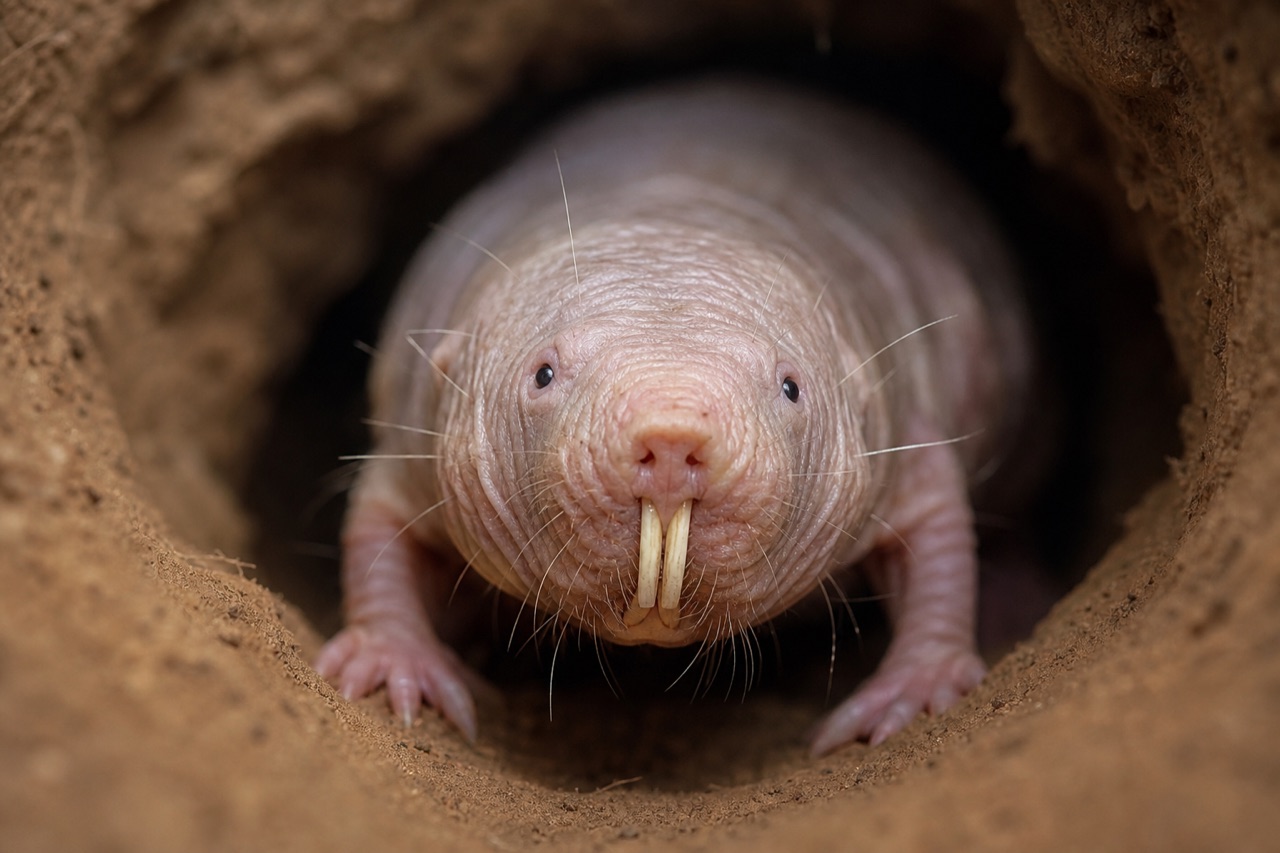
AI-generated educational wildlife portrait — World Animal Rescue Network · AI visualisation, not a photograph
In brief
The naked mole-rat (Heterocephalus glaber) is a eusocial East African rodent that lives in insect-like colonies with a breeding queen, tolerates extreme hypoxia and carbon dioxide, shows negligible ageing, resists cancer, and lacks normal acid pain sensation.
Also in Animals A to Z · Animals that start with N
By WARN Research & Conservation Team Last updated
The naked mole-rat is one of the strangest mammals alive: a hairless, wrinkled rodent of East African semi-arid savanna that lives underground in colonies structured like an insect society. A single breeding queen, a handful of breeding males, and dozens of sterile workers cooperate in a tunnel system that can extend for kilometres. It is the mammal most closely approaching eusociality — the reproductive division of labour seen in ants and termites. Its biology is equally unusual. Naked mole-rats are effectively cold-blooded at rest, regulating body temperature through behaviour rather than metabolism. They tolerate extreme hypoxia in sealed burrows. They show negligible senescence — barely ageing in the normal mammalian sense — and resist cancer through a unique cell mechanism. They do not feel certain types of pain, including acid pain, which allows them to tolerate the carbon dioxide that builds up in crowded burrows. Naked mole-rats have become a major biomedical research model precisely because they break so many mammalian rules. Their cancer resistance, extreme longevity, hypoxia tolerance and pain insensitivity each address major medical questions — and their Least Concern conservation status belies how extraordinary the underlying biology is.
Eusocial
Queen, breeders and sterile workers — like ants
30+ years
Lifespan in captivity — extraordinary for a rodent
No acid pain
Cannot feel pain from acid or capsaicin
Hypoxia
Survives minutes with almost no oxygen
Figures sourced from IUCN Red List — Heterocephalus glaber, Smithsonian National Zoo — Naked Mole-Rat .
Naked Mole-Rat: Quick Facts
| Length | 8–10 cm body |
|---|---|
| Weight | 30–80 g |
| Social system | Eusocial — queen, breeders and sterile workers |
| Lifespan | 30+ years in captivity |
| Cancer | Extremely resistant — hyaluronan mechanism |
| Pain | No acid or capsaicin pain sensation |
| Habitat | Underground colonies in East African savanna |
Scientific Classification
| Kingdom | Animalia |
|---|---|
| Phylum | Chordata |
| Class | Mammalia |
| Order | Rodentia |
| Family | Heterocephalidae |
| Genus | Heterocephalus |
| Species | Heterocephalus glaber |
Conservation Status
- IUCN Status
- Least Concern
- Population
- Unknown; considered common in suitable habitat
- Trend
- Stable
- Assessed
- 2016
- CITES
- Not listed
Locally affected by agricultural expansion and tuber harvesting, but the species remains common across its East African range.
Did you know?
Naked mole-rats can survive for minutes with almost no oxygen by switching to fructose-based metabolism — a pathway normally used by plants, not mammals.
Key Facts: Naked Mole-Rat
- Naked mole-rats are eusocial mammals — colonies have a breeding queen, a few males and many sterile workers, like an ant nest.
- They are essentially cold-blooded at rest, regulating temperature through behaviour rather than internal metabolism.
- They tolerate extreme hypoxia and high carbon dioxide in sealed underground burrows.
- They show negligible senescence and resist cancer through a unique cell-death mechanism involving hyaluronan.
- They cannot feel pain from acid or capsaicin, which may help them tolerate CO₂ in crowded tunnels.
- Lifespans exceed thirty years in captivity — extraordinary for a rodent of this size.
- Least Concern, but habitat disturbance and agricultural expansion affect local colonies.
A mammal that lives like an ant
Naked mole-rat colonies contain a single breeding queen, one to three breeding males, and dozens to hundreds of sterile workers of both sexes. The queen is the only female that reproduces; she suppresses ovulation in other females through social dominance, physical contact and pheromonal cues delivered in the colony's shared toilet chamber.
Workers dig tunnels, forage for tubers, defend the colony and care for pups — without ever breeding themselves. This reproductive division of labour is eusociality, a social system previously known only in insects. Naked mole-rats are the most eusocial mammal, though Damaraland mole-rats show a similar system. Colonies can contain over 300 individuals in tunnel systems that extend for kilometres beneath East African savanna.
The tunnels are dug through hard, compacted soil using enormous incisors — a quarter of the animal's muscle mass is devoted to jaw muscles. Naked mole-rats can dig backwards as easily as forwards, shovelling excavated soil above ground with their heads. The colony's tunnel system is a permanent, expanding structure that may be occupied for many years, with new tunnels added as the colony grows and old sections abandoned as food in the area is exhausted. A single large tuber can sustain a colony for months.
Cold-blooded, hypoxia-proof and long-lived
Naked mole-rats do not thermoregulate like normal mammals. At rest, their body temperature tracks the ambient temperature of the burrow — they are effectively poikilothermic, behaving more like a reptile than a rodent. They move to warmer or cooler tunnel sections to adjust, and huddle together when the burrow temperature drops. A colony huddled in a deep tunnel can maintain a workable temperature even when surface air falls sharply overnight in the savanna.
Their burrows are sealed environments where oxygen runs low and carbon dioxide accumulates. Naked mole-rats tolerate conditions that would kill most mammals: they can survive for minutes with almost no oxygen by switching to fructose-based metabolism, a pathway normally used by plants. Their lifespan exceeds thirty years in captivity — roughly ten times what a mouse of similar size would achieve — and they show negligible senescence, maintaining health, fertility and activity deep into old age.
The combination of hypoxia tolerance, negligible ageing and cancer resistance makes naked mole-rats the subject of intense biomedical research. Each trait addresses a major medical question — stroke treatment, ageing biology, oncology — and the fact that all three occur in one small rodent is what makes the species scientifically extraordinary rather than merely unusual.
Cancer resistance and pain that is not there
Naked mole-rats almost never develop cancer. The mechanism involves high-molecular-weight hyaluronan, a substance in the extracellular matrix that triggers early contact inhibition — cells stop dividing when they touch neighbours, preventing the uncontrolled growth that becomes a tumour. When researchers suppressed hyaluronan production, naked mole-rat cells became cancer-prone, confirming the link.
They also lack normal acid pain sensation. Naked mole-rat nociceptors do not respond to acid or capsaicin — the compound that makes chilli peppers hot. This may be an adaptation to crowded burrows where carbon dioxide dissolves into tissue acid, which would cause constant pain in a normal mammal. The absence of acid pain is not a deficit but a feature of life in sealed tunnels where CO₂ levels can reach levels that would distress most animals.
These traits are not independent. The same hyaluronan that prevents cancer also contributes to skin elasticity and wound healing in the tight tunnels. The metabolic adaptations for hypoxia tolerance may interact with the ageing mechanisms that produce negligible senescence. Naked mole-rat biology is a package, not a collection of separate tricks — which is why the species has become one of the most intensively studied rodents in biomedical research worldwide.
Why scientists study them obsessively
Naked mole-rats are a biomedical research model precisely because they break mammalian rules. Their cancer resistance, extreme longevity, hypoxia tolerance and pain insensitivity each address major medical questions. Understanding how their hyaluronan prevents tumour formation may inform human cancer therapy. Their fructose metabolism under hypoxia could inform stroke and heart attack treatment. Their negligible senescence challenges fundamental assumptions about mammalian ageing.
In the wild, they are Least Concern — colonies are common in suitable East African savanna across Kenya, Somalia and Ethiopia. Local threats include agricultural expansion, soil disturbance from ploughing and tuber harvesting that removes their primary food source. When farmers dig up the large underground tubers that naked mole-rats depend on, entire colony tunnel systems can lose their food base.
Captive colonies in research institutions worldwide maintain breeding populations for study, and the species breeds reliably in captivity — unlike many wild mammals that fail to reproduce under laboratory conditions. The naked mole-rat's combination of biological extremity and captive tractability makes it an ideal research subject. What is learned from them about ageing, cancer and hypoxia tolerance has direct relevance to human medicine — which is why a Least Concern rodent of East African savanna receives more laboratory attention than many Endangered mammals.
What WARN Does
WARN publishes free, sourced species education for animals whose biology challenges assumptions. The naked mole-rat is Least Concern and scientifically extraordinary — a combination that makes it worth covering because understanding unusual species broadens how people think about mammals altogether.
If this guide helps you understand wildlife and the pressures it faces, a gift to WARN supports habitat protection and free public education in our partner countries.
Naked Mole-Rat: Frequently Asked Questions
Are naked mole-rats really naked?
Are naked mole-rats eusocial?
Why do naked mole-rats live so long?
Can naked mole-rats feel pain?
Where do naked mole-rats live?
What do naked mole-rat / sand puppies eat?
Are naked mole-rat / sand puppies dangerous?
How long do naked mole-rat / sand puppies live?
How big is a naked mole-rat / sand puppy?
Sources & References
Population figures, conservation status and biological facts on this page are drawn from authoritative scientific and intergovernmental sources.
Terms used on this page
Plain-English definitions, from our wildlife and conservation glossary.
Explore more animals
Discover more animals, their habitats and their conservation status in the WARN wildlife-guide library.
Enjoyed this Naked Mole-Rat guide?
Receive appeal updates, animal-welfare news and published funding reports. Unsubscribe any time.
We only use your address for WARN updates. See our privacy policy.