Wildlife Guide · Indo-Pacific mangrove mudflats & Tropical west Africa for some species
Mudskipper
Periophthalmus spp. — family Oxudercidae (formerly Gobiidae)
A fish that walks on land, breathes through its skin and spends more time out of water than in it.
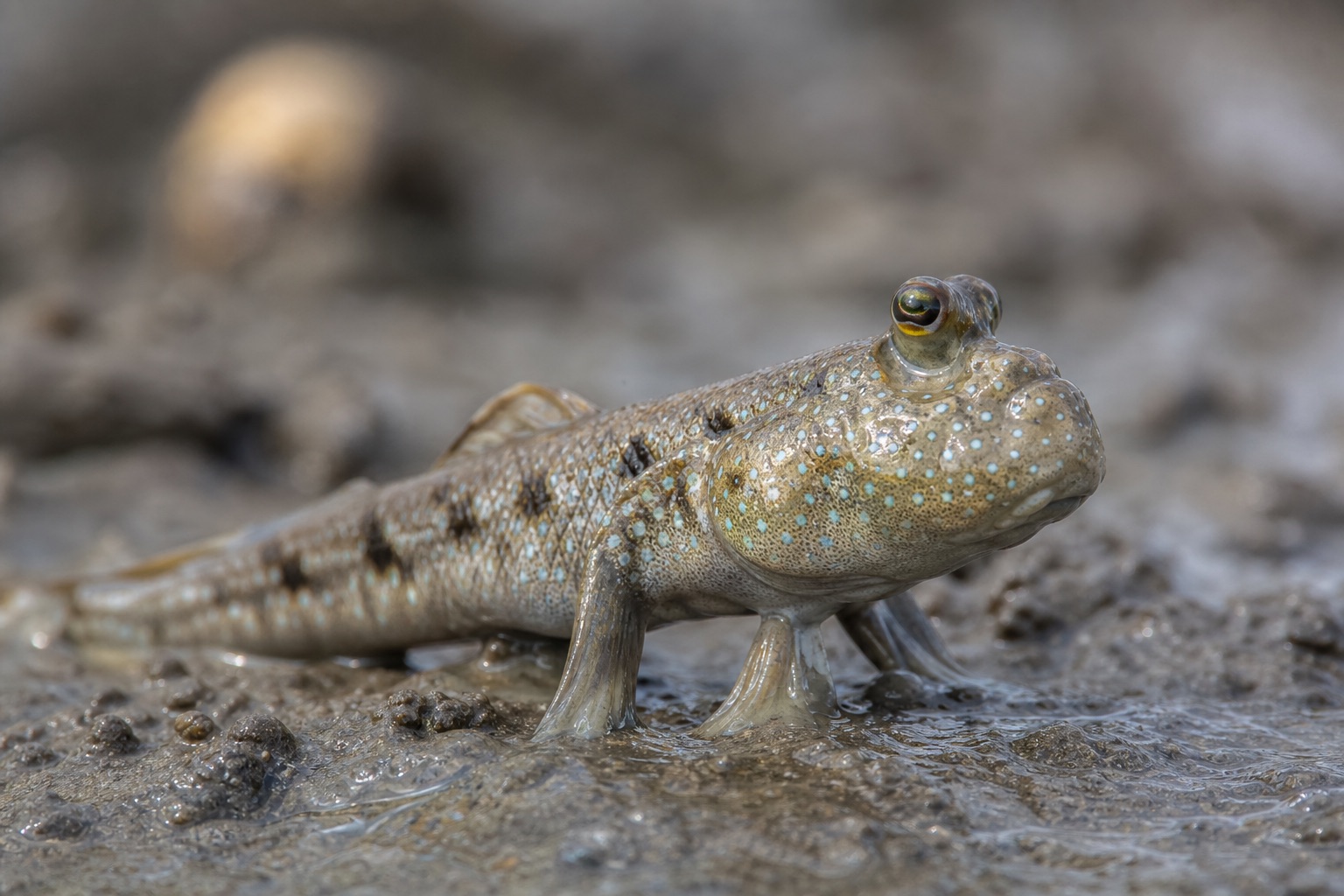
AI-generated educational wildlife portrait — World Animal Rescue Network · AI visualisation, not a photograph
In brief
Mudskippers (Periophthalmus and related genera) are intertidal fish that walk on pectoral fins, breathe air through skin and mouth lining, and live on mangrove mudflats in the Indo-Pacific; they spend most of active life out of water and are not assessed as a group on the IUCN Red List.
Also in Animals A to Z · Animals that start with M
By WARN Research & Conservation Team Last updated
Mudskippers are gobies that reversed the usual fish contract. They live on intertidal mudflats and mangrove edges, leave the water for hours at a time, walk on their pectoral fins, climb roots, and breathe air through the skin, mouth lining and enlarged gill chambers they keep moist. At low tide they are the dominant vertebrate on the flat; at high tide they retreat to burrows or shallow pools. The genus Periophthalmus contains most of the species people mean by 'mudskipper' — name means 'around the eye', referring to the bulging, independently movable eyes perched on the head for scanning above and below the waterline simultaneously. They are territorial, visually communicative — males flash fins and jump in display — and tightly bound to mangrove mud that is being cleared across much of their range.
Hours
Time spent out of water during each low-tide period
Bulging
Eyes that move independently on the head top
Burrows
Excavated in mud for refuge and breeding
Mangrove
Habitat being cleared across tropical coasts
Figures sourced from FishBase — Periophthalmus genus, Graham — Air-breathing fishes (mangrove amphibious gobies), Animal Diversity Web — Periophthalmus .
Mudskipper: Quick Facts
| Length | Roughly 10–20 cm depending on species |
|---|---|
| Diet | Algae, small invertebrates and surface organic film |
| Habitat | Intertidal mangrove mudflats and estuaries |
| Locomotion | Walking and skipping on pectoral fins |
| Respiration | Air through skin, mouth lining and gill chambers |
| Eyes | Bulging, independently movable on head top |
| IUCN status | Not Evaluated for most species |
Scientific Classification
| Kingdom | Animalia |
|---|---|
| Phylum | Chordata |
| Class | Actinopterygii |
| Order | Gobiiformes |
| Family | Oxudercidae |
| Genus | Periophthalmus (principal mudskipper genus) |
| Species | Multiple species — e.g. P. barbarus, P. kalolo, P. argentilineatus |
Conservation Status
- IUCN Status
- Not Evaluated
- Population
- No reliable estimates for most species
- Trend
- Unknown; local declines with mangrove and mudflat loss
- Assessed
- Most species not assessed
- CITES
- Not listed
Absence of assessment is not evidence of security. Mangrove clearance across tropical coasts removes mudskipper habitat faster than species accounts are written.
Did you know?
Mudskippers swallow air and hold it in enlarged gill chambers like portable oxygen tanks — then walk away from the water for hours on fins adapted to behave like legs.
Key Facts: Mudskipper
- Mudskippers are fish that spend most of their active time on land, walking on modified pectoral fins and breathing air through skin, mouth lining and moist gill chambers.
- Eyes sit on top of the head and can move independently, giving simultaneous view above and below the waterline.
- They live on intertidal mudflats and mangrove edges, retreating to water-filled burrows when threatened or when gills need rewetting.
- Territorial males display with fin flashes, jumps and mouth opening; some species leap vertically in rival contests.
- Most Periophthalmus species have not been individually assessed on the IUCN Red List; habitat is mangrove and estuary mud under heavy clearance pressure.
- Mudskippers feed on small invertebrates, algae and organic film on the mud surface during low tide.
Breathing air without lungs
Mudskippers do not have lungs. They exchange gases through cutaneous respiration — across moist skin — and through the lining of the mouth and pharynx, which they ventilate by swallowing air and holding it. Enlarged gill chambers sealed with opercular flaps store an air bubble that keeps gill filaments moist when the fish is on land.
If a mudskipper dries out, air exchange stops and gills fail. That is why mudskippers remain tied to tide and wet mud: they can roam the flat for hours but must return to water or a burrow to rewet. The physiology is an amphibious compromise — not as free on land as a frog, but far more terrestrial than any typical fish.
Walking on fins and climbing roots
Pectoral fins are muscular and shaped to act as props and crutches. A mudskipper moves in a series of skips and crawls, pulling the body forward and using the tail for thrust in faster motion. Some species climb mangrove prop roots and low branches in pursuit of insects and shelter.
The tail stores water for brief periods, helping maintain moisture during movement. Pelvic fins anchor the fish on steep mud. The overall effect is an animal that reads as half-frog, half-fish on the flat — which is exactly how early naturalists described them, and why mudskippers remain a standard example of extreme amphibious adaptation in textbooks.
Burrows, territory and display
Mudskippers excavate burrows in soft sediment — U-shaped or vertical shafts that reach the water table so the chamber stays moist at low tide. Burrows serve as refuge from predators, heat and desiccation, and as nest sites. Males defend territories around a burrow entrance and court females with visual displays: dorsal fin erection, lateral posturing and jumps that can reach several body lengths.
Some species feed by skimming the mud surface for diatoms, algae and small crustaceans; others take insects and worms. The eyes rotate and retract independently, scanning for rivals and for kingfishers, herons and other predators that hunt the flats at low tide.
Mangrove loss and unassessed status
Most mudskipper species have not received individual IUCN assessments. They are not targeted by commercial fisheries and are locally abundant on intact flats. That absence of Red List data does not mean security: it means nobody has prioritised assessment for small intertidal fish.
Mangrove clearance for shrimp ponds, coastal development and logging removes the exact mud-and-root interface mudskippers require. Pollution and sedimentation smother feeding surfaces. Because mudskippers are visible and charismatic on flats tourists visit, local disappearance is often noticed before formal status updates catch up — a pattern common among mangrove specialists without high-profile listings.
What WARN Does
WARN publishes free, sourced education for mangrove-dependent species that rarely receive individual Red List assessments. Mudskippers are indicators of intertidal health on flats being converted to aquaculture across the Indo-Pacific.
If this guide helps you understand wildlife and the pressures it faces, a gift to WARN supports habitat protection and free public education in our partner countries.
Mudskipper: Frequently Asked Questions
What do mudskippers eat?
Where do mudskippers live?
Are mudskippers dangerous?
How long do mudskippers live?
How big are mudskippers?
How do mudskippers breathe on land?
Are mudskippers endangered?
Sources & References
Population figures, conservation status and biological facts on this page are drawn from authoritative scientific and intergovernmental sources.
Terms used on this page
Plain-English definitions, from our wildlife and conservation glossary.
Explore more animals
Discover more animals, their habitats and their conservation status in the WARN wildlife-guide library.
Enjoyed this Mudskipper guide?
Receive appeal updates, animal-welfare news and published funding reports. Unsubscribe any time.
We only use your address for WARN updates. See our privacy policy.