Wildlife Guide · Worldwide except Antarctica & From Arctic tundra to tropical rainforest and deserts
Moth
Order Lepidoptera excluding butterflies — roughly 160,000 described species
Ten moths for every butterfly, most of the night-shift pollination, and the main food that feeds young birds.
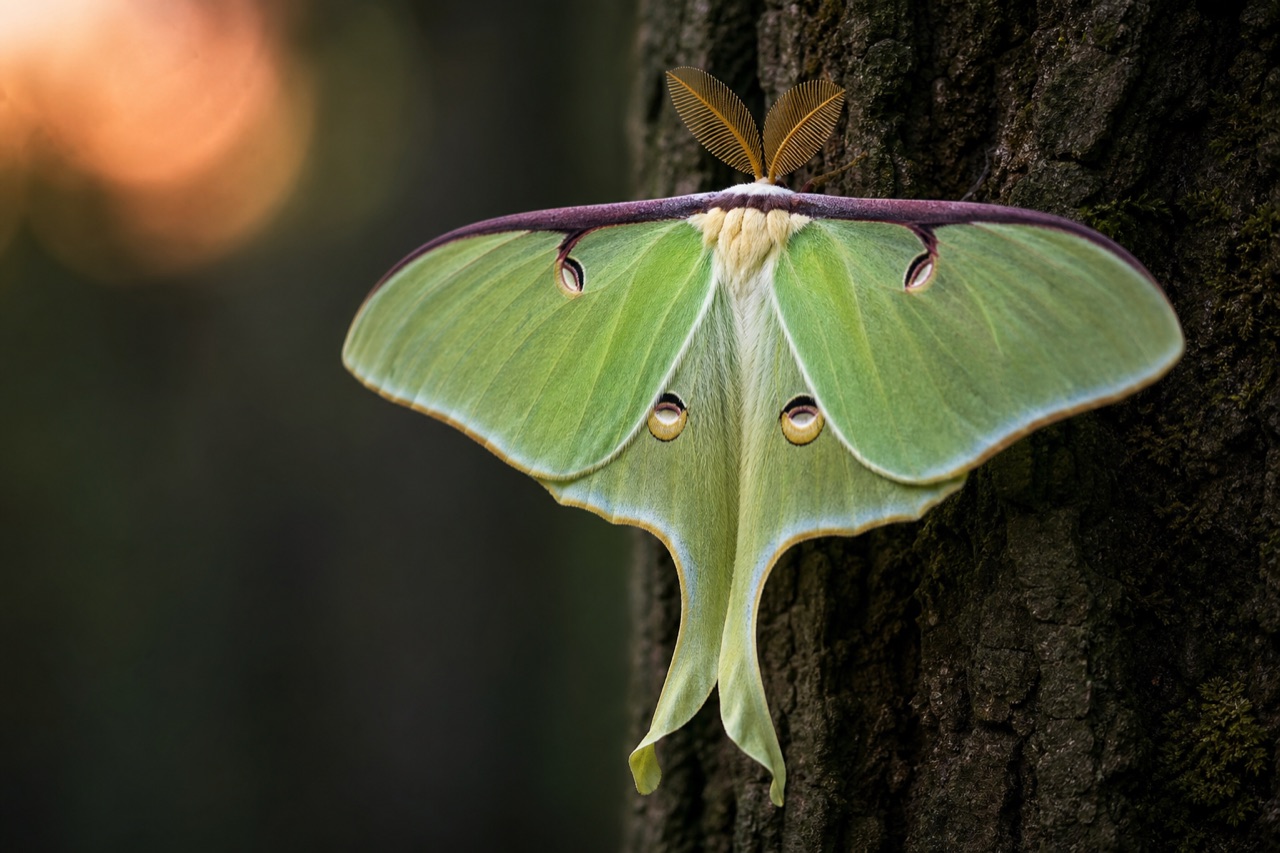
AI-generated educational wildlife portrait — World Animal Rescue Network · AI visualisation, not a photograph
In brief
Moths are the roughly 160,000 lepidopteran species that are not butterflies; most fly at night, they carry out substantial unrecorded pollination, and their caterpillars are the primary food for nestling birds.
Also in Animals A to Z · Animals that start with M
By WARN Research & Conservation Team Last updated
Moths are, numerically, what Lepidoptera actually is: roughly 160,000 described species against about 19,000 butterflies, and probably several times that number still undescribed. They are not a natural group — 'moth' simply means every lepidopteran branch that is not a butterfly — which is why no clean rule separates the two. Most fly at night, navigating by scent and celestial cues, and carry out a large share of pollination that goes unrecorded because nobody is watching after dark. Their caterpillars are the single most important food source for insectivorous birds raising chicks. Where moth numbers fall, bird breeding success follows.
~160,000
Described moth species — about 9 for every butterfly
Up to 11 km
Distance a male moth can track a female's pheromone
~30 cm
Wingspan of the largest species (Thysania agrippina)
6,000–9,000
Caterpillars a single pair of tits may feed one brood
Figures sourced from IUCN Red List, GBIF — Lepidoptera .
Moth: Quick Facts
| Described species | ~160,000 |
|---|---|
| Ratio to butterflies | About 9 moths per butterfly species |
| Mate detection | Pheromone plumes tracked over kilometres |
| Largest wingspan | ~30 cm (white witch, Thysania agrippina) |
| Ecological role | Night pollination; caterpillars feed nestling birds |
| Key pressure | Artificial light at night, habitat loss, pesticides |
Scientific Classification
| Kingdom | Animalia |
|---|---|
| Phylum | Arthropoda |
| Class | Insecta |
| Order | Lepidoptera |
| Note | 'Moth' = all Lepidoptera outside the butterfly superfamily Papilionoidea |
| Major families | Noctuidae, Geometridae, Erebidae, Sphingidae, Saturniidae |
Conservation Status
- IUCN Status
- Varies by species — group page
- Population
- Not applicable at group level
- Trend
- Substantial declines in biomass and species abundance in monitored regions
- Assessed
- Assessed species-by-species; the vast majority are unassessed
- CITES
- Not listed at group level
Long-running light-trap datasets, mostly European, provide some of the strongest evidence available for insect decline.
Did you know?
A male emperor moth can track a single female's scent from several kilometres downwind, using antennae carrying tens of thousands of pheromone receptors.
Key Facts: Moth
- Moths outnumber butterflies roughly nine to one and do not form a single taxonomic group.
- Male moths locate females by pheromone, in some species from many kilometres away.
- Night-flying moths are significant pollinators, particularly of pale, strongly scented flowers.
- Moth caterpillars are the primary protein source for most nestling songbirds.
- Artificial light at night disrupts moth navigation, feeding and breeding — a well-evidenced driver of decline.
- Only a handful of species damage clothing, and it is the larvae, not the adults, that feed on fibres.
Why 'moth' is not a real group
Lepidoptera splits into many lineages. Butterflies (Papilionoidea) form one of them; everything else gets called a moth. That means moths are a paraphyletic grab-bag, and the familiar distinguishing rules — night flight, feathery antennae, wings held flat, drab colour — all have abundant exceptions.
Day-flying moths are common and often brilliantly coloured. Some moths have clubbed antennae. Plenty of butterflies are dull brown. The only reliable approach is family-level identification, which is why moth recording is a specialist skill and why so many species remain unrecorded.
The night shift, and the bird-food question
Moths pollinate a substantial number of plants, favouring pale, tubular, night-scented flowers — honeysuckle, evening primrose, jasmine, tobacco plant. Because pollination studies have historically run in daylight, this contribution has been consistently underestimated; pollen-load studies on moths have shown far wider plant networks than expected.
The bigger ecological role is as food. Nestling songbirds are fed almost entirely on caterpillars, and moth larvae make up the bulk. A single pair of blue tits may deliver several thousand caterpillars to one brood. Declines in moth abundance propagate straight into bird breeding success, which is why farmland bird trends and moth trends track one another.
Clothes moths, and moths in the garden
Of roughly 160,000 species, a very small number damage textiles — principally the common clothes moth and the case-bearing clothes moth. The adults do not eat fabric at all; the larvae do, feeding on keratin in wool, silk, fur and feathers. Control is physical: cleaning, freezing, sealed storage and disruption, since larvae favour undisturbed, soiled material.
For everything else, moths are worth encouraging. Night-scented flowers, a long unmown season, native trees and shrubs for larvae, leaf litter left in place for pupae, and — the cheapest single intervention — turning off or shielding outdoor lighting and using warm-toned, downward-directed lamps.
What WARN Does
WARN publishes free, sourced species education across the whole of animal life, including the groups that carry ecosystems without ever attracting attention. Moth decline is a quiet driver of visible bird decline, and light pollution is one of the very few conservation problems an individual household can meaningfully reduce overnight.
If this guide helps you understand wildlife and the pressures it faces, a gift to WARN supports habitat protection and free public education in our partner countries.
Moth: Frequently Asked Questions
What is the difference between a moth and a butterfly?
Why are moths attracted to light?
Are moths important pollinators?
Do moths eat clothes?
Where do moths live?
Are moths dangerous?
How long do moths live?
How big is a moth?
What do moths eat?
Sources & References
Population figures, conservation status and biological facts on this page are drawn from authoritative scientific and intergovernmental sources.
Explore more animals
Discover more animals, their habitats and their conservation status in the WARN wildlife-guide library.
Enjoyed this Moth guide?
Receive appeal updates, animal-welfare news and published funding reports. Unsubscribe any time.
We only use your address for WARN updates. See our privacy policy.