Wildlife Guide · North America & Central America — Mexican overwintering forests
Monarch Butterfly
Danaus plexippus (Linnaeus, 1758) — family Nymphalidae, subfamily Danainae
The insect that migrates further than most birds — and needs milkweed to exist at all.
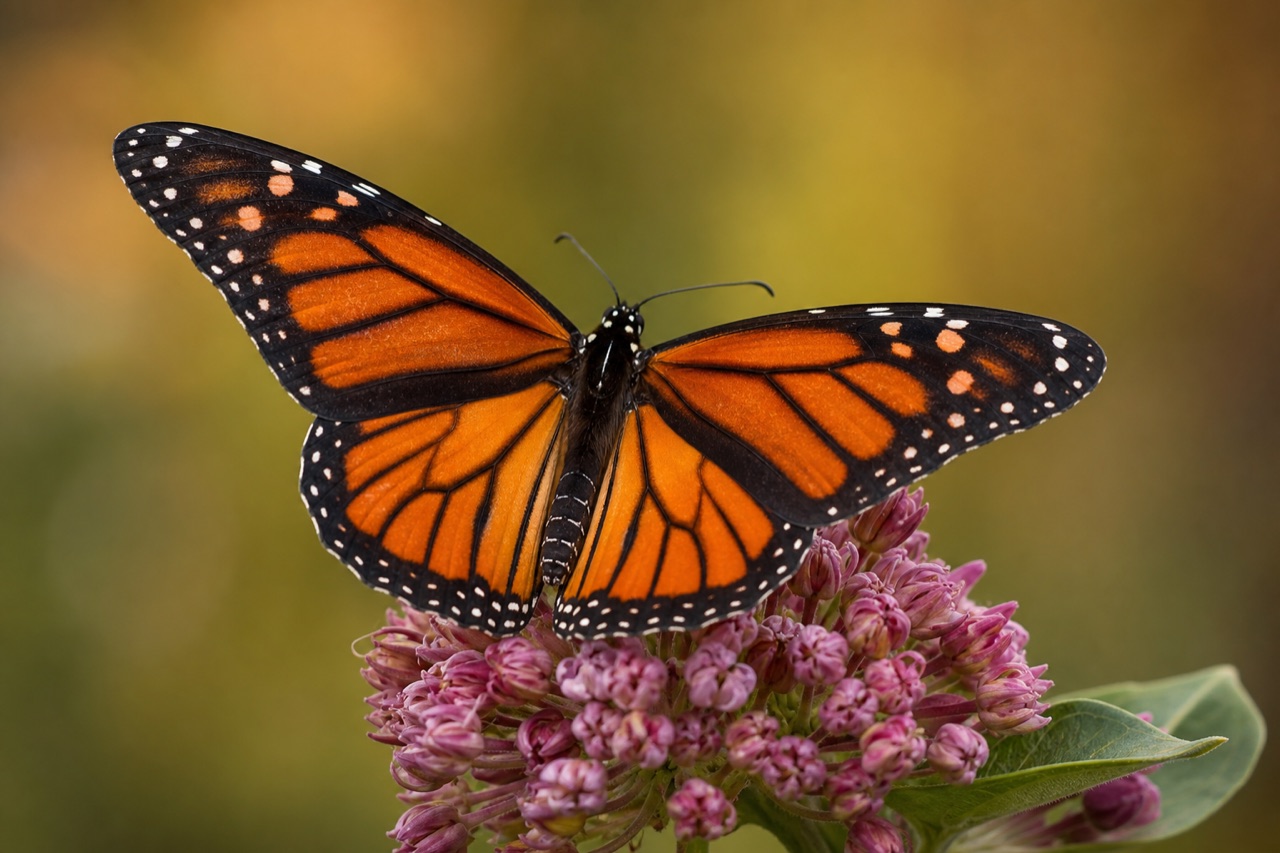
AI-generated educational wildlife portrait — World Animal Rescue Network · AI visualisation, not a photograph
In brief
The monarch butterfly (Danaus plexippus) is an orange-and-black North American butterfly whose migratory population travels up to 4,000 km to overwinter in Mexican fir forests; the migratory subspecies is listed Vulnerable, and it breeds only on milkweed.
Also in Animals A to Z · Animals that start with M
How you can help
You can support the related appeal — read its purpose, recipient status and fund terms first — or give once to where it is needed most. Sharing accurate information helps too.
By WARN Research & Conservation Team Last updated
The monarch is the most recognisable butterfly on Earth: deep orange wings veined and bordered in black, with white flecks along the margin. What makes it extraordinary is not the colour but the journey. Monarchs east of the Rocky Mountains fly up to 4,000 km each autumn to a handful of oyamel fir forests in central Mexico, cluster there through winter in their millions, and head north again in spring. No single butterfly completes the round trip — it takes three to four generations, and the insects that arrive in Mexico have never been there before. The monarch's whole life depends on one plant group. Females lay only on milkweed (Asclepias), caterpillars eat only milkweed, and the cardenolide toxins they take from it make both caterpillar and adult unpalatable to birds. Remove milkweed from the landscape and the monarch has nowhere to breed, however many nectar flowers remain.
4,000 km
Maximum autumn migration distance
3–4
Generations needed for one full migration cycle
~8 months
Lifespan of the overwintering generation (vs 2–6 weeks)
1 plant genus
Milkweed (Asclepias) — the only larval food
Figures sourced from IUCN Red List — Danaus plexippus plexippus, IUCN Red List — Danaus plexippus .
Monarch Butterfly: Quick Facts
| Wingspan | 8.9–10.2 cm |
|---|---|
| Larval food plant | Milkweed (Asclepias spp.) only |
| Migration | Up to 4,000 km, eastern North America |
| Overwintering | Oyamel fir forest, central Mexico (~3,000 m) |
| Defence | Sequestered cardiac glycosides; aposematic colouring |
| Egg to adult | About 30 days |
Scientific Classification
| Kingdom | Animalia |
|---|---|
| Phylum | Arthropoda |
| Class | Insecta |
| Order | Lepidoptera |
| Family | Nymphalidae |
| Genus | Danaus |
| Species | Danaus plexippus |
Conservation Status
- IUCN Status
- Vulnerable (migratory subspecies) / Least Concern (species)
- Population
- Overwintering area is the standard index; counts fluctuate sharply between years
- Trend
- Long-term decline in the migratory North American population
- Assessed
- 2022 (migratory monarch); species reassessed Least Concern
- CITES
- Not listed
Monarch abundance is reported as hectares of occupied overwintering forest rather than as a headcount. Single-season swings are large, so trends matter more than any one year.
Did you know?
A monarch that has never left Canada can find a specific grove of fir trees in Mexico its great-grandparents left the previous spring.
Key Facts: Monarch Butterfly
- Monarchs are famous for migration, but their limiting factor is milkweed, the only plant their caterpillars can eat.
- The migratory subspecies is assessed Vulnerable; monarchs as a species remain widespread and Least Concern.
- The overwintering generation lives around eight months — roughly ten times longer than a summer monarch.
- Caterpillars sequester milkweed toxins, which is why the adult's warning colours work.
- Overwintering sites are tiny in area, so forest loss or a severe storm can hit a huge share of the population at once.
- Planting locally native milkweed and pesticide-free nectar flowers is the single most useful thing a garden can do for them.
The migration, generation by generation
Monarchs east of the Rockies funnel south each autumn to roughly a dozen oyamel fir groves in Michoacán and the State of México, at around 3,000 m altitude. The cool, humid mountain air keeps them in a low-energy state without freezing them. Western monarchs make a shorter journey to coastal groves in California.
The butterflies that fly south are a distinct 'super generation' — reproductively delayed and long-lived. In spring they head north, breed on emerging milkweed and die; their offspring continue north, and so on, until autumn triggers another super generation. Each individual is navigating a route it has never flown, using a time-compensated sun compass and, in cloud, a magnetic sense.
Milkweed: the whole story in one plant
A female monarch lays single eggs on the underside of milkweed leaves. The caterpillar hatches, eats the leaf and grows through five instars in about two weeks, taking in cardiac glycosides that make it toxic to most vertebrate predators. It then pupates into a jade-green chrysalis rimmed with gold, and emerges as an adult roughly ten days later.
This is why milkweed availability, not nectar availability, drives monarch numbers. Agricultural intensification, roadside spraying and herbicide-tolerant cropping have removed enormous areas of milkweed from the North American breeding range. Adults will feed on many flowers; caterpillars will starve on anything but Asclepias.
Why the numbers fell
Three pressures stack. Breeding-habitat loss removes milkweed. Overwintering-habitat loss and degradation — illegal logging, thinning that breaks the forest microclimate — puts the whole eastern population at risk in a very small area. And climate volatility brings storms, freezes and droughts that can kill millions of clustered butterflies in a single event, or shift the timing of milkweed emergence out of step with arriving monarchs.
Insecticides, particularly systemic neonicotinoids present in plant tissue, add a further pressure on both caterpillars and adults. Counts fluctuate sharply year to year, so single-season figures should be read as part of a trend, not as a verdict.
What actually helps
Plant milkweed native to your own region — not tropical milkweed outside its range, which can keep monarchs breeding too late in the season and sustain the parasite Ophryocystis elektroscirrha. Pair it with a long succession of pesticide-free nectar flowers so migrating adults can refuel.
Beyond the garden, the leverage is in protecting overwintering forest, keeping field margins and roadside verges unsprayed, and supporting the community forestry that makes protection viable for people living beside the reserves. Captive rearing and mass release is popular but contested: it can spread disease and does nothing about the missing habitat.
What WARN Does
WARN publishes free, sourced wildlife education so that the animals people already love become an entry point into the pressures facing wildlife everywhere. Insect decline is the least visible part of the biodiversity crisis and the part most directly shaped by everyday choices — what gets planted, what gets sprayed and what gets left alone.
If this guide helps you understand wildlife and the pressures it faces, a gift to WARN supports habitat protection and free public education in our partner countries.
How can I help save the monarch butterfly?
Explore practical ways to support the monarch butterfly, from everyday choices and sharing reliable information to reviewing a related appeal before giving.
Explore ways to support
Read the related appeal’s purpose, recipient status and fund terms. Choose an affordable gift after checking what is proposed and what has been reported.
Ease the pressures
Avoid the wildlife trade and souvenirs, never buy wild animals as pets, and choose sustainable, habitat-friendly products — the threats behind the monarch butterfly's decline fall when demand does.
Spread the word
Share accurate, sourced information about the monarch butterfly. Wider awareness is what turns concern into lasting protection.
Monarch Butterfly: Frequently Asked Questions
How can I help save the monarch butterfly?
Are monarch butterflies endangered?
Why do monarch caterpillars only eat milkweed?
How far do monarch butterflies migrate?
How long do monarch butterflies live?
What is the best way to help monarch butterflies?
What do monarchs eat?
Where do monarchs live?
Are monarchs dangerous?
How big is a monarch?
Sources & References
Population figures, conservation status and biological facts on this page are drawn from authoritative scientific and intergovernmental sources.
Terms used on this page
Plain-English definitions, from our wildlife and conservation glossary.
Latest Monarch Butterfly Stories
Quick, fact-checked reads on the monarch butterfly — amazing facts, key questions and the threats it faces.
Species
12 Amazing Facts About Grey Wolves (And Why Alpha Wolves Aren't Real)
A howl that carries 16 km, a pack that is really a family, and the debunked study behind the 'alpha wolf' myth. Twelve verified facts.
Read the storySpecies
12 Amazing Facts About Beavers (Iron in Their Teeth, and They Rebuild Rivers)
Orange iron-hardened incisors, transparent eyelids, and a keystone role that reduces flooding and drought. Twelve facts.
Read the storySpecies
12 Amazing Facts About Wolverines (They Take Down Prey Five Times Their Size)
Frost-resistant fur, jaws that crush frozen bone, and territories the size of small countries. Twelve verified facts.
Read the storyExplore more animals
Discover more animals, their habitats and their conservation status in the WARN wildlife-guide library.
Enjoyed this Monarch Butterfly guide?
Receive appeal updates, animal-welfare news and published funding reports. Unsubscribe any time.
We only use your address for WARN updates. See our privacy policy.