Wildlife Guide · Madagascar & Eastern lowland forest floor
Madagascar Hissing Cockroach
Gromphadorhina portentosa (Schaum, 1853) — family Blaberidae
The cockroach that hisses through its spiracles — and gives birth to live young.
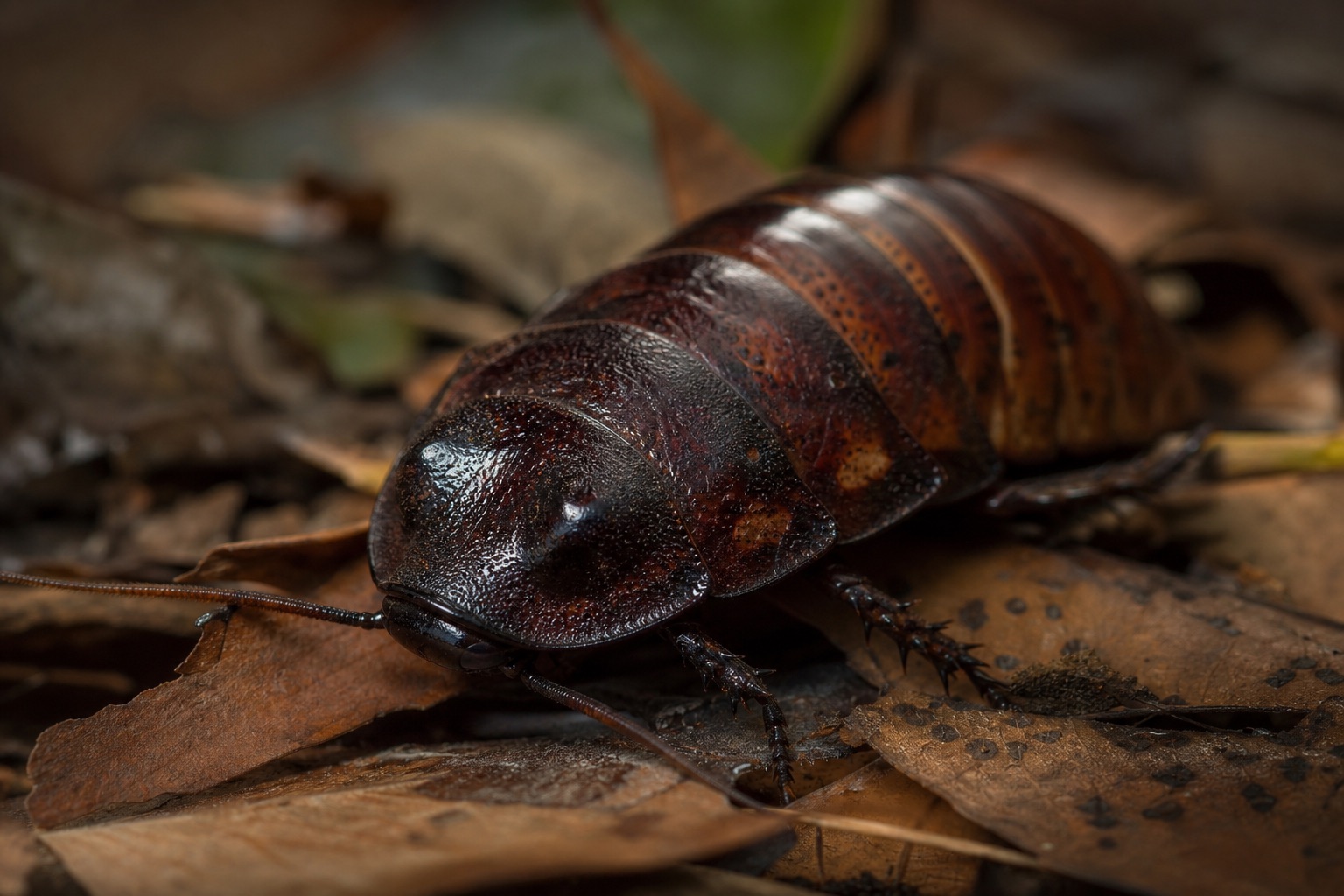
AI-generated educational wildlife portrait — World Animal Rescue Network · AI visualisation, not a photograph
In brief
The Madagascar hissing cockroach (Gromphadorhina portentosa) is a large wingless cockroach endemic to Madagascar that hisses by forcing air through spiracles and gives birth to live young; it is Least Concern but loses forest floor habitat as an estimated 80–90% of the island's original forest has been lost.
Also in Animals A to Z · Animals that start with M
By WARN Research & Conservation Team Last updated
The Madagascar hissing cockroach is a large, wingless cockroach endemic to the island's eastern lowland forest floor. It is among the most familiar Malagasy invertebrates worldwide — not because tourists encounter it often in the wild, but because it is kept in zoos, classrooms and pet collections across the globe. What makes it distinctive is the hiss. Most insects that hiss do so by rubbing body parts together — stridulation. The Madagascar hissing cockroach forces air through modified spiracles, the breathing pores along its abdomen, producing a sound without any rubbing. It is also ovoviviparous: the female retains eggs inside a brood pouch and gives birth to live nymphs, a rarity among cockroaches. Madagascar holds roughly 90% vertebrate endemism, and this cockroach is part of an invertebrate fauna equally unique. An estimated 80–90% of the island's original forest has been lost, and while the species remains Least Concern in surviving forest, forest floor habitat continues to shrink through tavy and charcoal production driven by rural poverty.
Spiracles
Hiss produced by forcing air through breathing pores — not stridulation
Live young
Ovoviviparous — nymphs born from a brood pouch
~7 cm
Body length — among the largest cockroaches
~90%
Share of Madagascar's vertebrates found nowhere else
Figures sourced from GBIF — Gromphadorhina portentosa, Encyclopedia of Life — Gromphadorhina portentosa .
Madagascar Hissing Cockroach: Quick Facts
| Length | Up to about 7 cm |
|---|---|
| Hiss mechanism | Air forced through abdominal spiracles |
| Reproduction | Ovoviviparous — live nymphs born |
| Wings | Wingless |
| Habitat | Eastern lowland forest floor, Madagascar |
| Main threats | Forest loss from tavy and charcoal production |
Scientific Classification
| Kingdom | Animalia |
|---|---|
| Phylum | Arthropoda |
| Class | Insecta |
| Order | Blattodea |
| Family | Blaberidae |
| Genus | Gromphadorhina |
| Species | Gromphadorhina portentosa |
Conservation Status
- IUCN Status
- Least Concern
- Population
- No estimate; common in remaining forest
- Trend
- Unknown; likely decreasing with forest loss
- Assessed
- Not formally assessed — treated as Least Concern
- CITES
- Not listed
Captive populations are abundant worldwide. Wild populations depend on forest floor habitat lost to tavy and charcoal — driven by rural poverty.
Did you know?
The Madagascar hissing cockroach is one of the few insects that hisses through its breathing holes — and one of the even fewer cockroaches that gives birth to live young rather than laying egg cases.
Key Facts: Madagascar Hissing Cockroach
- The Madagascar hissing cockroach hisses by forcing air through modified spiracles — not by rubbing body parts.
- Females are ovoviviparous: eggs hatch inside a brood pouch and live nymphs are born.
- The species is wingless, large — up to about 7 cm — and active on the forest floor at night.
- It is widely kept in captivity worldwide but endemic to Madagascar's eastern lowland forest.
- An estimated 80–90% of Madagascar's original forest has been lost; forest floor habitat continues to shrink.
- Tavy and charcoal production are driven by rural poverty — the context for forest loss across the island.
Hissing through spiracles
Most hissing insects — crickets, some beetles, the lowland streaked tenrec — stridulate by rubbing body parts together. The Madagascar hissing cockroach does something different. It forces air through the fourth spiracle on its abdomen, producing a hiss audible to human ears at close range.
Males hiss in three contexts: during fights with other males, when disturbed, and during courtship. Each context produces a slightly different hiss pattern. Because the sound comes from spiracles rather than stridulation, the cockroach can hiss repeatedly without the wear that rubbing structures would cause. It is a respiratory sound turned into communication — unusual even among cockroaches, and unique among hissing insects at this scale.
Live birth in a cockroach
Most cockroaches lay eggs in an ootheca — a hardened egg case deposited on a surface. The Madagascar hissing cockroach retains the ootheca inside a brood pouch, where eggs hatch and nymphs develop until the female gives birth to live young.
A female produces 30 to 60 nymphs in a brood, and nymphs take five to seven months to reach adulthood. Live birth reduces predation on exposed egg cases on the forest floor — a useful adaptation for an animal that lives in leaf litter where ground predators are abundant. It also makes captive breeding straightforward, which is why the species is so widely kept in zoos and education programmes.
Forest floor ecology
Madagascar hissing cockroaches are detritivores — they eat fallen fruit, decaying plant matter and organic debris on the forest floor. They are not pests of crops or stored food in their native habitat; they recycle nutrients in intact forest.
That ties them to forest floor habitat with leaf litter and humidity. Tavy clears the understorey and removes the litter layer. Charcoal production fells the trees that drop the fruit and leaves these cockroaches eat. An estimated 80–90% of Madagascar's original forest has been lost, and the forest floor community — including hissing cockroaches, tenrecs and leaf-litter geckos — loses ground with every cleared hectare.
Captivity, forest loss and the poverty context
The Madagascar hissing cockroach is probably the most exported Malagasy invertebrate in captivity — bred by the millions in laboratories and zoos worldwide. Captive populations are secure; wild populations depend on remaining forest.
Wild collection for the pet and education trade is minor compared with habitat loss. Tavy slash-and-burn and charcoal production remove forest across eastern Madagascar, driven by rural poverty and the lack of affordable cooking fuel — not by subsistence farmers acting without context. A Least Concern listing reflects current abundance in surviving forest, not long-term security on an island that has already lost most of its cover.
What WARN Does
WARN publishes free, sourced species education across Madagascar's fauna — including the invertebrates known worldwide from classroom terrariums but rarely understood in their forest context. Hissing cockroaches recycle leaf litter on a floor that tavy and charcoal production strip away.
If this guide helps you understand wildlife and the pressures it faces, a gift to WARN supports habitat protection and free public education in our partner countries.
Madagascar Hissing Cockroach: Frequently Asked Questions
How does the Madagascar hissing cockroach hiss?
Do Madagascar hissing cockroaches give live birth?
Are Madagascar hissing cockroaches endangered?
Can Madagascar hissing cockroaches fly?
What do Madagascar hissing cockroaches eat?
Why is Madagascar forest being cleared?
Where do madagascar hissing cockroachs live?
How long do madagascar hissing cockroachs live?
How big is a madagascar hissing cockroach?
Sources & References
Population figures, conservation status and biological facts on this page are drawn from authoritative scientific and intergovernmental sources.
Terms used on this page
Plain-English definitions, from our wildlife and conservation glossary.
Latest Madagascar Hissing Cockroach Stories
Quick, fact-checked reads on the madagascar hissing cockroach — amazing facts, key questions and the threats it faces.
Explore more animals
Discover more animals, their habitats and their conservation status in the WARN wildlife-guide library.
Enjoyed this Madagascar Hissing Cockroach guide?
Receive appeal updates, animal-welfare news and published funding reports. Unsubscribe any time.
We only use your address for WARN updates. See our privacy policy.