Wildlife Guide · Northern Europe & Russia
Lynx
Lynx lynx (Linnaeus, 1758)
Europe's largest cat — tufted, secretive and recovering across the north.
Source: Wikimedia Commons
In brief
The Eurasian lynx (Lynx lynx) is Europe's largest wild cat, listed as Least Concern by the IUCN; it inhabits boreal and temperate forests across Eurasia and has recovered in several western European countries after decades of persecution.
Also in Animals A to Z · Animals that start with L
By WARN Research & Conservation TeamLast updated
The Eurasian lynx is the largest of the four living lynx species and the biggest wild cat native to Europe. It ranges across boreal and temperate forests from Scandinavia and the Carpathians through Russia and Central Asia to the Himalayas. Secretive and mainly nocturnal, lynx are rarely seen despite a substantial population in some regions. Listed as Least Concern globally, the species has recolonised parts of western Europe thanks to legal protection and reintroduction programmes. The Iberian lynx and Canada lynx are separate, more threatened species covered by their own conservation programmes.
Least Concern
IUCN Red List status (2014 assessment)
18–30 kg
Typical adult weight (males heavier)
4 species
Living lynx: Eurasian, Iberian, Canada, bobcat
Appendix II
CITES listing
Figures sourced from IUCN Red List — Lynx lynx, IUCN Red List — Lynx pardinus (Iberian lynx), CITES — Checklist of CITES Species .
Lynx: Quick Facts
| Weight | 18–30 kg (Eurasian lynx) |
|---|---|
| Prey | Mainly roe deer; also hares and grouse |
| Distinctive features | Tufted ears, short tail, large paws |
| Activity | Mainly crepuscular and nocturnal |
| Lifespan | Up to ~17 years in the wild |
| CITES | Appendix II |
Scientific Classification
| Kingdom | Animalia |
|---|---|
| Phylum | Chordata |
| Class | Mammalia |
| Order | Carnivora |
| Family | Felidae |
| Genus | Lynx |
| Species | Lynx lynx (Linnaeus, 1758) |
Conservation Status
- IUCN Status
- Least Concern globally (IUCN, 2014). Iberian lynx (separate species) was Critically Endangered but is recovering.
- Population
- Roughly 50,000 Eurasian lynx; Iberian lynx exceeded 1,000 individuals by the 2020s after recovery efforts
- Trend
- Stable or increasing in much of Eurasia
- Assessed
- 2014
- CITES
- Appendix II
Iberian, Canada and bobcat are assessed as separate species.
Key Facts: Lynx
- The Eurasian lynx is the largest lynx species and Europe's biggest native cat.
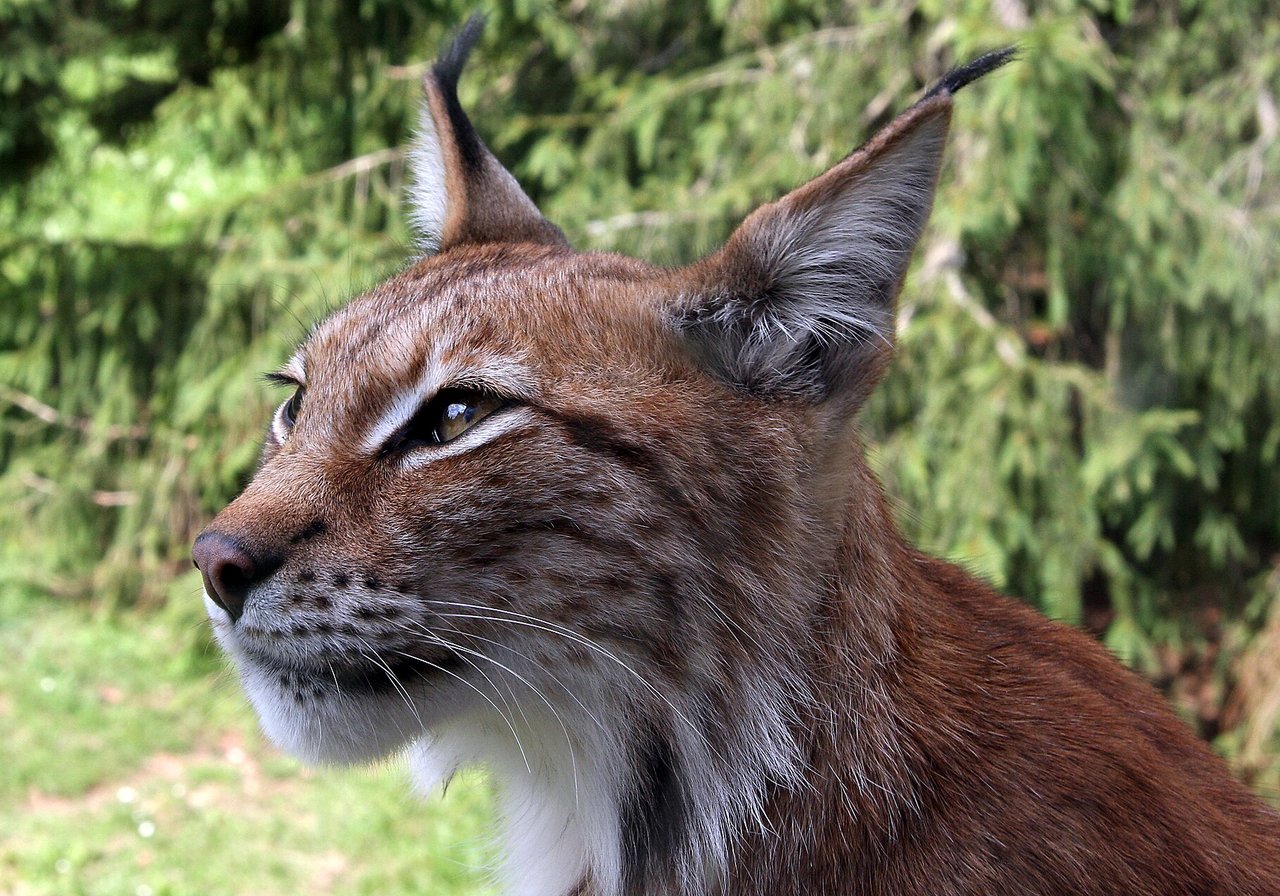
- Tufted ears, short tail and large snowshoe-like paws are characteristic lynx features.
- Lynx hunt mainly roe deer, hares and other medium-sized prey by ambush.
- The species has recolonised Switzerland, Slovenia and parts of France and Germany.
- The Iberian lynx is Critically Endangered — a separate, much rarer species.
- Human persecution and road mortality remain threats despite legal protection in the EU.
The four lynx species
Four lynx species survive today.
The Eurasian lynx (Lynx lynx) is the largest and most widespread, ranging across Europe and Asia. The Iberian lynx (Lynx pardinus) is confined to Spain and Portugal and was Critically Endangered before intensive recovery efforts. The Canada lynx (Lynx canadensis) depends on snowshoe hare cycles in North American boreal forest. The bobcat (Lynx rufus) is the smallest and most adaptable, ranging across much of North America. All share tufted ear tips, a short tail, a ruff of fur beneath the chin and large paws — adaptations for silent hunting in forest and snow.
Habitat and hunting
Eurasian lynx favour forested landscapes with sufficient cover and prey. Roe deer are the primary prey in much of Europe; in northern latitudes, lynx also take reindeer calves, hares and grouse.
They hunt by stealth, relying on short bursts of speed rather than long chases. Home ranges vary from roughly 100 km² for females to over 400 km² for males in prey-rich areas. Lynx are solitary except during breeding and when females raise kittens. Dens are often in rocky crevices or dense undergrowth; litters typically contain one to four kittens.
Recovery in western Europe
Lynx were eradicated from most of western Europe by the nineteenth century through hunting and habitat loss. Legal protection, forest regrowth and reintroduction programmes have reversed the decline in several countries. Switzerland, Slovenia, Croatia and the Carpathians now support breeding populations. France and Germany host small, expanding groups. Conflict with sheep farmers remains a political challenge; compensation schemes and livestock guarding dogs reduce retaliatory killing. Cross-border cooperation is essential because lynx ranges often span national frontiers.
Conservation outlook
The IUCN lists the Eurasian lynx as Least Concern with an estimated 50,000 individuals and a stable or increasing trend in much of its range. Road mortality, habitat fragmentation and illegal killing still suppress populations in some regions. CITES Appendix II regulates international trade. The Iberian lynx recovery — from fewer than 100 individuals in 2002 to over 1,000 by the 2020s — demonstrates what targeted conservation can achieve for lynx. Maintaining connected forest habitat and reducing human conflict remain priorities across the genus.
The Iberian lynx: the best recovery a cat species has ever had
In 2002 there were fewer than 100 Iberian lynx left alive. It was the most endangered cat in the world and was widely expected to become the first cat species driven to extinction since the sabre-tooths.
It did not. The 2024 census counted 2,401 individuals, including 1,557 adults and 470 breeding females — a 19% rise in a single year. In June 2024 the IUCN reassessed the species from Endangered down to Vulnerable, having already moved it off Critically Endangered earlier. The IUCN called it the greatest recovery of a cat species ever achieved.
What produced it was not one intervention but a stack of them held in place for two decades, largely through EU LIFE funding: captive breeding paired with carefully sited releases, restoration of the European rabbit populations the lynx almost exclusively eats, purchase and management of scrub habitat, road underpasses to cut vehicle deaths, and sustained agreements with the private landowners whose estates hold much of the remaining range.
It is not finished. Favourable conservation status is judged to need somewhere between 4,500 and 6,000 animals with at least 1,100 breeding females, so the species is roughly halfway. Rabbit disease outbreaks remain the single largest threat to the whole recovery, because a lynx population is only ever as secure as its prey base.
Should lynx be reintroduced to Britain?
The Eurasian lynx was native to Britain and disappeared several centuries ago through a combination of hunting and the loss of forest cover. The case for return rests on the fact that Britain has no large predator and a deer population big enough to suppress woodland regeneration.
The arguments against are practical rather than sentimental. Lynx do take sheep where sheep graze in or near woodland, and although the numbers recorded in European countries are modest, those losses fall on individual farms rather than being spread. Any credible proposal has to answer compensation and coexistence before it answers ecology.
The European experience is encouraging on the biology: lynx have re-established in the Alps, the Jura and the Vosges from small founder groups. It is equally clear on the politics — reintroductions done to communities rather than with them have produced persistent illegal killing, now a leading cause of death in several reintroduced populations.
WARN does not campaign for or against a British reintroduction. The honest summary is that the ecological question is largely settled and the social question is not.
Why lynx are so rarely seen
People who live inside lynx range routinely go decades without seeing one. That is not rarity alone; it is behaviour.
Lynx are solitary outside the breeding season and hold very large territories — a male Eurasian lynx may range across several hundred square kilometres. They are most active at dawn and dusk, they move through cover rather than across open ground, and a spotted coat breaks up their outline in dappled forest light almost perfectly.
They are also quiet. Unlike wolves they do not advertise their presence, and unlike bears they do not raid human food sources, so they leave very little trace near settlements. Most confirmed records in reintroduced European populations come from camera traps, snow tracking and genetic sampling rather than from sightings.
What lynx eat, and why the prey animal decides everything
Lynx are ambush hunters that stalk to within a few metres and finish with a short rush, which is why they need cover and why open farmland is effectively a barrier to them rather than a hunting ground.
The Eurasian lynx is primarily a deer hunter. Roe deer are the staple across most of its European range, supplemented by chamois in mountain areas and by hares, foxes and grouse where deer are scarce. A single lynx will typically kill a roe deer every week or so and return to the carcass over several days, which makes it vulnerable to having kills stolen by wolves, bears and, increasingly, by people removing carcasses.
The Iberian lynx went the opposite way and specialised. European rabbits make up the overwhelming majority of its diet — commonly cited at around 80 to 90% — and that single dependency explains most of the species' history. The collapse of Iberian rabbit populations through myxomatosis in the 1950s and rabbit haemorrhagic disease from the 1980s onwards is the principal reason the lynx nearly disappeared, far more than direct persecution.
It is also why the recovery had to begin with rabbits. Restocking lynx into landscapes without a rabbit population simply produces dead lynx, so a large share of the recovery budget went into rabbit habitat, warren construction and disease management before any cat was released. The general lesson holds well beyond Iberia: a predator cannot be conserved independently of what it eats.
The four lynx species compared
| Species | Range | Typical weight | IUCN status |
|---|---|---|---|
| Eurasian lynx (Lynx lynx) | Europe, Russia, Central Asia | 18–30 kg | Least Concern |
| Canada lynx (Lynx canadensis) | Canada, Alaska, northern USA | 8–11 kg | Least Concern |
| Bobcat (Lynx rufus) | USA, southern Canada, Mexico | 6–14 kg | Least Concern |
| Iberian lynx (Lynx pardinus) | Spain and Portugal | 9–13 kg | Vulnerable — downlisted in 2024 |
What WARN Does
WARN publishes this lynx guide as free public education. Our field work focuses on threatened species in partner countries; the Eurasian lynx illustrates how large carnivores can recover when persecution ends and forests are protected.
If this guide helps you understand wildlife and the pressures it faces, a gift to WARN supports habitat protection and free public education in our partner countries.
Lynx: Frequently Asked Questions
Why do lynx have tufted ears?
What sound does a lynx make?
Is the Iberian lynx still endangered?
Are lynx endangered?
Will lynx be reintroduced to Britain?
How many lynx species are there?
Are lynx dangerous to humans?
What do lynx eat?
Where do lynx live in Europe?
What is the difference between a lynx and a bobcat?
Is the Iberian lynx the same species?
How long do lynxs live?
How big is a lynx?
Sources & References
Population figures, conservation status and biological facts on this page are drawn from authoritative scientific and intergovernmental sources.
Terms used on this page
Plain-English definitions, from our wildlife and conservation glossary.
Latest Lynx Stories
Quick, fact-checked reads on the lynx — amazing facts, key questions and the threats it faces.
Species
Clouded Leopard vs Snow Leopard: Key Differences Between Two Misnamed Cats
Despite the shared name, neither cat is a true leopard, and they differ sharply in size, habitat and looks. Here is how to tell the clouded leopard from the snow leopard.
Read the storySpecies
How Big Is a Himalayan Brown Bear — and How Many Are Left?
How large, how long-lived, how many remain and whether they're dangerous: clear, sourced answers to the most-asked questions about the Himalayan brown bear.
Read the storySpecies
12 Amazing Facts About Sea Otters (The Densest Fur on Earth, and Tool Use)
A million hairs per square inch, a favourite rock kept in a pouch, and a keystone role holding kelp forests together.
Read the storyExplore more animals
Discover more animals, their habitats and their conservation status in the WARN wildlife-guide library.