Wildlife Guide · Native: Indo-Pacific coral reefs & Invasive: Western Atlantic, Caribbean and Gulf of Mexico since the 1980s
Lionfish
Genus Pterois — red lionfish P. volitans and devil firefish P. miles invasive in the Atlantic
A spectacular Indo-Pacific predator that became the textbook Atlantic invasive — venomous, fertile and unchecked.
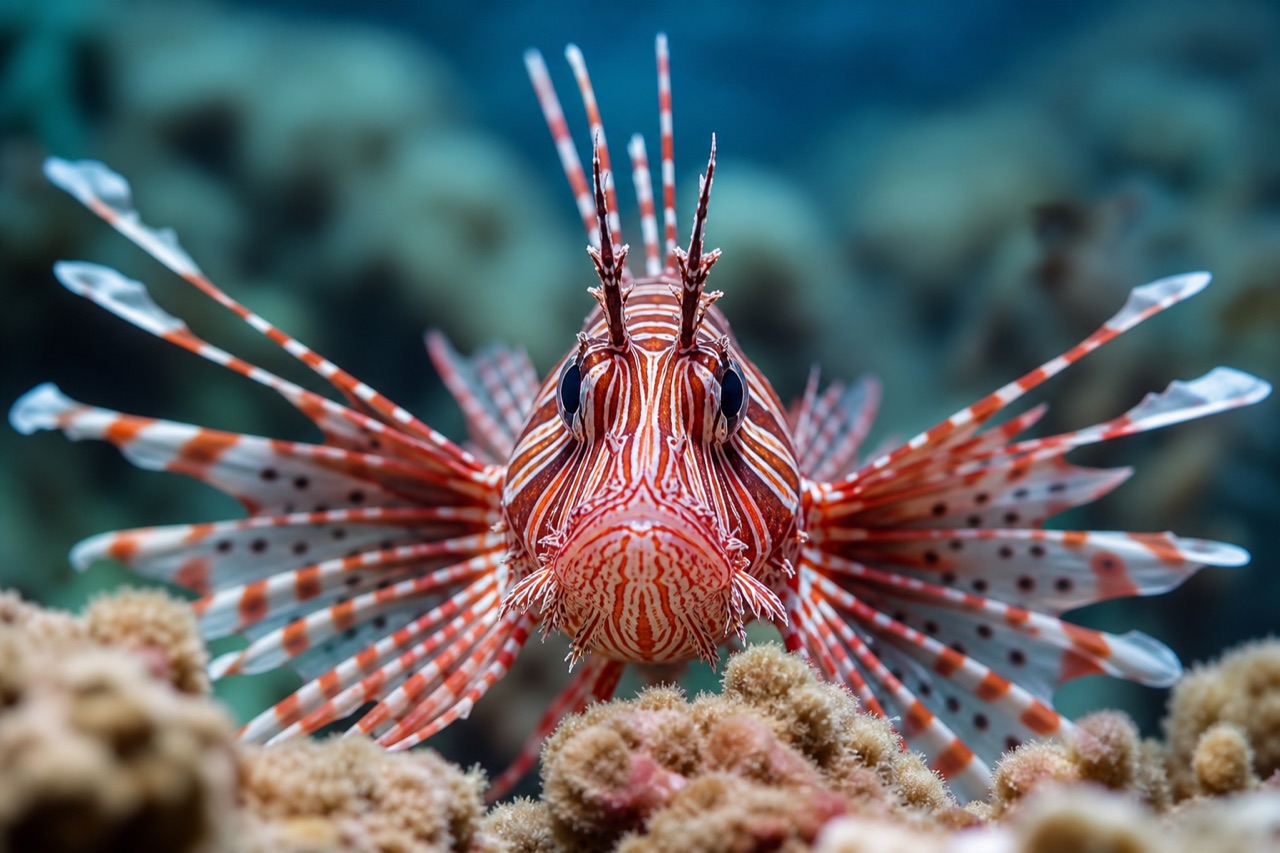
AI-generated educational wildlife portrait — World Animal Rescue Network · AI visualisation, not a photograph
In brief
Lionfish (genus Pterois) are venomous Indo-Pacific reef fish whose red lionfish and devil firefish became invasive in the Atlantic from the 1980s — unchecked by predators, they devastate native reef fish communities.
Also in Animals A to Z · Animals that start with L
By WARN Research & Conservation Team Last updated
Lionfish are venomous marine fish of the genus Pterois, recognised by bold striping, elaborate pectoral fins and dorsal spines that deliver a painful but rarely fatal sting. In the Indo-Pacific — their native range — lionfish are mesopredators on coral reefs, controlled by co-evolved predators and competitors. In the western Atlantic, Caribbean and Gulf of Mexico, they are among the most studied marine invasions of the modern era. Red lionfish (Pterois volitans) and devil firefish (P. miles) were first recorded off Florida in the 1980s, likely from aquarium releases. Without native predators that recognise them as food, populations exploded. Lionfish eat small reef fish and juvenile stages of commercially important species; a single individual can consume dozens of prey fish daily. They mature early, reproduce year-round in warm water and produce buoyant egg masses that spread larvae on currents. The Atlantic invasion is a case study in invasion biology: rapid range expansion, ecological impact on reef fish communities, economic cost to fisheries and tourism, and management through human harvest, derbies and attempted predator training. Native-range lionfish are Least Concern; Atlantic lionfish are not a separate species but a harmful population of the same animals in the wrong ocean. Caribbean reef fisheries already stressed by overfishing and coral bleaching face an additional mesopredator that eats juvenile grouper and snapper before they recruit to adult stocks — lionfish impact stacks on existing pressures rather than replacing them. Restaurant menus featuring lionfish in Florida and the Caribbean began as novelty and became a sustained harvest incentive — one of the few invasions where eating the invader is genuinely part of the management toolbox rather than a gimmick alone. Training grouper and sharks to accept lionfish as prey in controlled experiments showed promise but does not scale to reef-wide predator re-education; harvest remains the practical Atlantic tool for now. Citizen science reporting of lionfish sightings helps map invasion fronts and target derby events where they matter most rather than where tourism already concentrates effort.
1980s
First Atlantic records — likely aquarium releases
Year-round
Reproduction in warm Atlantic waters
Venomous
Dorsal, anal and pelvic spines — painful sting
No predators
Atlantic reef predators did not evolve to hunt them
Figures sourced from IUCN Red List — Pterois volitans, NOAA — invasive lionfish .
Lionfish: Quick Facts
| Invasive species | Pterois volitans, P. miles |
|---|---|
| Native range | Indo-Pacific |
| Atlantic arrival | 1980s off Florida |
| Impact | Reduced native reef fish biomass |
| Control | Spearfishing, derbies, food markets |
| Native IUCN status | Least Concern |
Scientific Classification
| Kingdom | Animalia |
|---|---|
| Phylum | Chordata |
| Class | Actinopterygii |
| Order | Scorpaeniformes |
| Family | Scorpaenidae |
| Genus | Pterois — P. volitans and P. miles in Atlantic invasion |
Conservation Status
- IUCN Status
- Least Concern
- Population
- Abundant in native Indo-Pacific; explosively dense in invaded Atlantic
- Trend
- Increasing in Atlantic invasion range; stable in native range
- Assessed
- 2016
- CITES
- Not listed
IUCN assessment reflects native Indo-Pacific status. Atlantic invasion is an ecological and economic crisis managed separately from Red List categorisation.
Did you know?
A single invasive lionfish can eat dozens of small reef fish in a day — and Atlantic predators did not evolve to treat it as food, which is why populations exploded.
Key Facts: Lionfish
- Red lionfish (P. volitans) and devil firefish (P. miles) are invasive in the Atlantic and Caribbean.
- Likely introduced via aquarium trade releases off Florida in the 1980s.
- Atlantic populations grow rapidly — early maturity, continuous breeding, planktonic larvae.
- They reduce native reef fish biomass by heavy predation on juveniles and small species.
- Venomous spines deter Atlantic predators; human harvest and lionfish derbies are management tools.
- Native Indo-Pacific populations are Least Concern; the invasion is a western Atlantic crisis.
How lionfish reached the wrong ocean
The leading hypothesis is deliberate or accidental release of aquarium fish off southern Florida, with first confirmed Atlantic records in the mid-1980s. Genetic analysis points to a small founder population — consistent with a handful of releases rather than gradual natural dispersal, which is impossible across the Atlantic from the Indo-Pacific.
Warm Gulf Stream currents spread larvae north along the US East Coast and into the Caribbean. By the 2000s, lionfish occurred from Rhode Island in summer warm spells to Venezuela, including Bermuda and the Bahamas. Depth records extend beyond recreational diving limits on some reefs, complicating removal.
Ballast water and ship-mediated spread are secondary compared with larval drift once establishment occurred. The lesson for the aquarium trade is stark: tropical marine ornamentals released in suitable climate can founder entire regional ecosystems.
Ecological impact on Atlantic reefs
Lionfish are generalist carnivores with a vacuum-cleaner feeding mode — they corner prey against reef structure and swallow anything that fits. Diet studies across the Atlantic show consumption of dozens of fish species plus crustaceans, including juveniles of grouper, snapper and parrotfish that maintain reef function.
Population densities on invaded reefs can exceed native Pacific densities because predation pressure is absent. Native groupers and sharks can learn to eat lionfish where fishing has left large predators present, but recovery of top predators is slow and geographically patchy. Lionfish compete with native mesopredators for food and territory, often winning through lower fear and high reproductive output.
Measurable declines in native fish biomass followed lionfish arrival at multiple monitored sites. Recovery of native fish where sustained lionfish removal occurs suggests impact is reversible locally if effort continues — but effort rarely scales to entire coastlines.
Venom, stings and human interaction
Lionfish spines — dorsal, anal and pelvic — deliver venom from glands at the spine base. Stings cause intense pain, swelling and nausea; systemic effects are uncommon in healthy adults but possible. Heat denatures the protein venom; immersion in hot water is standard first aid alongside wound care and tetanus consideration.
For divers and anglers, sting risk is handling after capture. Spearfishing lionfish is a promoted control method using specialised equipment; puncture-resistant gloves and shears to trim spines before handling are standard practice. Restaurants and markets in invaded areas promote lionfish as food — white flaky flesh with no residual venom in the fillet — linking cuisine to control.
Tourism messaging mixes caution with opportunity: lionfish are beautiful and dangerous, edible and invasive. The narrative supports harvest without pretending recreational spearing alone will eradicate Atlantic populations.
Management lessons from an ongoing invasion
Complete eradication in the open Atlantic is not considered feasible. Management goals are local biomass reduction at high-value sites — marine reserves, tourist reefs, spawning aggregation areas — and building markets for lionfish as food to sustain commercial and recreational harvest.
Lionfish derbies — organised spearfishing competitions — remove thousands in a day at hotspot locations and raise public awareness. Continuous removal by dive operators on frequented sites can keep densities low enough for native juvenile fish to persist, but larvae reseed from deeper and less visited areas.
Policy responses include banning import of lionfish where still legal, early detection networks for new invasions elsewhere, and research on bio control — none deployed safely at scale. The Atlantic lionfish case is now taught as standard invasion ecology: lag phase, explosion, impact, permanent management rather than cure. Preventing the next Pterois introduction matters as much as continuing to spearfishing this one.
Native Indo-Pacific lionfish versus Atlantic invaders
In native range — coral reefs from the Red Sea to the Pacific — lionfish populations are controlled by co-evolved predators including large groupers, moray eels and reef sharks, plus competition from native mesopredators. Densities are lower; impacts on reef fish communities are within historical dynamics.
The same species behaving invasively in the Atlantic is a lesson in release geography, not biology changed. P. volitans and P. miles did not become super-fish; they entered a food web without adapted enemies. Caribbean grouper overfishing further removed potential predators.
Early detection protocols now watch for lionfish outside native range — Mediterranean, Brazil, Pacific coasts — because the Atlantic catastrophe demonstrated lag between introduction and explosion. Rapid response at incipient stages is the only scenario where eradication remains plausible.
What WARN Does
WARN publishes free, sourced species education including invasion case studies that explain why aquarium release is not harmless. Lionfish in the Atlantic are the same species doing fine at home — the disaster is geographic, not taxonomic.
If this guide helps you understand wildlife and the pressures it faces, a gift to WARN supports habitat protection and free public education in our partner countries.
Lionfish: Frequently Asked Questions
Are lionfish invasive?
How did lionfish get to the Atlantic?
Are lionfish venomous?
Why are lionfish a problem in the Atlantic?
Where do lionfish live?
Are lionfish dangerous?
How long do lionfish live?
How big is a lionfish?
What do lionfish eat?
Sources & References
Population figures, conservation status and biological facts on this page are drawn from authoritative scientific and intergovernmental sources.
Terms used on this page
Plain-English definitions, from our wildlife and conservation glossary.
Explore more animals
Discover more animals, their habitats and their conservation status in the WARN wildlife-guide library.
Enjoyed this Lionfish guide?
Receive appeal updates, animal-welfare news and published funding reports. Unsubscribe any time.
We only use your address for WARN updates. See our privacy policy.