Wildlife Guide · All tropical and temperate oceans & Feeds as far north as Norway and Alaska
Leatherback Turtle
Dermochelys coriacea (Vandelli, 1761) — family Dermochelyidae
A reptile that dives to 1,200 metres, swims into Arctic water, and eats almost nothing but jellyfish.
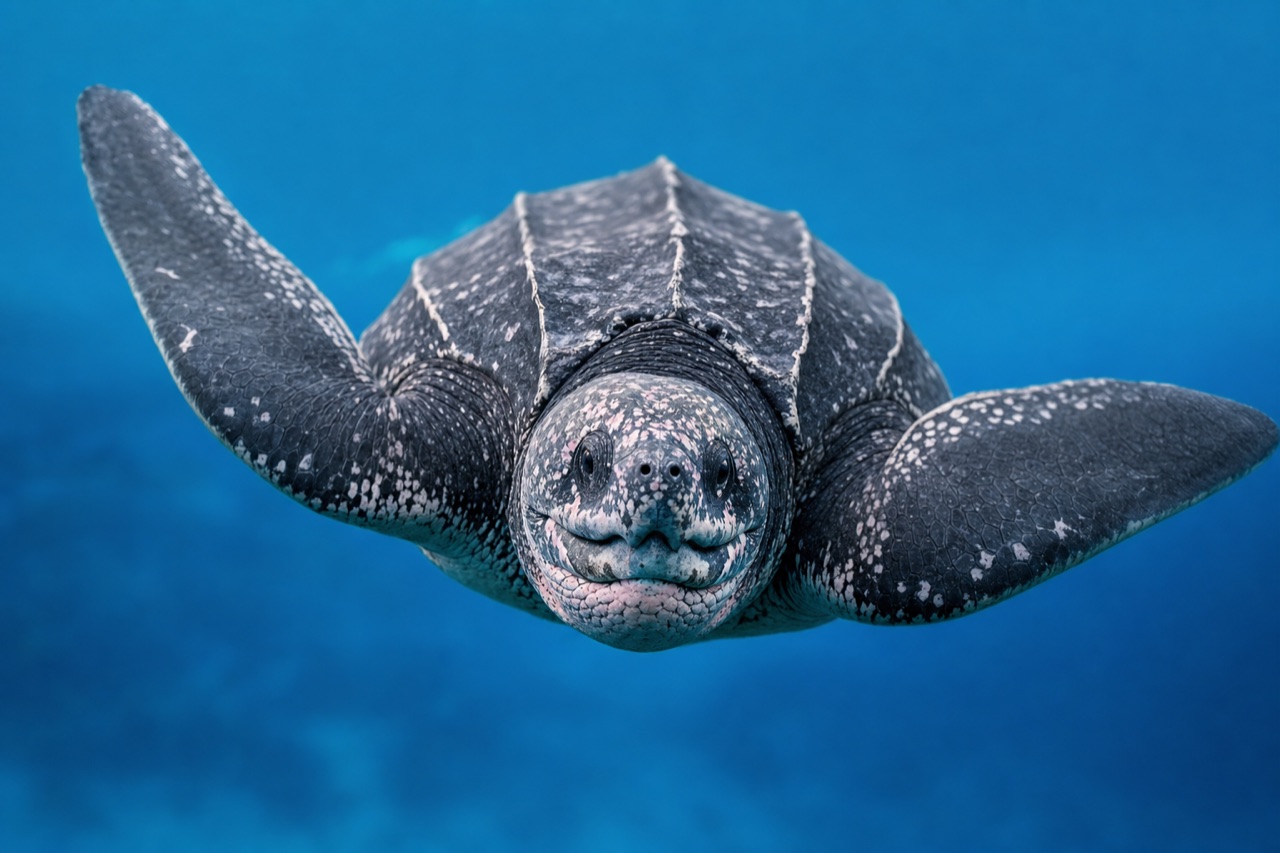
AI-generated educational wildlife portrait — World Animal Rescue Network · AI visualisation, not a photograph
In brief
The leatherback is the world's largest turtle at up to 700 kg, the only sea turtle without a hard shell, and the deepest-diving reptile at over 1,200 m; it feeds almost entirely on jellyfish and is Vulnerable globally, with Pacific subpopulations Critically Endangered.
Also in Animals A to Z · Animals that start with L
How you can help
You can support the related appeal — read its purpose, recipient status and fund terms first — or give once to where it is needed most. Sharing accurate information helps too.
By WARN Research & Conservation Team Last updated
The leatherback is the largest turtle alive and the strangest. It has no hard shell — the carapace is a leathery, oil-saturated skin over a mosaic of small bone plates — and it is the only surviving member of its family, a lineage separated from all other sea turtles for over 100 million years. It does things no other reptile does. It dives past 1,200 metres, deeper than most whales. It swims in water near freezing, maintaining a body temperature well above the sea around it. It migrates further than any other reptile, crossing entire ocean basins. And it lives almost entirely on jellyfish — a diet so low in energy that it must eat a huge daily volume, which is precisely why floating plastic is so dangerous to it.
916 kg
Heaviest recorded individual — the largest turtle ever measured
1,280 m
Deepest recorded dive — deeper than most whales
~16,000 km
Longest recorded migration, Indonesia to the US west coast
100+ million yr
Since the leatherback lineage split from other sea turtles
Figures sourced from IUCN Red List — Dermochelys coriacea, NOAA Fisheries — Leatherback turtle, CITES Appendices .
Leatherback Turtle: Quick Facts
| Maximum weight | 916 kg recorded; typically up to ~700 kg |
|---|---|
| Deepest dive | 1,280 m |
| Longest migration | Around 16,000 km |
| Diet | Almost entirely jellyfish and gelatinous plankton |
| Shell | Leathery skin over small bone plates — no hard carapace |
| Main threats | Fisheries bycatch, plastic ingestion, egg harvesting, beach loss |
Scientific Classification
| Kingdom | Animalia |
|---|---|
| Phylum | Chordata |
| Class | Reptilia |
| Order | Testudines |
| Family | Dermochelyidae |
| Genus | Dermochelys |
| Species | Dermochelys coriacea |
Conservation Status
- IUCN Status
- Vulnerable globally; East and West Pacific subpopulations Critically Endangered
- Population
- Atlantic populations relatively stable; East Pacific in the hundreds of nesting females
- Trend
- Decreasing in the Pacific; mixed elsewhere
- Assessed
- 2013
- CITES
- Appendix I
Sand temperature determines hatchling sex, so warming nesting beaches are producing female-skewed clutches. Nesting-beach protection is the cheapest and fastest intervention available.
Did you know?
The leatherback's lineage split from all other sea turtles more than 100 million years ago — it is a lone survivor of a family that watched the rest of the dinosaurs come and go.
Key Facts: Leatherback Turtle
- The leatherback is the largest turtle alive — typically up to about 700 kg, with a record individual at 916 kg.
- It has no hard shell. The carapace is leathery skin over thousands of small interlocking bone plates, ridged into seven longitudinal keels.
- It is the deepest-diving reptile, with a recorded dive of 1,280 m, and one of the deepest-diving air-breathing animals of any kind.
- Leatherbacks maintain a body temperature well above the surrounding water through size, insulating fat and counter-current heat exchange — a strategy called gigantothermy.
- The diet is almost entirely jellyfish. Backward-pointing spines called papillae line the throat and oesophagus so prey cannot slip back out.
- That diet is why plastic is lethal: a floating carrier bag closely resembles a jellyfish, and a swallowed one blocks the gut.
- The global listing is Vulnerable, but East and West Pacific subpopulations are Critically Endangered, having declined by more than 90%.
The turtle with no shell
Every other sea turtle has a rigid carapace of fused bony plates covered in keratin scutes. The leatherback does not. Its carapace is a layer of tough, oil-saturated skin over a mosaic of thousands of small dermal bones, arranged into seven pronounced ridges running the length of the body.
This is not a deficiency but a specialisation. A rigid shell would be crushed by pressure at depth; a flexible one compresses and recovers. The structure is also lighter and more hydrodynamic, which matters for an animal that swims continuously across ocean basins. The trade-off is that adult leatherbacks have far less physical protection than other sea turtles, which they compensate for with sheer size — a full-grown leatherback has few predators beyond large sharks and killer whales.
A warm-blooded reptile, more or less
Leatherbacks feed in water that would immobilise any other reptile, ranging as far north as Norway and Alaska and as far south as New Zealand and Chile. They manage this through gigantothermy: a very large body has a low surface-area-to-volume ratio and loses heat slowly, and the leatherback adds a thick insulating fat layer plus counter-current heat exchangers in the flippers, which recycle heat from outgoing blood into returning blood.
Continuous swimming generates the heat in the first place. A leatherback in cold water can hold a core temperature up to 18°C above the sea around it. It is not endothermy in the mammalian sense — there is no metabolic thermostat — but the practical result is a reptile with access to feeding grounds no other reptile can use.
Why plastic kills leatherbacks
Jellyfish are around 95% water and provide very little energy, so a leatherback has to consume an enormous daily volume — estimates run to hundreds of kilograms — simply to sustain itself. It feeds by taking in anything gelatinous that drifts within reach, and its throat is lined with backward-pointing papillae specifically to stop soft prey escaping.
A floating plastic bag looks like a jellyfish, feels like a jellyfish, and once swallowed cannot be regurgitated because of those same papillae. It blocks the digestive tract, and the animal starves with a full stomach. Studies of stranded leatherbacks routinely find plastic in a substantial proportion of individuals examined. The feature that makes the leatherback an efficient jellyfish predator is the feature that makes marine plastic specifically, mechanically fatal to it.
The Pacific collapse
The global Vulnerable listing conceals a much worse regional picture. Atlantic leatherback populations are relatively stable and in places increasing. Pacific populations have fallen by more than 90% and are assessed as Critically Endangered — the East Pacific population is estimated in the hundreds of nesting females.
The causes are bycatch in longline and gillnet fisheries, egg harvesting at nesting beaches, coastal development that destroys nesting habitat, and plastic ingestion. Nesting beaches are the single most tractable point of intervention: protecting a beach and its clutches is cheap relative to fisheries reform and delivers measurable results within a nesting season. Sand temperature also determines hatchling sex, so warming beaches are producing increasingly female-skewed clutches — a slower problem, and a harder one.
What WARN Does
WARN publishes free, sourced species education, including on marine plastic and bycatch — the two pressures doing most of the damage to leatherbacks. Understanding why a carrier bag is specifically lethal to this animal, rather than generally bad for the ocean, is the kind of detail that changes behaviour.
If this guide helps you understand wildlife and the pressures it faces, a gift to WARN supports habitat protection and free public education in our partner countries.
How can I help save the leatherback turtle?
Explore practical ways to support the leatherback turtle, from everyday choices and sharing reliable information to reviewing a related appeal before giving.
Explore ways to support
Read the related appeal’s purpose, recipient status and fund terms. Choose an affordable gift after checking what is proposed and what has been reported.
Ease the pressures
Avoid the wildlife trade and souvenirs, never buy wild animals as pets, and choose sustainable, habitat-friendly products — the threats behind the leatherback turtle's decline fall when demand does.
Spread the word
Share accurate, sourced information about the leatherback turtle. Wider awareness is what turns concern into lasting protection.
Leatherback Turtle: Frequently Asked Questions
How can I help save the leatherback turtle?
How big do leatherback turtles get?
Why is it called a leatherback?
How deep can leatherback turtles dive?
What do leatherback turtles eat?
Why are plastic bags dangerous to leatherbacks?
Are leatherback turtles endangered?
Where do leatherback sea turtles live?
How long do leatherback sea turtles live?
Sources & References
Population figures, conservation status and biological facts on this page are drawn from authoritative scientific and intergovernmental sources.
Terms used on this page
Plain-English definitions, from our wildlife and conservation glossary.
Explore more animals
Discover more animals, their habitats and their conservation status in the WARN wildlife-guide library.
Enjoyed this Leatherback Turtle guide?
Receive appeal updates, animal-welfare news and published funding reports. Unsubscribe any time.
We only use your address for WARN updates. See our privacy policy.