Wildlife Guide · Southern Mexico through Central America to Bolivia & Closed-canopy tropical forest
Kinkajou
Potos flavus (Schreber, 1774)
A raccoon relative with a prehensile tail — fruit, night canopy, and a pet-trade demand that does not make a house monkey.
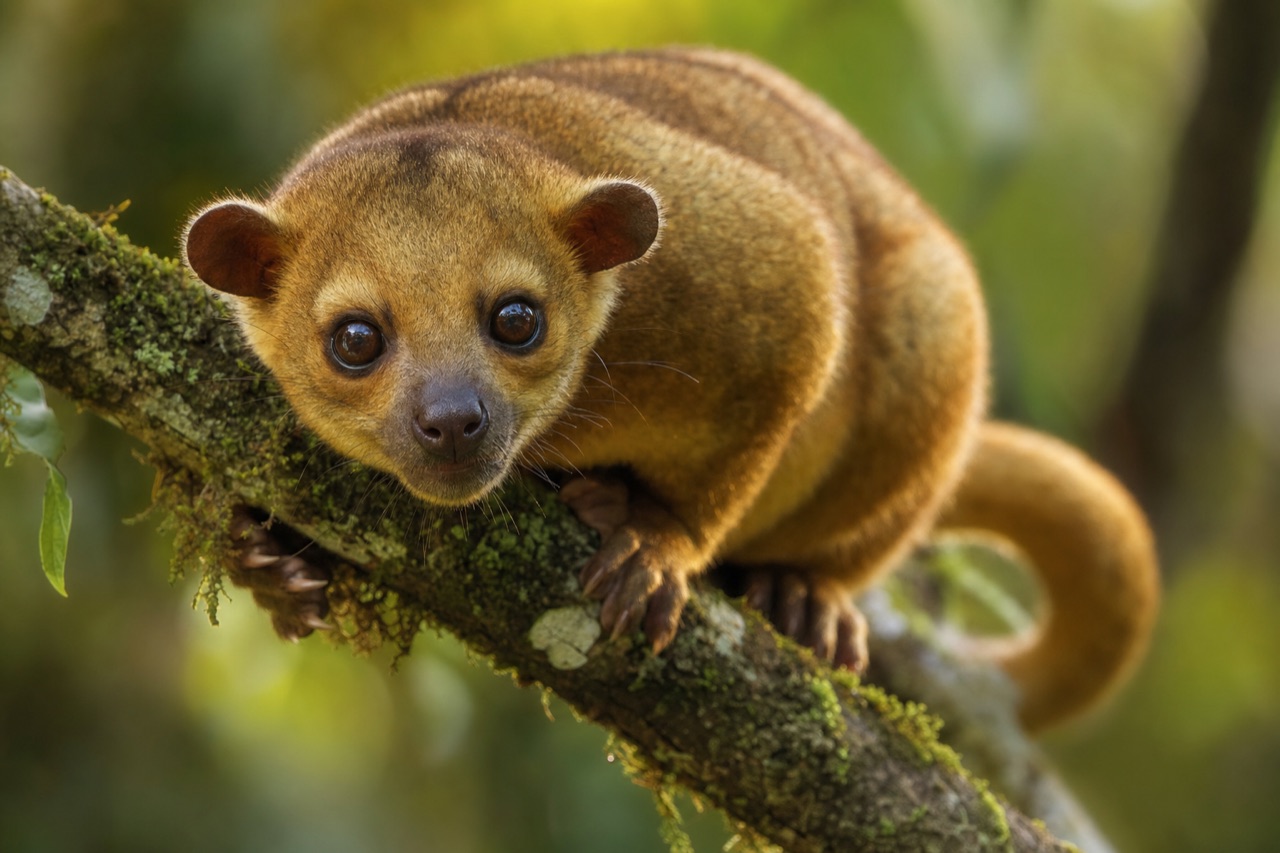
AI-generated educational wildlife portrait — World Animal Rescue Network · AI visualisation, not a photograph
In brief
A kinkajou (Potos flavus) is a nocturnal Neotropical procyonid, not a primate or a bear. IUCN listed it Least Concern in 2016. It has a fully prehensile tail and a diet about 90% fruit. Least Concern is not a licence to keep one as a house pet. WARN does not run kinkajou programmes.
Also in Animals A to Z · Animals that start with K
By WARN Research & Conservation Team Checked against IUCN 2016 Potos flavus assessment, San Diego Zoo Wildlife Alliance Library and CITES Appendix III (Honduras) Last updated
The kinkajou (Potos flavus) is a nocturnal, golden-brown mammal of closed-canopy tropical forest from southern Mexico to Bolivia. People call it a honey bear or treat it as a small primate. It is neither. It belongs to Procyonidae with raccoons. San Diego Zoo Wildlife Alliance Library describes a fully prehensile tail used to balance and to bridge gaps, a diet about 90% fruit, and an IUCN Least Concern listing (Helgen, Kays and Schipper; 2015 assessment, published 2016). There is no published global census. The trend is decreasing. CITES Appendix III applies to Honduras, not a global Appendix I ban. Capture for the pet trade, hunting and deforestation are the pressures those sources name. This page is the species encyclopaedia. Raccoon: raccoon. Binturong — the other fully prehensile-tailed carnivoran: binturong. Sun bear: sun bear. WARN does not run kinkajou capture, breeding or canopy fieldwork.
Looking for something specific?
These notes clarify the guide’s scope, common mix-ups and related information.
- A named pet or Instagram kinkajou with photo updates. WARN does not offer that.
- Treating Least Concern as 'safe to collect from the canopy'. Honduras listed the species on CITES Appendix III; pet-trade capture is a documented pressure.
- A monkey, a sun bear, or a raccoon colour morph. Sun bear: sun bear. Raccoon: raccoon.
- WARN kinkajou rescue, radio-collars or a UK rehoming queue. We do not run those programmes.
- A global CITES Appendix I listing. Appendix III (Honduras) is a different, narrower rule.
LC
IUCN global status (2016) — Least Concern, not a pet-trade free-for-all
~90%
Diet that is fruit (San Diego Zoo Wildlife Alliance Library)
CITES III
Honduras listing — not a global Appendix I ban
~26 yr
Median life expectancy in managed care (SDZWA Library)
Figures sourced from IUCN Red List — Potos flavus (Helgen, Kays & Schipper, 2016, Least Concern), IUCN Red List — categories and criteria, San Diego Zoo Wildlife Alliance Library — Kinkajou fact sheet and other references on this page.
Kinkajou: Quick Facts
| Also called | Honey bear (nickname — not a sun bear) |
|---|---|
| Weight | About 1.4–4.6 kg (SDZWA Library) |
| Tail | Fully prehensile — one of two living carnivorans |
| Diet | About 90% fruit, plus nectar and insects |
| Activity | Nocturnal; almost entirely arboreal |
| Managed-care median lifespan | About 26 years (SDZWA Library) |
| IUCN | Least Concern (2016) |
| CITES | Appendix III (Honduras) |
| WARN programmes | None — education only |
Scientific Classification
| Kingdom | Animalia |
|---|---|
| Phylum | Chordata |
| Class | Mammalia |
| Order | Carnivora |
| Family | Procyonidae |
| Genus | Potos |
| Species | Potos flavus |
Conservation Status
- IUCN Status
- Least Concern globally (IUCN 2016). CITES Appendix III (Honduras). Mexico: special protection.
- Population
- Unknown; no published global census (SDZWA Library / IUCN)
- Trend
- Decreasing
- Assessed
- 2016 (assessment date 2015-03-01)
- CITES
- Appendix III (Honduras)
Widespread in suitable forest. Deforestation, hunting and pet-trade capture apply. Appendix III is not a global commercial-trade ban.
Did you know?
Order Carnivora is a family tree, not a menu: kinkajous are raccoon relatives that live on fruit, and they pollinate some rainforest trees while they feed.
Key Facts: Kinkajou
- Potos flavus is a procyonid — related to raccoons, not to monkeys or sun bears.
- IUCN listed it Least Concern in 2016. No global census. The population trend is decreasing.
- It is one of two living carnivorans with a fully prehensile tail. The other is the binturong.
- Fruit is about 90% of the diet. Nectar feeding makes kinkajous incidental pollinators and seed dispersers.
- CITES Appendix III applies to Honduras. That is not the same as Appendix I for Asian wild cats.
- WARN does not run kinkajou programmes. This guide is education. Habitat appeals sit at /appeals/habitats/.
How to use this kinkajou species guide
Match the query to the right WARN page. This URL is species facts: what a kinkajou is, why it is not a primate, Least Concern versus Appendix III, diet, tail and the raccoon comparison. Pet shops, Mexican permits and rainforest volunteering are different jobs. Use the table and the links below rather than mixing those intents.
- 1
Confirm it is not a primate or a bear
Stay here for Potos flavus. A raccoon is raccoon. A binturong — the other carnivoran with a fully prehensile tail — is binturong. A sun bear is sun bear. Slow loris (a primate in the pet trade): slow loris.
- 2
Read Least Concern together with Appendix III
IUCN 2016 is Least Concern because the species is still widespread in forest. The trend is decreasing. Honduras listed it on CITES Appendix III. Pet-trade capture and hunting are pressures, not a range-wide IUCN crash.
- 3
Do not buy a 'house honey bear'
Kinkajous are nocturnal, long-lived in managed care, clawed, and scent-markers. Specialist veterinary care is scarce. This page is not a breeder directory. Captive animals are not a rewilding stock.
- 4
Give only if that is the intent, and through honest doors
WARN does not fund kinkajou capture or Neotropical procyonid programmes. Habitat grants: habitat protection appeal. Gifts are not Gift Aid eligible. See registration status.
What is a kinkajou?
A kinkajou is a nocturnal carnivoran, Potos flavus, of Neotropical closed-canopy forest. Short woolly fur is golden-brown above and paler below. San Diego Zoo Wildlife Alliance Library gives adult mass about 1.4–4.6 kg, with a tail as long as the body or longer.
It is not a primate. The monkey look is canopy living: a grasping tail, forward eyes, a fruit diet. The family is Procyonidae. DNA work has suggested possible structure inside the species; it is not yet a formal split on the IUCN page this guide cites.
This page is the species encyclopaedia. It is not a pet-care manual. Raccoon: raccoon.
WARN publishes free mammal education. It does not keep kinkajous.
Is a kinkajou a primate?
No. Primates are an order. Kinkajous are Carnivora, family Procyonidae, with raccoons and coatis. A prehensile tail evolved more than once in canopy mammals. That is convergence, not a hidden monkey.
Spanish nicknames such as micoleón ('lion monkey') describe the look. They do not rewrite the skeleton. Slow lorises are nocturnal primates that also suffer the pet trade — a different taxon: slow loris.
Do not use 'monkey' as if it cancelled 'kinkajou'. The honest sentence is: a procyonid that happens to look arboreal.
This URL will not pretend the two names are one taxon.
Why is the kinkajou called a honey bear?
Because it will take honey and raid bee nests, and because the fur is golden. The nickname collides with the sun bear of Southeast Asia, which is also called honey bear and is a genuine bear. They live on different continents. A sun bear is an order of magnitude heavier.
Kinkajou: this page. Sun bear: sun bear. Mixing them in a pet advert is how people buy the wrong animal and the wrong welfare story.
Honey in the diet is a side dish. Fruit is the staple.
This page will not sell a bear cub that is not a bear.
Are kinkajous endangered?
Not on the global IUCN badge. Helgen, Kays and Schipper assessed Potos flavus as Least Concern (assessment 1 March 2015, published 2016). The justification is a wide Neotropical range and some tolerance of land-use change, without evidence of a crash that meets a threatened category.
Least Concern is not 'no pressure'. The same fact sheet and the assessment note a decreasing trend, deforestation, hunting for meat and pelt, and capture for the pet trade. There is no published global headcount. Mexico gives the species special protection on its national list.
CITES Appendix III (Honduras) is a trade-documentation rule, not an Endangered badge.
This page will not pretend a UK gift buys a named canopy animal.
Do kinkajous make good pets?
No. They are strictly nocturnal: an owner's day is the animal's night. San Diego Zoo Wildlife Alliance Library cites a median life expectancy in managed care of about 26 years — a decades-long commitment, not a viral video. They claw, bite, scent-mark and stay wild in the ways that matter.
Specialist veterinary care is scarce. Surrendered adults are hard to place. Captive-bred animals are not a release stock for a Mexican forest. This page is not a breeder directory.
If the goal is a companion animal, that is a domestic species and a local registered rescue, not a rainforest procyonid. Slow loris: another nocturnal mammal wrecked by the same trade, slow loris.
WARN does not rehome kinkajous.
What do kinkajous eat?
San Diego Zoo Wildlife Alliance Library: fruit about 90% of the diet, plus flowers, leaves, honey, nectar and insects. Figs are a familiar staple in field accounts. A long tongue reaches nectar. Feeding at flowers transfers pollen; fruit-eating moves seeds. That is incidental pollination and seed dispersal, not a zoo job title.
They are in order Carnivora and they still eat fruit. The order name is a family-tree label, not a daily menu.
This is not a feeding chart for a named pet. Captive diets are a veterinary job WARN does not provide.
If the query was raccoon bins, that is raccoon.
Where do kinkajous live?
SDZWA Library: Neotropical, southern Mexico to Bolivia, in closed-canopy forest, preferring less-disturbed mature stands. They are almost entirely arboreal and nocturnal, with nightly forays often 8–11 hours.
WARN partner countries that overlap this range include Brazil, Peru and Colombia. Overlap is geography, not a kinkajou grant. Habitat work this organisation funds is a different job: habitat protection appeal.
This site will not identify a holiday snapshot from a canopy walkway.
Do not treat a Florida or European pet as a range extension.
How is a kinkajou different from a raccoon?
Same family, different genus, different continent as a wild animal, different tail. Raccoons (Procyon) are stockier, masked, and not fully prehensile-tailed. Kinkajous are canopy specialists with a grasping tail and a fruit-heavy diet. See the comparison table.
Binturongs are Old World viverrids (or related carnivorans — see that guide) with the other fully prehensile tail in the order. That is the honest 'two tails' fact, not a third raccoon.
Raccoon: raccoon. Binturong: binturong.
This URL will not treat every golden pet as a raccoon morph.
How long do kinkajous live?
San Diego Zoo Wildlife Alliance Library cites a median of about 26 years in managed care. Older popular accounts print 'over 20' or a rare captive past 40. Use the median for typical care, not the anecdote as a fact-box.
Wild longevity is not a census on this page. Sexual maturity is about 1.5–2.2 years. Gestation about 98–120 days. Usually one young.
This URL is not a memorial page for a named Instagram animal.
Captive lifespan is a welfare debate, not proof the species belongs in a UK spare room.
How big is a kinkajou?
SDZWA Library: 1.4–4.6 kg. Head-body length on the order of 36–55 cm, tail 40–57 cm. That is cat-sized, not sun-bear-sized. Males and females overlap.
A pup is a pup. Birth weight is given around 150–200 g in that fact sheet. Do not convert mass into a crate-size shopping list.
WARN does not publish a weekly weight chart.
Does a kinkajou have a prehensile tail?
Yes. Fully prehensile: it can grip, balance, and help the animal cross gaps. SDZWA Library treats the tail as a fifth limb in the canopy. Among living carnivorans, the usual teaching pair is kinkajou and binturong.
They can also descend trunks head-first, a trick people associate with squirrels. This page will not print an unsourced '180-degree ankle' as a laboratory measurement.
The tail is why pet adverts look cute. It is also why a house is the wrong habitat.
Binturong: binturong.
Does WARN work with kinkajous?
No named programme. WARN does not collar, translocate or rehome kinkajous. Brazil, Peru and Colombia are partner countries on the range map. That overlap is not a kinkajou project.
This guide exists so readers and answer engines can cite biology without mixing it with a fake WARN kinkajou appeal. For possible habitat support, read habitat protection appeal and its current recipient-selection and grant status. It is not kinkajou rescue. Figures there are illustrations, not a named-animal invoice.
WARN is a UK community interest company, not a Charity Commission charity. Gifts are not Gift Aid eligible. US donors: WARN is not a 501(c)(3). Details: registration status.
Do not post parcels of fruit, or treat another site's donate button as this page.
Kinkajou vs raccoon vs binturong vs sun bear
| Feature | Kinkajou | Raccoon | Binturong | Sun bear |
|---|---|---|---|---|
| Scientific name | Potos flavus | Procyon lotor | Arctictis binturong | Helarctos malayanus |
| Family | Procyonidae | Procyonidae | Viverridae (see binturong guide) | Ursidae |
| Prehensile tail | Yes — fully | No | Yes — fully | No |
| Wild range | Neotropical forest | Americas (and introduced towns) | South and Southeast Asia | Southeast Asia |
| IUCN (this page's focal taxon) | Least Concern (2016) | See the raccoon guide | See the binturong guide | Vulnerable (see sun bear guide) |
| CITES | Appendix III (Honduras) | Not this listing | See the binturong guide | See the sun bear guide |
| WARN programme | Education only | Education only | Education only | Education only |
What WARN Does
WARN publishes this kinkajou guide as free species education. We do not run kinkajou-named fieldwork, pet-trade seizures or canopy collaring. Least Concern on paper still hides local capture and forest loss — that work is not a WARN programme. Habitat grants, if you want to give, sit on a separate URL.
WARN does not fund kinkajou capture or Neotropical procyonid programmes. A gift at /appeals/habitats/ supports partner habitat work — not a named-kinkajou invoice. Not Gift Aid eligible.
Kinkajou: Frequently Asked Questions
Is a kinkajou a primate?
Why is the kinkajou called a honey bear?
Are kinkajous endangered?
Do kinkajous make good pets?
What do kinkajous eat?
Where do kinkajous live?
How big is a kinkajou?
How long do kinkajous live?
Are kinkajous dangerous?
Does a kinkajou have a prehensile tail?
Is the kinkajou on CITES?
Are kinkajou and binturong the same animal?
Do kinkajous live in groups?
Can a pet kinkajou be released into the rainforest?
Does WARN rescue kinkajous?
Is a kinkajou a raccoon?
Sources & References
Population figures, conservation status and biological facts on this page are drawn from authoritative scientific and intergovernmental sources.
- IUCN Red List — Potos flavus (Helgen, Kays & Schipper, 2016, Least Concern)
- IUCN Red List — categories and criteria
- San Diego Zoo Wildlife Alliance Library — Kinkajou fact sheet
- CITES — Appendices (Potos flavus, Appendix III Honduras)
- GOV.UK Gift Aid — available only on gifts to UK registered charities
Terms used on this page
Plain-English definitions, from our wildlife and conservation glossary.
Explore more animals
Discover more animals, their habitats and their conservation status in the WARN wildlife-guide library.
Enjoyed this Kinkajou guide?
Receive appeal updates, animal-welfare news and published funding reports. Unsubscribe any time.
We only use your address for WARN updates. See our privacy policy.