Wildlife Guide · Oceans & North America
Atlantic Horseshoe Crab
Limulus polyphemus
The ancient living fossil with blue blood
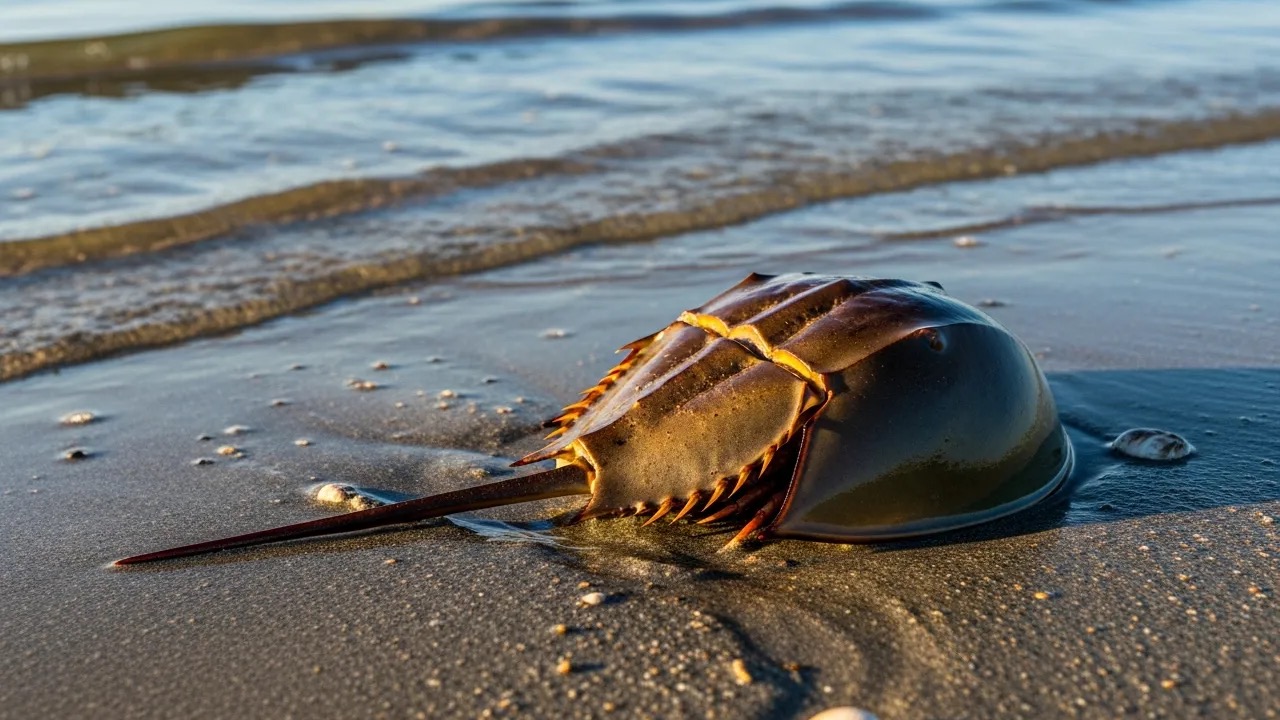
Photo: Shubham Chatterjee / Wikimedia Commons (CC BY-SA 3.0)
In brief
The Atlantic horseshoe crab (Limulus polyphemus) is an ancient marine arthropod, more closely related to spiders and scorpions than to true crabs. It has a domed horseshoe-shaped shell, a long spike-like tail, and reaches about 60 cm (24 in) including the tail.
Also in Animals A to Z · Animals that start with A
By WARN Research & Conservation Team Last updated
The Atlantic horseshoe crab (Limulus polyphemus) is an ancient marine arthropod, more closely related to spiders and scorpions than to true crabs. It has a domed horseshoe-shaped shell, a long spike-like tail, and reaches about 60 cm (24 in) including the tail. Found in shallow coastal waters and sandy beaches, it crawls along the bottom feeding on worms and molluscs, often living more than 20 years. It is listed as Vulnerable.
0.6 m
Typical length
2 kg
Typical weight
1 km/h
Top speed
20 yrs
Lifespan
Figures sourced from IUCN Red List — Limulus polyphemus, Wikipedia — Atlantic Horseshoe Crab, Wikidata — Atlantic Horseshoe Crab .
Atlantic Horseshoe Crab: Quick Facts
| Scientific name | Limulus polyphemus |
|---|---|
| Diet | Omnivore (worms, mollusks, algae, carrion) |
| Habitat | Shallow coastal waters and sandy beaches |
| Lifespan | Often 20+ years |
| Size | Up to about 60 cm (24 in) including tail |
| Top speed | Slow; crawls and plows through sand |
| Conservation status | Vulnerable (IUCN) |
Scientific Classification
| Kingdom | Animalia |
|---|---|
| Phylum | Arthropoda |
| Class | Merostomata |
| Order | Xiphosura |
| Family | Limulidae |
| Genus | Limulus |
Conservation Status
- IUCN Status
- Vulnerable (IUCN Red List category)
- Population
- Global population not compiled for this guide
- Trend
- See the IUCN Red List assessment
- Assessed
- See the IUCN Red List assessment
- CITES
- See CITES appendices
Conservation figures are drawn from the IUCN Red List and CITES; this guide links to the authoritative sources rather than restating population counts.
Key Facts: Atlantic Horseshoe Crab
- Horseshoe crabs belong to an ancient lineage whose body plan has changed remarkably little for hundreds of millions of years, earning them the nickname "living fossils".
- The horseshoe crab has a hard, domed carapace shaped like a horseshoe, a smaller abdominal section, and a long, pointed tail called a telson.
- Atlantic horseshoe crabs live in shallow coastal waters and estuaries along the western Atlantic, moving onto sandy beaches to breed.
A living fossil
Horseshoe crabs belong to an ancient lineage whose body plan has changed remarkably little for hundreds of millions of years, earning them the nickname "living fossils". Despite the name, they are not true crabs but chelicerates, more closely related to spiders and scorpions. The Atlantic species, Limulus polyphemus, is one of only four horseshoe crab species alive today. Their long evolutionary history makes them a favourite subject for studies of animal design and survival.
Anatomy and blue blood
The horseshoe crab has a hard, domed carapace shaped like a horseshoe, a smaller abdominal section, and a long, pointed tail called a telson. It grows to about 60 cm (24 in) including the tail and weighs around 2 kg, with several pairs of legs and multiple eyes, including large compound eyes on the shell. Its blood is copper-based and appears blue, and it contains a clotting agent that reacts to bacterial contamination. That property makes horseshoe crab blood valuable for testing the safety of medical products.
Habitat and movement
Atlantic horseshoe crabs live in shallow coastal waters and estuaries along the western Atlantic, moving onto sandy beaches to breed. They are slow-moving bottom-dwellers that crawl and plough through the sand rather than swim quickly, with a top speed of only around 1 km/h. The tail is used mainly as a lever to right themselves if a wave flips them over, not as a weapon. They tend to stay in soft-bottomed areas where food is easy to find.
Diet and feeding
Horseshoe crabs are omnivores that feed on marine worms, small molluscs, crustaceans, algae, and carrion. Lacking jaws, they crush food between the bristly bases of their legs and push it toward the mouth as they move. They forage mainly along the seabed, ploughing through sand and mud in search of buried prey. Their scavenging helps keep the shallow-water bottom clear of dead material.
Breeding and conservation
In spring and early summer horseshoe crabs gather on sandy beaches in large numbers to spawn, with females laying thousands of eggs in the sand and males fertilising them. These eggs are a vital food source for migrating shorebirds, so the crabs' breeding success affects other species too. The Atlantic horseshoe crab is listed as Vulnerable by the IUCN, threatened by habitat loss, harvesting for bait, and collection for the biomedical industry. Long-lived individuals, often surviving more than 20 years, take about a decade to reach breeding age.
What WARN Does
WARN does not run a dedicated atlantic horseshoe crab programme — this guide is part of the World Animal Rescue Network's free educational library. The atlantic horseshoe crab faces documented conservation pressure in the wild, which is why clear, sourced public information about it matters. Building public understanding of species like the atlantic horseshoe crab supports the broader conservation awareness that underpins WARN's partner-led rescue work across its network.
If clear, science-based wildlife guides like this help you understand and value animals, please consider supporting the World Animal Rescue Network's educational and rescue work so we can keep producing them.
Atlantic Horseshoe Crab: Frequently Asked Questions
Is a horseshoe crab really a crab?
Why is horseshoe crab blood blue and valuable?
Are horseshoe crabs dangerous?
What do horseshoe crabs eat?
How long do horseshoe crabs live?
Are horseshoe crabs endangered?
Where do atlantic horseshoe crabs live?
How big is an atlantic horseshoe crab?
Sources & References
Population figures, conservation status and biological facts on this page are drawn from authoritative scientific and intergovernmental sources.
Terms used on this page
Plain-English definitions, from our wildlife and conservation glossary.
Latest Atlantic Horseshoe Crab Stories
Quick, fact-checked reads on the atlantic horseshoe crab — amazing facts, key questions and the threats it faces.
Species
Why Are Sea Turtles Endangered? The Threats — and How to Help
Sea turtles have survived for more than 100 million years, yet within a few human generations most species have been pushed toward extinction. Here is what is driving the decline — bycatch, plastic, poaching and lost nesting beaches — and what actually helps.
Read the storySpecies
12 Amazing Facts About the Humpback Whale, the Ocean's Great Singer
From hours-long songs that only males sing to flippers longer than any other whale, here are 12 genuinely surprising facts about the humpback whale.
Read the storySpecies
How Big Is a Humpback Whale? Size, Weight and Strength Explained
Humpback whales reach 14 to 16 metres and weigh up to 30 tonnes, with the longest flippers of any whale. Here's how their size, weight and power really compare.
Read the storyExplore more animals
Discover more animals, their habitats and their conservation status in the WARN wildlife-guide library.
Enjoyed this Atlantic Horseshoe Crab guide?
Receive appeal updates, animal-welfare news and published funding reports. Unsubscribe any time.
We only use your address for WARN updates. See our privacy policy.