Wildlife Guide · Northern moorland, tundra and boreal forest worldwide & British species include red grouse, black grouse and capercaillie
Grouse
Tetraoninae — subfamily of Phasianidae including Lagopus, Tetrao and Lyrurus
Birds of the moor — heather, lek and long decline for some.
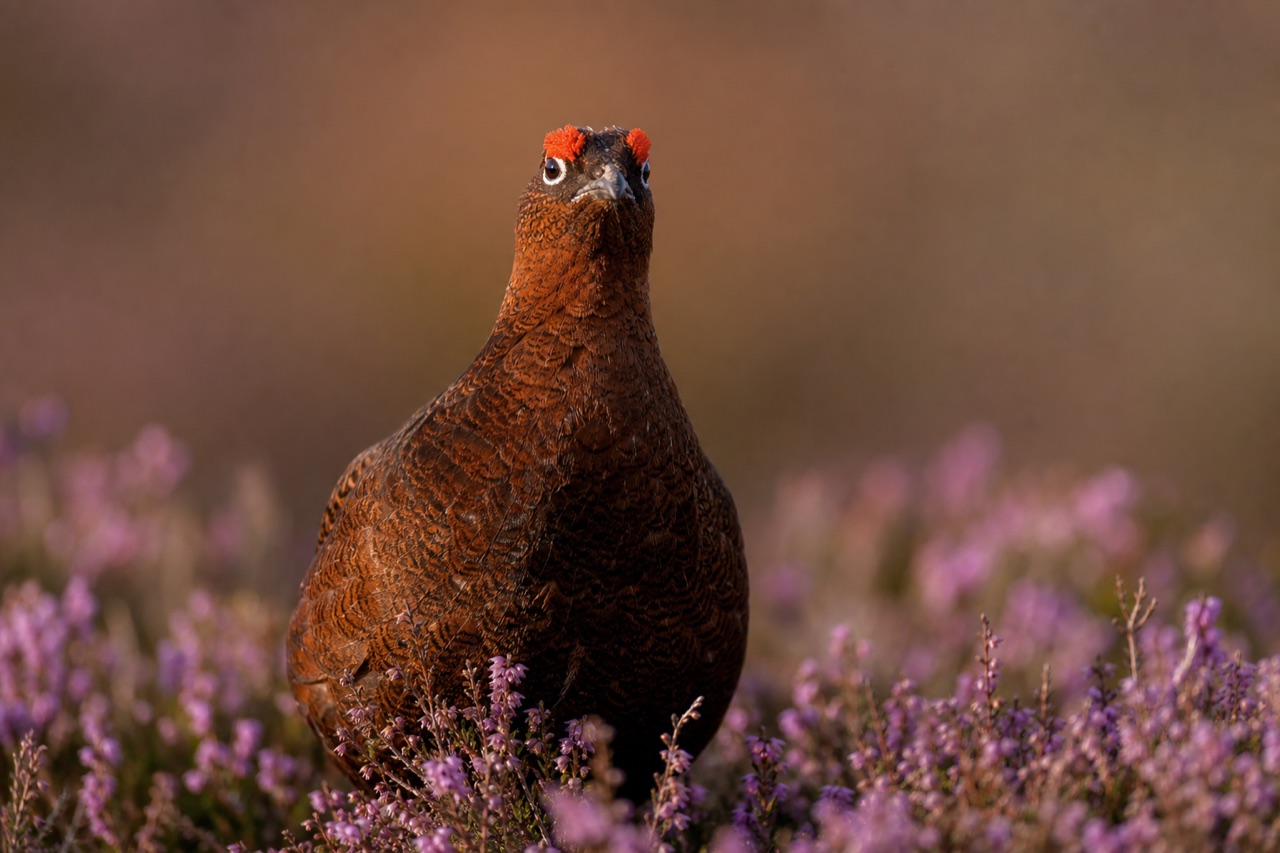
AI-generated educational wildlife portrait — World Animal Rescue Network · AI visualisation, not a photograph
In brief
Grouse are moorland and forest gamebirds; Britain holds red grouse on heather moors, declining black grouse with lek displays, and capercaillie in Scottish pine forest — status ranges from shooting-abundant to Critically Endangered as British breeders.
Also in Animals A to Z · Animals that start with G
By WARN Research & Conservation Team Last updated
Grouse are plump, ground-dwelling gamebirds of moorland, tundra and boreal forest — family Phasianidae, subfamily Tetraoninae. In Britain three species matter: the red grouse (Lagopus lagopus scotica) — endemic to heather moorland, chestnut-brown, the bird behind driven grouse shooting — the black grouse (Lyrurus tetrix) — lekking males with lyre-shaped tail feathers, Amber-listed and lost from most of England — and the capercaillie (Tetrao urogallus) — massive forest grouse reintroduced to Scotland, now Critically Endangered as a British breeder. Grouse depend on specific vegetation — heather for red grouse, mixed moor edge for black grouse, native pine forest for capercaillie. They are sedentary, territorial and shaped by land management: muirburn rotation for heather, predator control on shooting estates, forestry expansion and fence collisions for black grouse. Searching 'grouse' without naming the species conflates a abundant shooting bird with two in serious trouble. Red grouse remain numerous on managed moors; black grouse and capercaillie are conservation emergencies — lek loss, fence mortality and forest fragmentation respectively. Grouse shooting culture, moorland walking and capercaillie crisis news all drive 'grouse' searches — a family guide prevents the abundant red grouse from obscuring black grouse and capercaillie emergencies. One family name covers three fates; species-level detail is not optional for honest guidance.
Heather moor
Red grouse tied to managed heather moorland
Black grouse lek
Males display communally — Amber-listed in Britain
Capercaillie
Critically Endangered as British breeder
Sedentary
Territorial — do not migrate
Figures sourced from IUCN Red List — Tetrao urogallus (Capercaillie), BTO — BirdFacts: Black Grouse .
Grouse: Quick Facts
| Red grouse | Heather moorland; endemic; abundant on moors |
|---|---|
| Black grouse | Lek display; Amber-listed; fence collision risk |
| Capercaillie | Forest giant; Critically Endangered in Britain |
| Habitat | Moorland heather, moor edge, native pine forest |
| Movement | Sedentary — no migration |
| Display | Black grouse lek; capercaillie forest display |
| Conservation split | Red abundant; black and capercaillie in decline |
Scientific Classification
| Kingdom | Animalia |
|---|---|
| Phylum | Chordata |
| Class | Aves |
| Order | Galliformes |
| Family | Phasianidae |
| Subfamily | Tetraoninae (grouse) |
| British species | Red grouse, black grouse, capercaillie |
Conservation Status
- IUCN Status
- Least Concern
- Population
- Varies — red grouse numerous; capercaillie fewer than 1000 in Britain
- Trend
- Red stable on moors; black grouse and capercaillie decreasing
- Assessed
- Varies by species
- CITES
- Not listed (subfamily overview)
Capercaillie Critically Endangered as British breeder. Black grouse Amber-listed. Red grouse abundant on managed moors.
Did you know?
Black grouse males display at dawn leks with tails shaped like lyres — one of the few communal courtship spectacles remaining in Britain.
Key Facts: Grouse
- Red grouse live on heather moorland — chestnut-brown, endemic subspecies, abundant on shooting moors.
- Black grouse lek on moor edge — males display lyre tail; lost from most of England, Amber-listed.
- Capercaillie is a huge forest grouse — Critically Endangered as British breeder in Scottish pinewoods.
- Grouse depend on specific habitat management — heather rotation, open moor, native forest.
- Fence collisions kill black grouse in uplands — marking fences reduces mortality.
- Red grouse abundance reflects shooting estate management as much as natural carrying capacity.
- Family overview essential — 'grouse' spans abundant red grouse and critically rare capercaillie.
Red grouse — heather, muirburn and the shooting moor
Red grouse are endemic to Britain and Ireland — a subspecies of willow grouse that never develops white winter plumage. They live on heather moorland, feeding on heather shoots, buds and seeds, nesting in deep heather cover. Populations cycle on multi-year patterns linked to parasite load and weather.
Muirburn — rotational burning of heather to create fresh growth — shapes red grouse habitat on managed moors. Shooting estates maintain heather age mosaic for grouse; conservation debate centres on burn extent, peat damage and raptor persecution on some moors. Red grouse numbers on managed estates can be high; the bird is not Red-listed.
For searchers, 'grouse' often means red grouse — the bird on moorland walks in Yorkshire, Scotland and Wales. It is the default grouse of British upland experience.
Red grouse shooting economics maintain heather moorland that might otherwise be afforested or converted — the conservation outcome of grouse moor management is contested, with peat damage from burning, raptor persecution on some estates and biodiversity trade-offs against open heather habitat that suits red grouse and some waders.
Willow grouse — the white winter-plumage relative of red grouse — occurs in Arctic Eurasia but not Britain. Red grouse isolation as a non-white subspecies is a quirk of British post-glacial history, not a separate species split.
Heather beetle outbreaks and disease can crash red grouse populations on moors independently of shooting pressure — cyclic boom and bust is natural, though management and medication on some estates smooths cycles for shooting interests.
Black grouse — the lek and the decline
Black grouse are larger, sexually dimorphic — males black with white wing bar and lyre-shaped tail held fanned in display; females grey-brown, cryptic. Males gather at leks — communal display grounds on moor edge — in dawn rituals where females choose mates.
Black grouse have declined across Britain and lost range from Wales, much of England and lowland Scotland. Causes include afforestation of open moor, overgrazing, fence collisions — males fly low across valleys and strike deer fences — and predation. Amber-listed, they are a conservation priority where reintroduction and fence marking programmes operate.
Seeing a black grouse lek is among Britain's great wildlife spectacles — remaining sites are local and often wardened during display season.
Black grouse require transition habitat — moor edge, woodland fringe, rough pasture — that intensive forestry and sheep farming removed from much of Scotland and Wales. Reintroduction projects use fence marking, predator control and habitat restoration together; single-measure fixes rarely succeed.
Black grouse translocation projects require source populations, suitable receptor habitat and years of fence marking and predator management — reintroduction is not a quick fix for a species that needs landscape-scale moor edge restoration.
Capercaillie — forest giant in crisis
Capercaillie are the largest grouse — males display with tail fanned, wings drooped, in native pine forest. Reintroduced to Scotland after extinction, the population peaked then collapsed. Capercaillie is Critically Endangered as a British breeder — fewer than a thousand birds, confined to Scottish pinewoods.
Threats include forest fragmentation, deer fencing mortality, disturbance by recreational access, wet springs that chill chicks, and predation. Forestry management that opens canopy and maintains bilberry understory helps; capercaillie require large contiguous forest with minimal fence barriers.
Capercaillie and red grouse share the name grouse but not habitat or status — searching 'grouse' without context misses that one British grouse species faces extirpation.
Capercaillie lek in forest clearings — males display at dawn in traditional sites used across generations. Disturbance by recreational access, dog walking and photography at leks reduces mating success; seasonal path closures in core pinewoods are a direct conservation tool for the remaining British population.
Capercaillie diet shifts seasonally — pine needles, bilberry, shoots and invertebrates for chicks — all tied to native pinewood structure. Plantation forestry without bilberry understory and with deer fences does not substitute for native Caledonian forest habitat.
Grouse conservation — fences, forest and honest status
Practical grouse conservation differs by species. Black grouse: mark or remove deer fences on moorland, maintain open moor edge, control grazing, support lek site protection. Capercaillie: reduce fence mortality, manage forestry for bilberry and low disturbance, limit recreational pressure in core woods. Red grouse: peatland restoration, sustainable muirburn, ending illegal raptor persecution on moors.
A family grouse guide exists because 'grouse' searches mix shooting culture, moorland walking and conservation concern. Red grouse remain on moors in numbers; black grouse and capercaillie need urgent action — the family name hides opposite trajectories.
Searching 'grouse' from Britain without context usually means red grouse on a moorland walk — not capercaillie in crisis or black grouse lek. The family name hides three conservation statuses; a family guide is the minimum honesty required before species-level pages carry the detail.
Public access management in capercaillie woods balances recreation rights with disturbance reduction — seasonal path routing and dog control during lek and breeding season are active conservation tools, not optional courtesy.
Moorland walkers who report black grouse lek locations and capercaillie sightings contribute data that directs fence-marking and access management — public reporting supports targeted action for the two grouse species in decline while red grouse remain the default moorland encounter.
What WARN Does
WARN publishes free, sourced species education where one word covers opposite fates. 'Grouse' on a moor is red grouse; 'grouse' in conservation news may be capercaillie — Critically Endangered as a British breeder.
If this guide helps you understand wildlife and the pressures it faces, a gift to WARN supports habitat protection and free public education in our partner countries.
Grouse: Frequently Asked Questions
What is the difference between red and black grouse?
What is a grouse lek?
Are capercaillie found in Britain?
Why do black grouse hit fences?
What habitat do grouse need?
What do grouses eat?
Are grouses dangerous?
How long do grouses live?
How big is a grouse?
Sources & References
Population figures, conservation status and biological facts on this page are drawn from authoritative scientific and intergovernmental sources.
Terms used on this page
Plain-English definitions, from our wildlife and conservation glossary.
Explore more animals
Discover more animals, their habitats and their conservation status in the WARN wildlife-guide library.
Enjoyed this Grouse guide?
Receive appeal updates, animal-welfare news and published funding reports. Unsubscribe any time.
We only use your address for WARN updates. See our privacy policy.