Wildlife Guide · Tropical Africa & Rainforest belt from Cameroon to Congo and Tanzania
Goliath Beetle
Goliathus goliatus (Drury, 1770) — family Scarabaeidae
Among the heaviest insects on Earth — and most of that weight is spent underground as a grub.
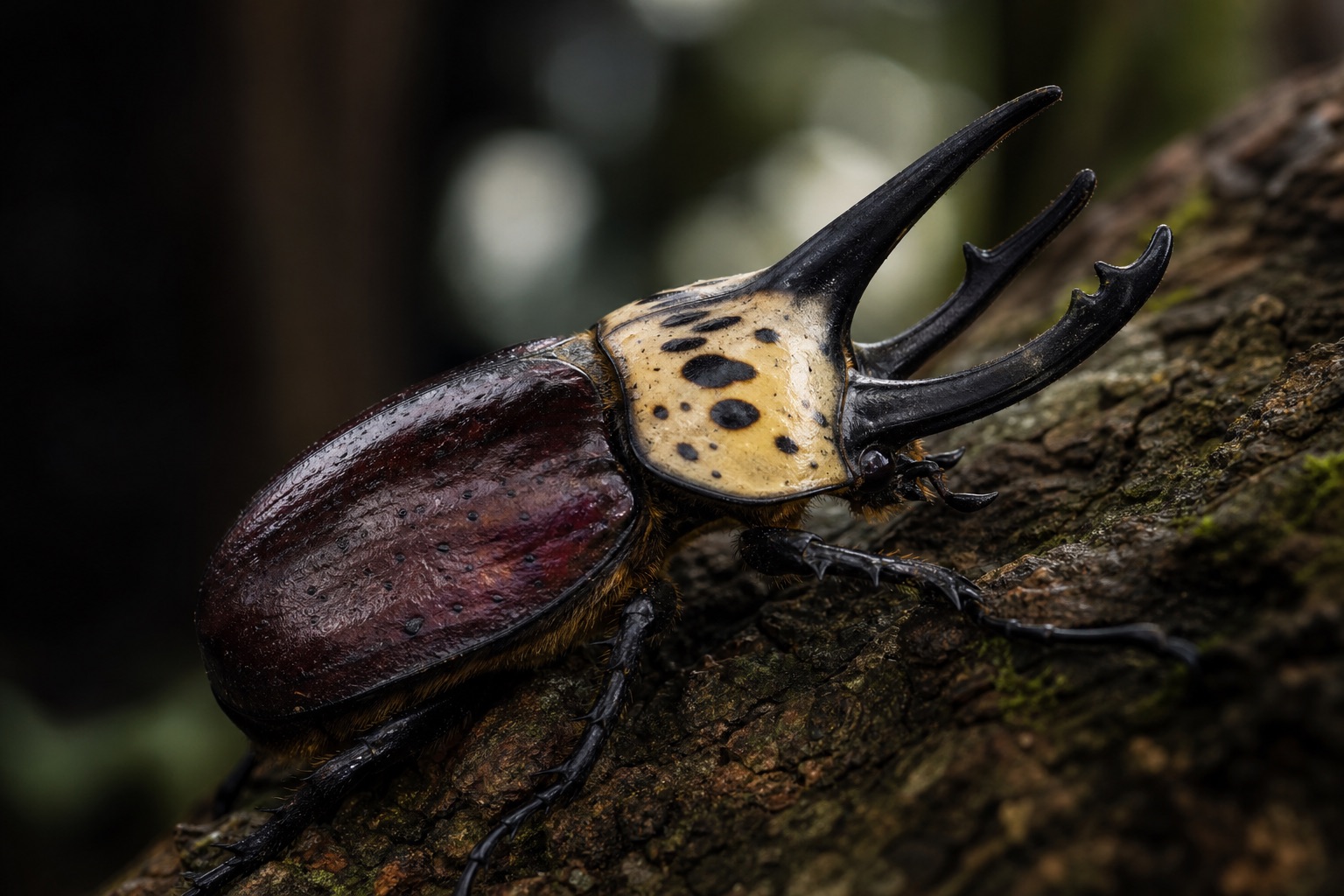
AI-generated educational wildlife portrait — World Animal Rescue Network · AI visualisation, not a photograph
In brief
The goliath beetle (Goliathus goliatus) is a large African scarab among the heaviest insects alive at up to about 100 g and 10 cm, with larvae developing in rotting wood; most Goliathus species are not individually assessed on the IUCN Red List.
Also in Animals A to Z · Animals that start with G
By WARN Research & Conservation Team Last updated
Goliath beetles belong to the genus Goliathus, a group of African scarabs famous for size. Adults of Goliathus goliatus can exceed 10 centimetres in length and weigh on the order of 100 grams in the largest males — placing them among the heaviest insects alive, though the heaviest stage is the larva, which can weigh more while feeding in rotting wood. The patterned wing covers — white spots on dark elytra in goliatus — and the Y-shaped horn on the male thorax make the beetle a standard museum drawer specimen. In life they feed on fruit and sap as adults; larvae spend months to a year or more in decaying wood. Most Goliathus species lack IUCN assessments, but range overlaps rainforest under logging pressure.
~100 g
Approximate mass of the largest males — among heaviest insects
~10 cm
Typical maximum adult body length
Months+
Larval development in rotting wood
Not Evaluated
IUCN status for most Goliathus species
Figures sourced from Natural History Museum — Goliath beetle facts, Animal Diversity Web — Goliathus, Encyclopedia of Life — Goliathus goliatus .
Goliath Beetle: Quick Facts
| Adult length | Up to about 10 cm |
|---|---|
| Adult mass | Large males around 90–100 g |
| Diet | Larvae: rotting wood; adults: fruit and sap |
| Habitat | Tropical African rainforest |
| Larval stage | Many months in decaying wood |
| IUCN status | Not Evaluated for most species |
Scientific Classification
| Kingdom | Animalia |
|---|---|
| Phylum | Arthropoda |
| Class | Insecta |
| Order | Coleoptera |
| Family | Scarabaeidae |
| Genus | Goliathus |
| Species | Goliathus goliatus (plus related species in the genus) |
Conservation Status
- IUCN Status
- Not Evaluated
- Population
- No reliable estimates for most Goliathus species
- Trend
- Unknown; habitat loss and collection occur across the range
- Assessed
- Most species not assessed
- CITES
- Not listed
Absence of assessment should not be read as abundance. Rainforest logging and the live insect trade affect the same rotting-wood larval habitat the genus requires.
Did you know?
The heaviest stage of a goliath beetle's life is often the larva chewing rotting wood underground — the famous adult is the short final act.
Key Facts: Goliath Beetle
- Goliathus beetles are among the heaviest insects; large males can approach 100 g and 10 cm in length.
- Larvae feed in rotting wood and can outweigh adults; development takes many months before pupation.
- Adults eat fruit, sap and decaying plant matter; males may use thoracic horns in contests.
- The genus Goliathus contains several species across tropical African rainforest.
- Most species have not received individual IUCN Red List assessments.
- Collection for the insect trade and rainforest logging are the main documented pressures.
What 'largest insect' actually measures
Heaviest insect claims require careful definitions. Goliath beetles compete with certain rhinoceros beetles and giant weta for the title depending on whether larvae or adults are measured and which species is included. Published masses for large male Goliathus goliatus around 90–100 g appear in entomological literature; females are typically smaller.
Length up to roughly 10 cm for the body excludes the legs and antennae, which extend further. The bulk comes from powerful flight muscles and thick cuticle. Impressive as adults are, the larval stage in rotting wood often accumulates more mass — a white grub with a hardened head capsule chewing through decay for months before metamorphosis.
From rotting wood to fruit-feeding adult
Female goliath beetles lay eggs in soil near rotting wood. Larvae tunnel into the substrate, feeding on decay until ready to pupate in an underground cell. The adult emerges with soft wing covers that harden and darken over days.
Adult goliath beetles are short-lived in the wild — weeks to a few months — and feed on sugary fruit, tree sap and decaying plant material. In captivity they take banana, apple and proprietary beetle diets. Males of some species use the thoracic horn to lever rivals off territory on logs; the horn is not a weapon against predators in the way stag beetle mandibles are used in shoving matches.
Trade and rainforest overlap
Goliath beetles are collected for the live insect trade and for specimen collections. Sustainable captive breeding exists, but wild-caught adults still enter markets. Because larvae depend on rotting wood in forest, logging that removes dead timber and mature trees reduces breeding sites even when canopy remains.
Most Goliathus species have not been individually assessed by the IUCN. That gap does not imply security — it reflects low assessment priority for African forest beetles with limited economic profile beyond the hobby trade.
Several species under one common name
Goliathus goliatus, G. regius, G. orientalis and other species share the goliath name with different spot patterns and ranges. G. goliatus is widespread in central African rainforest; G. regius is among the largest and most sought after in trade.
Identification to species requires pattern detail on the elytra and thorax. Guides at genus level risk conflating status across species with different ranges and pressures — worth stating when exact species-level data are missing.
What WARN Does
WARN publishes free, sourced education for rainforest species that attract trade attention without corresponding assessment coverage. Goliath beetles are emblematic of African forest invertebrates whose habitat and collection pressure outrun Red List documentation.
If this guide helps you understand wildlife and the pressures it faces, a gift to WARN supports habitat protection and free public education in our partner countries.
Goliath Beetle: Frequently Asked Questions
What do goliath beetles eat?
Where do goliath beetles live?
Are goliath beetles dangerous?
How long do goliath beetles live?
How big are goliath beetles?
Are goliath beetles the heaviest insect?
Are goliath beetles endangered?
Sources & References
Population figures, conservation status and biological facts on this page are drawn from authoritative scientific and intergovernmental sources.
Terms used on this page
Plain-English definitions, from our wildlife and conservation glossary.
Latest Goliath Beetle Stories
Quick, fact-checked reads on the goliath beetle — amazing facts, key questions and the threats it faces.
Explore more animals
Discover more animals, their habitats and their conservation status in the WARN wildlife-guide library.
Enjoyed this Goliath Beetle guide?
Receive appeal updates, animal-welfare news and published funding reports. Unsubscribe any time.
We only use your address for WARN updates. See our privacy policy.