Wildlife Guide · Madagascar & Eastern humid forest
Giraffe Weevil
Trachelophorus giraffa (Pascoe, 1860) — family Attelabidae
The beetle whose male neck is three times the female's — and who builds a leaf-roll nest.
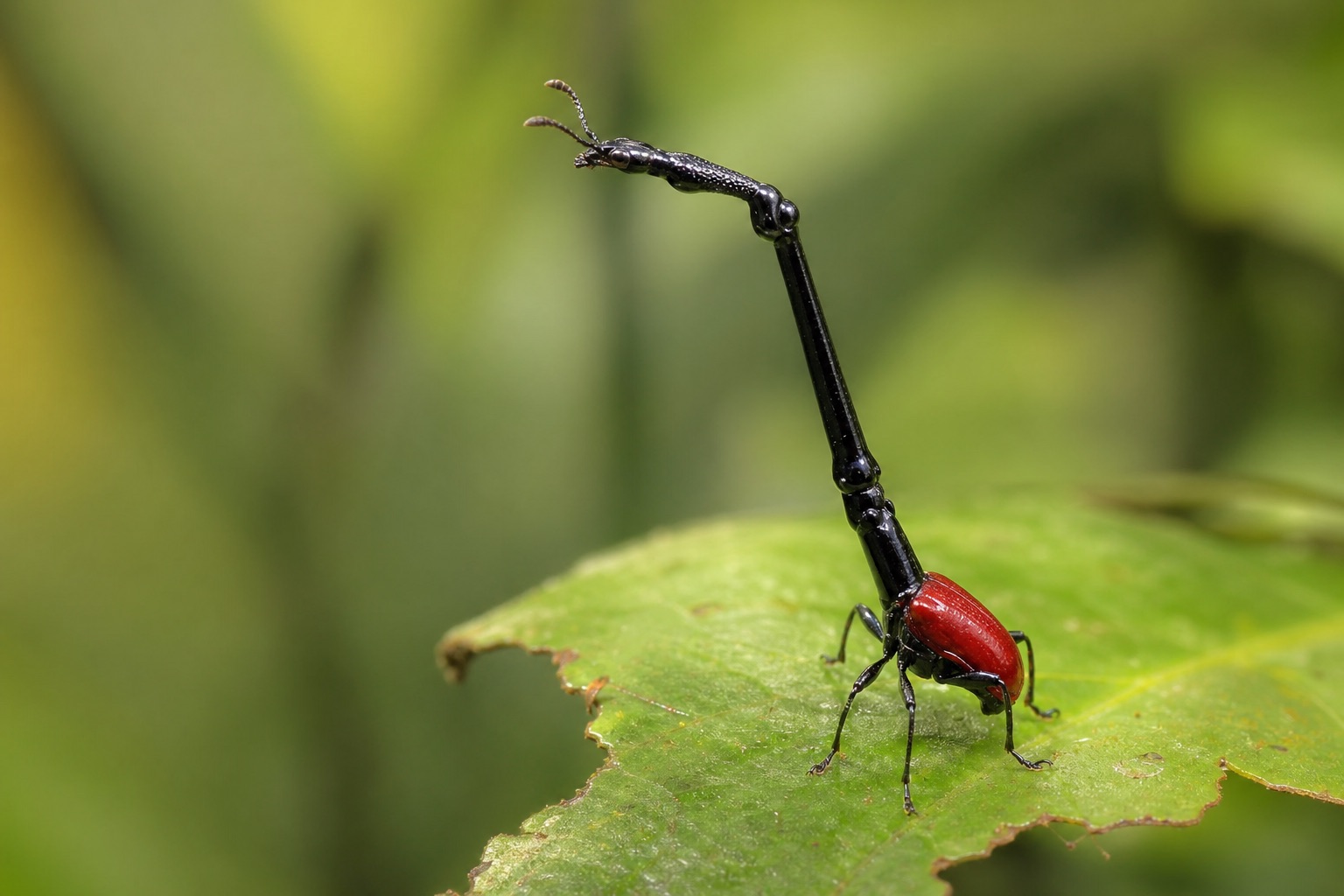
AI-generated educational wildlife portrait — World Animal Rescue Network · AI visualisation, not a photograph
In brief
The giraffe weevil (Trachelophorus giraffa) is a beetle endemic to Madagascar whose male has a neck two to three times longer than the female's, used for fighting and for rolling leaves into nest tubes; it is Least Concern but loses forest to tavy and charcoal production as an estimated 80–90% of Madagascar's original cover has been lost.
Also in Animals A to Z · Animals that start with G
By WARN Research & Conservation Team Last updated
The giraffe weevil is a small black beetle endemic to Madagascar with one of the most extreme sexual dimorphisms in the insect world. The male's neck — technically an elongated prothorax — can be two to three times the length of the female's, and he uses it to fight other males and to roll leaves into tubes where the female lays a single egg. Madagascar holds roughly 90% vertebrate endemism, and its invertebrate fauna is equally distinctive — the giraffe weevil is one of the island's most photographed endemics. An estimated 80–90% of the island's original forest has been lost, and while the species is listed Least Concern because it remains widespread in eastern humid forest, that listing describes current range rather than trajectory. Tavy slash-and-burn and charcoal production remove the forest trees whose leaves this beetle rolls — pressures driven by rural poverty and the lack of affordable alternatives, the same context behind every Malagasy conservation crisis.
2–3×
Male neck length relative to the female's
~90%
Share of Madagascar's vertebrates found nowhere else
Leaf roll
Nest built by cutting and rolling a leaf tube
1 egg
Laid inside each leaf-roll nest
Figures sourced from GBIF — Trachelophorus giraffa, Encyclopedia of Life — Trachelophorus giraffa .
Giraffe Weevil: Quick Facts
| Male neck | Two to three times longer than female's |
|---|---|
| Nest | Single egg in a rolled leaf tube |
| Colour | Black with red elytra covering wings |
| Habitat | Eastern humid forest, Madagascar |
| Endemism | Madagascar only |
| Main threats | Forest loss from tavy and charcoal production |
Scientific Classification
| Kingdom | Animalia |
|---|---|
| Phylum | Arthropoda |
| Class | Insecta |
| Order | Coleoptera |
| Family | Attelabidae |
| Genus | Trachelophorus |
| Species | Trachelophorus giraffa |
Conservation Status
- IUCN Status
- Least Concern
- Population
- No estimate; common in remaining eastern forest
- Trend
- Unknown; likely decreasing with forest loss
- Assessed
- Not formally assessed on IUCN — treated as Least Concern by range
- CITES
- Not listed
An estimated 80–90% of Madagascar's original forest has been lost. Least Concern reflects current abundance, not long-term security.
Did you know?
Male giraffe weevils fight by neck-wrestling on a branch — the same elongated prothorax they use to roll leaves into nest tubes for the female's single egg.
Key Facts: Giraffe Weevil
- The giraffe weevil is endemic to Madagascar — a black attelabid beetle with extreme neck dimorphism.
- The male's elongated prothorax is two to three times longer than the female's, used for fighting and nest-building.
- Females lay a single egg inside a leaf tube that the male or female cuts and rolls from a living leaf.
- Madagascar's invertebrate fauna is as distinctive as its vertebrates — part of the island's isolation story.
- An estimated 80–90% of Madagascar's original forest has been lost; eastern humid forest is the giraffe weevil's habitat.
- Tavy and charcoal production are driven by rural poverty — forest loss threatens even Least Concern endemics over time.
Why the male neck is so long
Sexual selection, not feeding. The giraffe weevil's elongated prothorax is a weapon and a tool. Males fight by grappling with their necks, attempting to flip rivals off branches. Longer necks win more fights and gain more mating opportunities.
The neck also assists in leaf rolling — the nest-building behaviour that gives the family Attelabidae its common name, leaf-rolling weevils. A male may help cut and roll a leaf into a tube, though the female completes the nest and lays inside it. The dimorphism is among the most extreme in beetles: males and females look like different species until you know what to check.
The leaf-roll nest
A female giraffe weevil selects a living leaf on a forest tree and cuts it so it curls into a tight tube. She lays a single egg inside, and the larva develops within the rolled leaf, feeding on the interior tissue before pupating and emerging as an adult.
The nest ties the species to intact forest with suitable host plants — typically trees in the family Dalrymplea and related genera in eastern humid forest. Clear the forest for tavy or charcoal and you remove both the trees and the humidity the leaf rolls need to persist. A beetle that builds its nursery inside a living leaf cannot reproduce in a cassava field.
Madagascar's invertebrate endemism
Visitors focus on lemurs, but Madagascar's invertebrates are equally irreplaceable. The giraffe weevil is one of hundreds of endemic beetles, and the island's isolation produced radiations in butterflies, moths, stick insects and cockroaches found nowhere else.
Roughly 90% of Madagascar's vertebrates are endemic; invertebrate endemism is similarly high though less catalogued. Losing forest does not only remove lemurs — it removes the leaf-rolling beetles, the comet moths and the hissing cockroaches that evolved in the same isolation. Every tavy fire and charcoal kiln takes species that have no backup population anywhere on Earth.
Forest loss and the poverty context
The giraffe weevil is Least Concern because it remains common in surviving eastern forest. That is not the same as secure. An estimated 80–90% of Madagascar's original forest cover has been lost, and eastern humid forest continues to shrink.
Tavy clears land for subsistence crops when families have no other income. Charcoal production removes living trees for cooking fuel when alternatives are unaffordable. These are poverty-driven pressures, not moral failures by subsistence farmers. Conservation that protects giraffe weevils protects the forest blocks where they nest — the same forest lemurs, fossas and leaf-tailed geckos depend on.
What WARN Does
WARN publishes free, sourced species education across Madagascar's fauna, including the invertebrates tourists photograph but rarely understand. The giraffe weevil nests in leaves on trees that tavy and charcoal production remove — on an island where an estimated 80–90% of original forest is already gone.
If this guide helps you understand wildlife and the pressures it faces, a gift to WARN supports habitat protection and free public education in our partner countries.
Giraffe Weevil: Frequently Asked Questions
Why does the male giraffe weevil have a long neck?
How does the giraffe weevil nest?
Where do giraffe weevils live?
Are giraffe weevils endangered?
Are giraffe weevils related to giraffes?
Are giraffe weevils dangerous?
How long do giraffe weevils live?
How big is a giraffe weevil?
What do giraffe weevils eat?
Sources & References
Population figures, conservation status and biological facts on this page are drawn from authoritative scientific and intergovernmental sources.
Terms used on this page
Plain-English definitions, from our wildlife and conservation glossary.
Latest Giraffe Weevil Stories
Quick, fact-checked reads on the giraffe weevil — amazing facts, key questions and the threats it faces.
Explore more animals
Discover more animals, their habitats and their conservation status in the WARN wildlife-guide library.
Enjoyed this Giraffe Weevil guide?
Receive appeal updates, animal-welfare news and published funding reports. Unsubscribe any time.
We only use your address for WARN updates. See our privacy policy.