Wildlife Guide · Madagascar & Remaining forest across the island
Fossa
Cryptoprocta ferox (Bennett, 1833) — family Eupleridae
Madagascar's top predator — looks like a cat, related to mongooses, and eats lemurs.
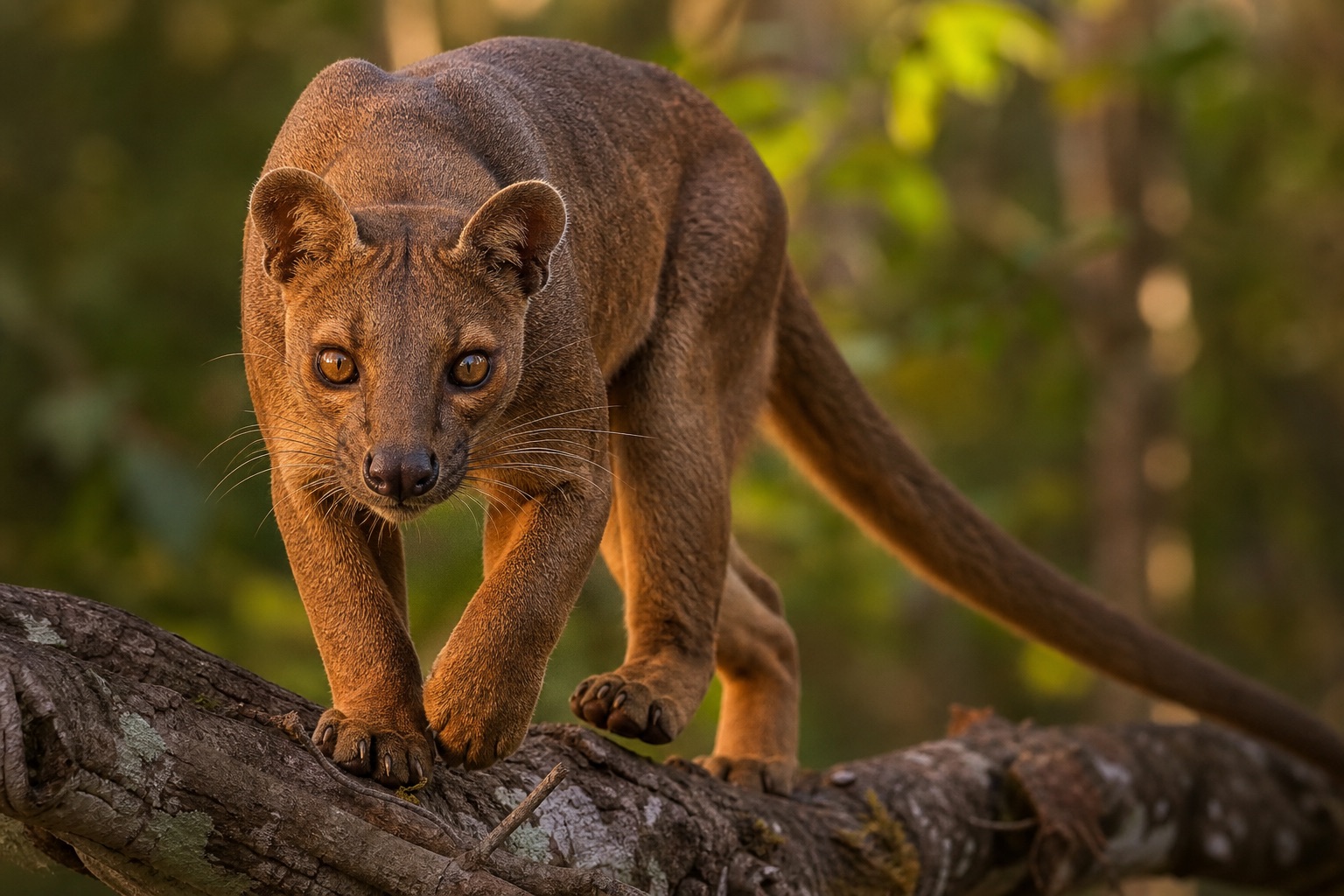
AI-generated educational wildlife portrait — World Animal Rescue Network · AI visualisation, not a photograph
In brief
The fossa (Cryptoprocta ferox) is Madagascar's largest native carnivore and apex predator, cat-like in appearance but a euplerid mongoose relative; it hunts lemurs in the canopy, is listed Vulnerable, and declines as an estimated 80–90% of Madagascar's original forest has been lost.
Also in Animals A to Z · Animals that start with F
How you can help
You can support the related appeal — read its purpose, recipient status and fund terms first — or give once to where it is needed most. Sharing accurate information helps too.
By WARN Research & Conservation Team Last updated
The fossa is the largest native carnivore on Madagascar and the island's apex predator. It has a cat-like head, short reddish-brown fur, a long tail and retractable claws — enough to fool most visitors into calling it a big cat. It is not one. The fossa belongs to Eupleridae, the Malagasy mongoose family, and its closest relatives are the island's smaller carnivorans rather than any felid. It is also the main predator of lemurs, climbing as competently as its prey and hunting both day-active and nocturnal species. Madagascar holds roughly 90% vertebrate endemism, and the fossa–lemur relationship is one of the clearest examples of co-evolution on an island where both predator and prey occur nowhere else. An estimated 80–90% of the island's original forest has been lost, and the fossa is listed Vulnerable — losing the forest that supports lemurs removes the prey base and the canopy connectivity this predator needs. Tavy slash-and-burn, charcoal production and hunting pressure follow the same poverty-driven pattern seen across Madagascar.
~90%
Share of Madagascar's vertebrates found nowhere else
~1.8 m
Total length including tail — the largest native Malagasy carnivore
Reversible
Ankles that rotate to climb head-first down tree trunks
Vulnerable
IUCN status as forest fragments and hunting pressure increase
Figures sourced from IUCN Red List — Cryptoprocta ferox, CITES Appendices .
Fossa: Quick Facts
| Length | About 1.4–1.8 m including tail |
|---|---|
| Weight | Roughly 5.5–8.6 kg |
| Closest relatives | Malagasy mongooses (Eupleridae), not cats |
| Main prey | Lemurs |
| Key adaptation | Reversible ankles for head-first tree descent |
| Main threats | Forest loss from tavy and charcoal; persecution |
Scientific Classification
| Kingdom | Animalia |
|---|---|
| Phylum | Chordata |
| Class | Mammalia |
| Order | Carnivora |
| Family | Eupleridae |
| Genus | Cryptoprocta |
| Species | Cryptoprocta ferox |
Conservation Status
- IUCN Status
- Vulnerable
- Population
- No reliable estimate; declining in fragmented areas
- Trend
- Decreasing
- Assessed
- 2015
- CITES
- Appendix II
Forest loss driven by tavy and charcoal production is linked to rural poverty. Protecting connected forest protects both fossas and the lemur prey they depend on.
Did you know?
The fossa is the animal Madagascar built to eat lemurs — a mongoose that evolved into a cat-shaped canopy predator because no real cats ever reached the island.
Key Facts: Fossa
- The fossa is Madagascar's largest native carnivore and apex predator, hunting lemurs in the canopy.
- It looks cat-like but belongs to Eupleridae — the Malagasy mongoose family — not Felidae.
- Its ankles rotate so it can climb head-first down tree trunks, like a squirrel — unlike any cat.
- Madagascar holds roughly 90% vertebrate endemism; fossas and lemurs co-evolved in isolation.
- An estimated 80–90% of Madagascar's original forest has been lost; the fossa is listed Vulnerable.
- Forest loss from tavy and charcoal production is driven by rural poverty — the same context that threatens every forest-dependent Malagasy species.
Cat-like, but a mongoose
The fossa's convergent resemblance to a small puma is misleading. Euplerids split from other carnivorans on Madagascar and radiated into forms that fill niches occupied elsewhere by cats, civets and mongooses. Cryptoprocta ferox sits at the top of that radiation.
Retractile claws, a long tail for balance and a jaw built for killing vertebrate prey describe a cat as well as a fossa. The differences are in the details: the fossa's scent glands, dental formula and genetic placement all align with mongooses and their Malagasy relatives, not with felids. On an island with no native cats, a mongoose lineage became the predator that lemurs evolved to fear.
The lemur predator
Fossas hunt lemurs — the primates that make up most of their diet alongside tenrecs, rodents, birds and reptiles. They climb well enough to pursue arboreal lemurs through the canopy and are agile enough to take sifakas when those lemurs descend to cross open ground.
The relationship is ecological, not optional. WARN's lemur wildlife guide at lemur covers the roughly 100 lemur species that share Madagascar's remaining forest with the fossa. Remove lemurs through hunting or habitat loss and you remove the fossa's primary prey. Remove forest and you remove both. The two groups stand or fall together on an island where roughly 90% of vertebrates occur nowhere else.
Reversible ankles
A fossa can climb head-first down a tree trunk because its ankle joints rotate — the same adaptation found in squirrels and some mustelids, and absent in cats. The hind feet can point backward, letting the animal grip the bark while descending face-down after an arboreal lemur.
That flexibility matters for a predator that hunts in three dimensions. Lemurs escape upward and outward; a fossa that could only climb up would lose prey at the first vertical chase. The reversible ankle is the mechanical answer to an evolutionary arms race that has played out only on Madagascar.
Forest loss and the poverty context
The fossa is listed Vulnerable. It still occurs across much of Madagascar where forest remains, but that forest is shrinking. An estimated 80–90% of the island's original cover has been lost. What survives is fragmented — patches too small to support a ranging carnivore, separated by open farmland that fossas cross at risk from dogs and people.
Tavy slash-and-burn clears land for subsistence crops; charcoal production removes trees for cooking fuel. Both are driven by rural poverty and the absence of affordable alternatives on much of the island — not by farmers acting without reason. Persecution adds pressure where fossas take poultry. Conservation that works protects forest, supports community alternatives to charcoal, and treats the poverty behind tavy as part of the problem rather than blaming subsistence farmers in isolation.
What WARN Does
WARN publishes free, sourced species education across Madagascar's unique fauna. The fossa is the apex predator of an island where roughly 90% of vertebrates occur nowhere else — and its future is tied to the lemurs it hunts and the forest both depend on.
If this guide helps you understand wildlife and the pressures it faces, a gift to WARN supports habitat protection and free public education in our partner countries.
How can I help save the fossa?
Explore practical ways to support the fossa, from everyday choices and sharing reliable information to reviewing a related appeal before giving.
Explore ways to support
Read the related appeal’s purpose, recipient status and fund terms. Choose an affordable gift after checking what is proposed and what has been reported.
Ease the pressures
Avoid the wildlife trade and souvenirs, never buy wild animals as pets, and choose sustainable, habitat-friendly products — the threats behind the fossa's decline fall when demand does.
Spread the word
Share accurate, sourced information about the fossa. Wider awareness is what turns concern into lasting protection.
Fossa: Frequently Asked Questions
How can I help save the fossa?
Is a fossa a cat?
What do fossas eat?
Why can fossas climb down trees head-first?
Are fossas endangered?
Where do fossas live?
How are fossas related to lemurs?
Are fossas dangerous?
How big is a fossa?
How long do fossas live?
Sources & References
Population figures, conservation status and biological facts on this page are drawn from authoritative scientific and intergovernmental sources.
Terms used on this page
Plain-English definitions, from our wildlife and conservation glossary.
Latest Fossa Stories
Quick, fact-checked reads on the fossa — amazing facts, key questions and the threats it faces.
Explore more animals
Discover more animals, their habitats and their conservation status in the WARN wildlife-guide library.
Enjoyed this Fossa guide?
Receive appeal updates, animal-welfare news and published funding reports. Unsubscribe any time.
We only use your address for WARN updates. See our privacy policy.