Wildlife Guide · South Asia & Southeast Asia — wetlands, mangroves and marsh
Fishing Cat
Prionailurus viverrinus (Bennett, 1833) — family Felidae
A cat that swims on purpose, hooks fish with its claws, and is losing its habitat faster than surveys can track.
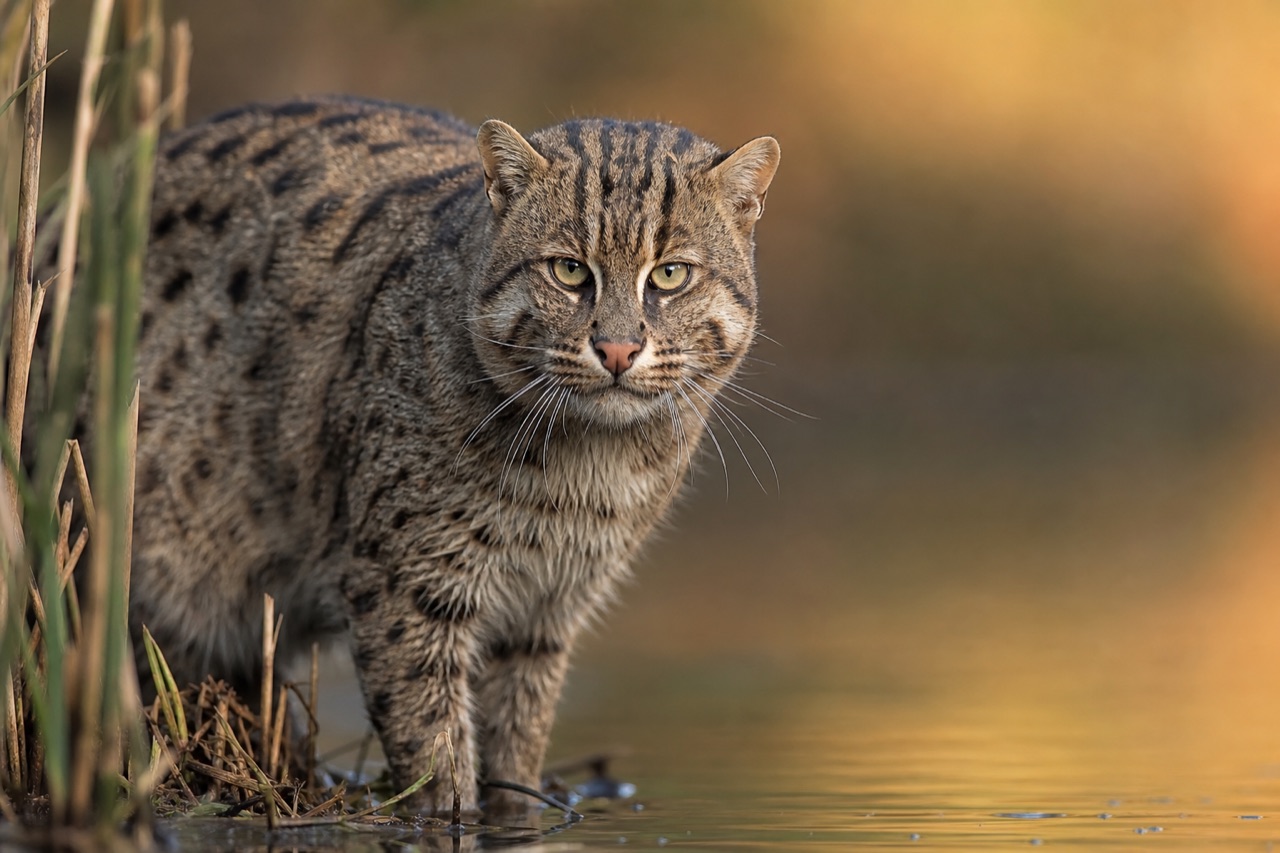
AI-generated educational wildlife portrait — World Animal Rescue Network · AI visualisation, not a photograph
In brief
The fishing cat (Prionailurus viverrinus) is a Vulnerable wetland felid of South and Southeast Asia that swims and dives to catch fish, with partially webbed toes and a stocky build adapted to marsh, mangrove and reedbed habitat.
Also in Animals A to Z · Animals that start with F
How you can help
You can support the related appeal — read its purpose, recipient status and fund terms first — or give once to where it is needed most. Sharing accurate information helps too.
By WARN Research & Conservation Team Last updated
The fishing cat is a medium-sized wild felid of South and Southeast Asian wetlands — one of the few cats that takes to water by choice rather than necessity. It swims well, dives after fish, and has partially webbed toes that help it move through marsh and mangrove. Its coat is olive-grey with dark spots and stripes, and its build is stockier than most small cats, closer to a small leopard cat in size but heavier in the frame. The name is accurate. Fishing cats eat fish, frogs, crustaceans and water birds, and they hunt at the water's edge and in shallow channels. They will also take rodents and livestock on occasion, which creates conflict with people in some areas. But the binding threat is not retaliation — it is the rapid loss of the wetlands they require. Fishing cats are also one of the most poorly known Asian felids. They are secretive, active mainly at night, and occupy habitat that is being converted faster than it can be surveyed. What is documented — from radio-telemetry studies in India, Sri Lanka and Cambodia — confirms a wetland specialist whose survival depends entirely on the persistence of marsh, mangrove and reedbed ecosystems across a region that is losing them at extraordinary speed.
Vulnerable
IUCN status — wetland loss is the main driver
Webbed toes
Partial webbing helps movement through water
Swims
One of the few cats that enters water deliberately to hunt
~90%
Of global wetlands lost since 1700 — habitat fishing cats depend on
Figures sourced from IUCN Red List — Prionailurus viverrinus, CITES Appendices .
Fishing Cat: Quick Facts
| Weight | 5–16 kg |
|---|---|
| Habitat | Wetlands — marsh, mangrove, reed swamp |
| Range | South and Southeast Asia |
| Swimming | Enters water deliberately to hunt |
| Toes | Partially webbed |
| Diet | Fish, frogs, crustaceans, birds, rodents |
| Main threat | Wetland loss and drainage |
Scientific Classification
| Kingdom | Animalia |
|---|---|
| Phylum | Chordata |
| Class | Mammalia |
| Order | Carnivora |
| Family | Felidae |
| Genus | Prionailurus |
| Species | Prionailurus viverrinus |
Conservation Status
- IUCN Status
- Vulnerable
- Population
- Unknown; suspected declining across most of the range
- Trend
- Decreasing
- Assessed
- 2016
- CITES
- Appendix II
Wetland drainage and conversion to aquaculture are the dominant threats. The species has declined or disappeared from many areas where wetlands have been lost.
Did you know?
Fishing cat claws do not fully retract — which may help them grip slippery fish, making them one of the few cats whose claws are partly deployed even at rest.
Key Facts: Fishing Cat
- Fishing cats are wetland specialists of South and Southeast Asia, listed Vulnerable by the IUCN.
- They swim and dive to catch fish, frogs and crustaceans — unusual behaviour among felids.
- Partially webbed toes and a stocky build are adaptations for marsh and mangrove life.
- Wetland drainage, aquaculture expansion and mangrove clearance are the primary threats.
- They occasionally prey on poultry and fish stocks, creating local conflict with people.
- Population declines are suspected across most of the range as wetland area shrinks.
A cat that hunts in water
Most cats avoid water. Fishing cats enter it deliberately. They swim across channels, wade through reedbeds, and dive to grab fish — sometimes using their front paws in a scooping motion that resembles a bear's fishing technique. The claws do not fully retract, which may help grip slippery prey and is one of the few felid adaptations where partially exposed claws are an advantage rather than a wear concern.
Webbing between the toes is partial rather than extensive, but enough to improve propulsion in soft mud and shallow water. The coat is dense and water-resistant, shedding moisture quickly after a swim. Combined with a muscular, low-slung body, the fishing cat is built for a habitat — marsh, mangrove, reed swamp — that most felids cannot exploit at all.
Fishing cats also hunt on land. Rodents, birds and small mammals are taken from the wetland margins, and in some areas poultry and fish from aquaculture ponds bring the cats into direct contact with people. But the core of the diet is aquatic, and the core of the habitat requirement is permanent or seasonal standing water with vegetative cover — a combination that is disappearing across tropical Asia faster than any single species can adapt.
Wetlands under pressure
The fishing cat's problem is habitat specificity in a habitat category that is disappearing fast. South and Southeast Asia have lost a large proportion of their original wetlands to drainage for agriculture, aquaculture ponds, urban expansion and mangrove clearance for coastal development. The Mekong Delta, the Ganges-Brahmaputra floodplain and the coastal wetlands of Sri Lanka and Bangladesh have all been transformed within a single human generation.
A fishing cat can use modified landscapes at the margins — irrigation channels, rice paddies, suburban ponds — but it cannot persist where wetland connectivity is gone entirely. Radio-telemetry studies in India and Sri Lanka show that fishing cats require home ranges with access to multiple water bodies and vegetative cover; a single isolated pond surrounded by cropland is not sufficient.
The IUCN Vulnerable listing reflects suspected population declines across most of the range, driven primarily by this habitat loss rather than by direct persecution, though retaliatory killing after poultry depredation occurs locally. The species has already disappeared from many areas where wetlands have been converted, and the rate of conversion shows no sign of slowing across much of South and Southeast Asia. Restoring even small wetland fragments can support fishing cats if prey and cover remain.
Conflict at the water's edge
Fishing cats occasionally take poultry, fish from aquaculture ponds and small livestock, which brings them into conflict with people living near wetlands. In Bangladesh, India and Sri Lanka, retaliatory killing and road mortality near fragmented wetland patches are documented. A fishing cat caught raiding a fish pond at night is often killed on sight.
Conflict mitigation — securing poultry at night in predator-proof enclosures, compensating documented losses, and maintaining wetland buffer zones around villages — reduces killing pressure where it has been tried. But conflict is secondary to habitat loss: a cat that still has intact marsh can feed on fish and rodents without entering a chicken coop; a cat whose marsh has been converted to aquaculture has nowhere else to go and will take whatever food is available.
The overlap between fishing cat habitat and human food production is not accidental. Wetlands are productive land, and the same water that supports fishing cats supports rice, fish farming and grazing. Resolving the conflict requires recognising that wetland conservation and human livelihood are not opposing goals — intact wetlands provide flood control, fisheries and water filtration alongside fishing cat habitat.
Why wetland cats are indicator species
Fishing cats require connected wetland systems with permanent or seasonal water, vegetative cover and prey. Their presence indicates a functioning wetland food web — fish, amphibians, rodents and birds in sufficient density to support a mid-sized predator. When fishing cats disappear from a wetland complex, it is a signal that the ecosystem has lost either its water, its prey or its connectivity.
Protecting fishing cats means protecting wetlands, which deliver flood control, water filtration, carbon storage and fisheries far beyond the cat's own ecological role. In the Chilika Lake region of India and the Haor wetlands of Bangladesh, fishing cat conservation projects have used the species as an umbrella for broader wetland protection — a strategy that works because the cat's requirements align with the wetland's ecological functions.
The Vulnerable listing is a warning, not a final verdict. Fishing cats persist in protected areas and in modified landscapes where wetland fragments remain. But the trajectory across the range is downward, and the habitat driving that decline — tropical and subtropical wetlands — is among the most threatened on Earth. Without wetland protection, the fishing cat follows the same path as the wetland itself: fragmented, drained and eventually absent.
What WARN Does
WARN publishes free, sourced species education for animals whose habitat is being erased faster than the species can be assessed. The fishing cat is a wetland indicator in a region losing wetlands at extraordinary speed — the kind of story free public education should tell clearly.
If this guide helps you understand wildlife and the pressures it faces, a gift to WARN supports habitat protection and free public education in our partner countries.
How can I help save the fishing cat?
Explore practical ways to support the fishing cat, from everyday choices and sharing reliable information to reviewing a related appeal before giving.
Explore ways to support
Read the related appeal’s purpose, recipient status and fund terms. Choose an affordable gift after checking what is proposed and what has been reported.
Ease the pressures
Avoid the wildlife trade and souvenirs, never buy wild animals as pets, and choose sustainable, habitat-friendly products — the threats behind the fishing cat's decline fall when demand does.
Spread the word
Share accurate, sourced information about the fishing cat. Wider awareness is what turns concern into lasting protection.
Fishing Cat: Frequently Asked Questions
How can I help save the fishing cat?
Do fishing cats really fish?
Why are fishing cats Vulnerable?
Can fishing cats swim?
Where do fishing cats live?
Do fishing cats attack livestock?
How big is a fishing cat?
What do fishing cats eat?
Are fishing cats dangerous?
How long do fishing cats live?
Sources & References
Population figures, conservation status and biological facts on this page are drawn from authoritative scientific and intergovernmental sources.
Terms used on this page
Plain-English definitions, from our wildlife and conservation glossary.
Latest Fishing Cat Stories
Quick, fact-checked reads on the fishing cat — amazing facts, key questions and the threats it faces.
Species
How Big Is a Markhor? Size, Weight and Those Giant Corkscrew Horns
The markhor is the largest wild goat on Earth. Here is exactly how big it gets — height, weight and the record-setting spiral horns.
Read the storySpecies
Markhor vs Ibex: How to Tell These Wild Mountain Goats Apart
Both are wild mountain goats with impressive horns, but the markhor and the ibex differ in size, horn shape and range. Here's how to tell them apart.
Read the storySpecies
12 Amazing Facts About the Snow Leopard, the Ghost of the Mountains
From a tail nearly as long as its body to leaps of up to 15 metres, here are 12 verified facts about the elusive snow leopard of Central and South Asia.
Read the storyExplore more animals
Discover more animals, their habitats and their conservation status in the WARN wildlife-guide library.
Enjoyed this Fishing Cat guide?
Receive appeal updates, animal-welfare news and published funding reports. Unsubscribe any time.
We only use your address for WARN updates. See our privacy policy.