Wildlife Guide · Oceans
Cuttlefish
Sepia officinalis
The color-changing master of camouflage
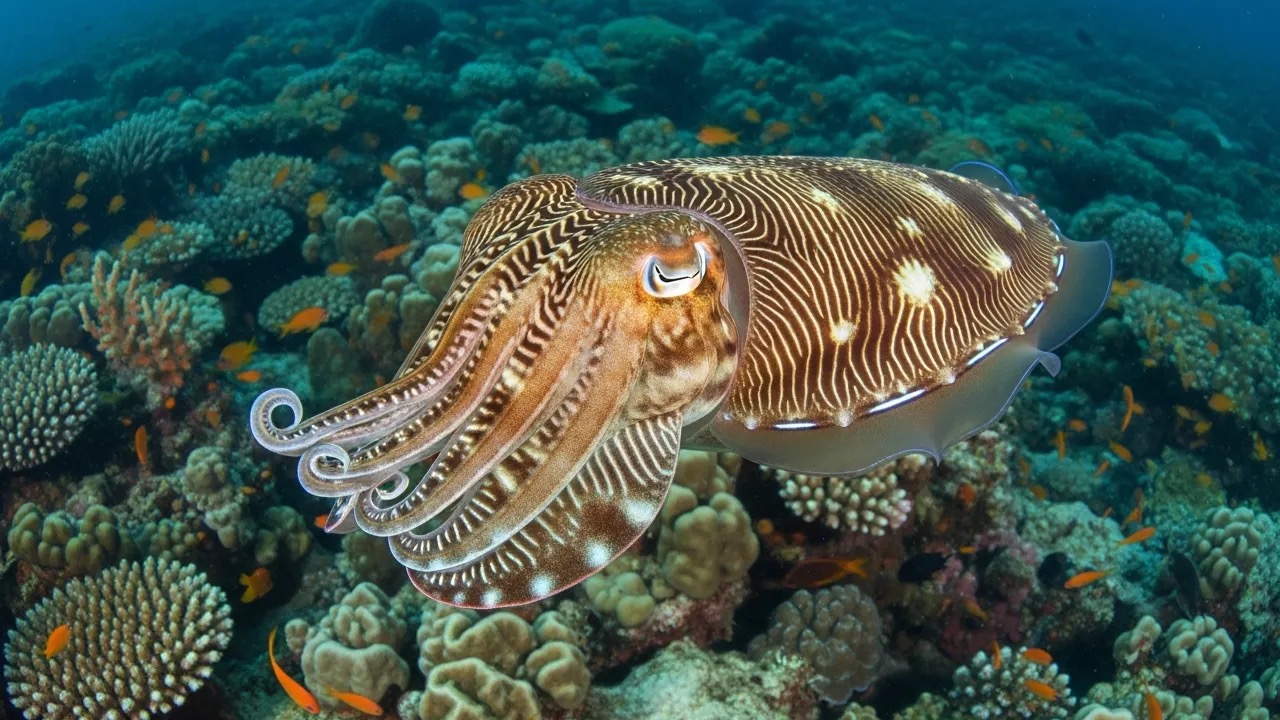
Photo: Diego Delso / Wikimedia Commons (CC BY-SA 4.0)
In brief
The common cuttlefish (Sepia officinalis) is a soft-bodied marine mollusc found over sandy seabeds and seagrass in coastal seas of the eastern Atlantic and Mediterranean. Despite its name it is not a fish but a cephalopod, related to octopuses and squid, and it can transform its colour and skin texture in a fraction of a second.
Also in Animals A to Z · Animals that start with C
By WARN Research & Conservation Team Last updated
The common cuttlefish (Sepia officinalis) is a soft-bodied marine mollusc found over sandy seabeds and seagrass in coastal seas of the eastern Atlantic and Mediterranean. Despite its name it is not a fish but a cephalopod, related to octopuses and squid, and it can transform its colour and skin texture in a fraction of a second. It grows to about 50 cm including its arms, weighs around 2 kg, and lives only one to two years.
0.5 m
Typical length
2 kg
Typical weight
25 km/h
Top speed
2 yrs
Lifespan
Figures sourced from IUCN Red List — Sepia officinalis, Wikipedia — Cuttlefish, Wikidata — Cuttlefish .
Cuttlefish: Quick Facts
| Scientific name | Sepia officinalis |
|---|---|
| Diet | Carnivore (fish, crabs, shrimp) |
| Habitat | Coastal seas, sandy seabeds, and seagrass |
| Lifespan | 1–2 years |
| Length | Up to about 50 cm (20 in) including arms |
| Top speed | Up to 25 km/h (16 mph) in a jet burst |
| Conservation status | Least Concern (IUCN) |
Scientific Classification
| Kingdom | Animalia |
|---|---|
| Phylum | Mollusca |
| Class | Cephalopoda |
| Order | Sepiida |
| Family | Sepiidae |
| Genus | Sepia |
Conservation Status
- IUCN Status
- Least Concern (IUCN Red List category)
- Population
- Global population not compiled for this guide
- Trend
- See the IUCN Red List assessment
- Assessed
- See the IUCN Red List assessment
- CITES
- See CITES appendices
Conservation figures are drawn from the IUCN Red List and CITES; this guide links to the authoritative sources rather than restating population counts.
Key Facts: Cuttlefish
- Cuttlefish are among the most accomplished quick-change artists in the animal kingdom, altering their colour, pattern and even skin texture almost instantly.
- The common cuttlefish is a patient carnivore that preys on fish, crabs and shrimp.
- For everyday travel a cuttlefish swims gracefully by rippling the fin that runs around the edge of its body.
Camouflage and colour change
Cuttlefish are among the most accomplished quick-change artists in the animal kingdom, altering their colour, pattern and even skin texture almost instantly. They achieve this using thousands of pigment cells called chromatophores, layered over reflective iridophores and leucophores that bounce light. Remarkably, cuttlefish are colour-blind, yet they still match the hues of their surroundings, probably by sensing light through their skin and detecting polarised light. This mastery lets them melt into a sandy seabed to ambush prey or vanish from a passing predator.
Hunting and diet
The common cuttlefish is a patient carnivore that preys on fish, crabs and shrimp. It stalks or waits in ambush, then shoots out two long, sucker-tipped feeding tentacles to seize prey in a fraction of a second. Its parrot-like beak, hidden at the base of the arms, breaks apart hard shells, while venom in its saliva helps subdue struggling crustaceans. Some cuttlefish also hypnotise prey with rippling bands of colour that pulse across the body before they strike.
Movement and the cuttlebone
For everyday travel a cuttlefish swims gracefully by rippling the fin that runs around the edge of its body. When it needs to flee, it draws water into its mantle and jets it out through a funnel, rocketing backwards at bursts of up to 25 km/h (16 mph). Buoyancy is controlled by the cuttlebone, a porous internal shell whose tiny gas-filled chambers let the animal hover effortlessly at any depth. If threatened it can also release a cloud of dark ink to confuse an attacker while it makes its escape.
Intelligence and senses
Cuttlefish have the largest brain-to-body ratio of almost any invertebrate and show genuine problem-solving ability. Their W-shaped pupils give excellent vision, and experiments suggest they can exercise self-control, waiting for a preferred meal rather than taking an inferior one immediately. They can even remember details of past meals, adjusting their foraging accordingly. This combination of sharp senses and a large brain makes them formidable hunters despite their short lives.
Reproduction and short life
Cuttlefish live fast and die young, surviving only one to two years. Males compete intensely for females and court them with dazzling displays of shifting colour, while smaller males sometimes disguise themselves as females to sneak past rivals. After mating, the female lays clusters of grape-like eggs, often stained black with her own ink, and attaches them to seaweed or rocks. Both parents die soon after breeding, a life cycle known as semelparity.
What WARN Does
WARN does not run a dedicated cuttlefish programme — this guide is part of the World Animal Rescue Network's free educational library. The cuttlefish is currently widespread and not globally threatened, and this guide helps readers understand the pressures that can change that. Building public understanding of species like the cuttlefish supports the broader conservation awareness that underpins WARN's partner-led rescue work across its network.
If clear, science-based wildlife guides like this help you understand and value animals, please consider supporting the World Animal Rescue Network's educational and rescue work so we can keep producing them.
Cuttlefish: Frequently Asked Questions
Is a cuttlefish a fish?
How do cuttlefish change colour?
How long do cuttlefish live?
What do cuttlefish eat?
How big do cuttlefish get?
Are cuttlefish intelligent?
Where do cuttlefish live?
Are cuttlefish dangerous?
Sources & References
Population figures, conservation status and biological facts on this page are drawn from authoritative scientific and intergovernmental sources.
Terms used on this page
Plain-English definitions, from our wildlife and conservation glossary.
Latest Cuttlefish Stories
Quick, fact-checked reads on the cuttlefish — amazing facts, key questions and the threats it faces.
Species
Why Are Sea Turtles Endangered? The Threats — and How to Help
Sea turtles have survived for more than 100 million years, yet within a few human generations most species have been pushed toward extinction. Here is what is driving the decline — bycatch, plastic, poaching and lost nesting beaches — and what actually helps.
Read the storySpecies
12 Amazing Facts About the Humpback Whale, the Ocean's Great Singer
From hours-long songs that only males sing to flippers longer than any other whale, here are 12 genuinely surprising facts about the humpback whale.
Read the storySpecies
How Big Is a Humpback Whale? Size, Weight and Strength Explained
Humpback whales reach 14 to 16 metres and weigh up to 30 tonnes, with the longest flippers of any whale. Here's how their size, weight and power really compare.
Read the storyExplore more animals
Discover more animals, their habitats and their conservation status in the WARN wildlife-guide library.
Enjoyed this Cuttlefish guide?
Receive appeal updates, animal-welfare news and published funding reports. Unsubscribe any time.
We only use your address for WARN updates. See our privacy policy.