Wildlife Guide · Coasts, estuaries, lakes and rivers worldwide & Widespread breeder and winter visitor in Britain
Cormorant
Phalacrocorax carbo (Linnaeus, 1758) — family Phalacrocoracidae
The black diver that spreads its wings to dry — and eats fish for a living.
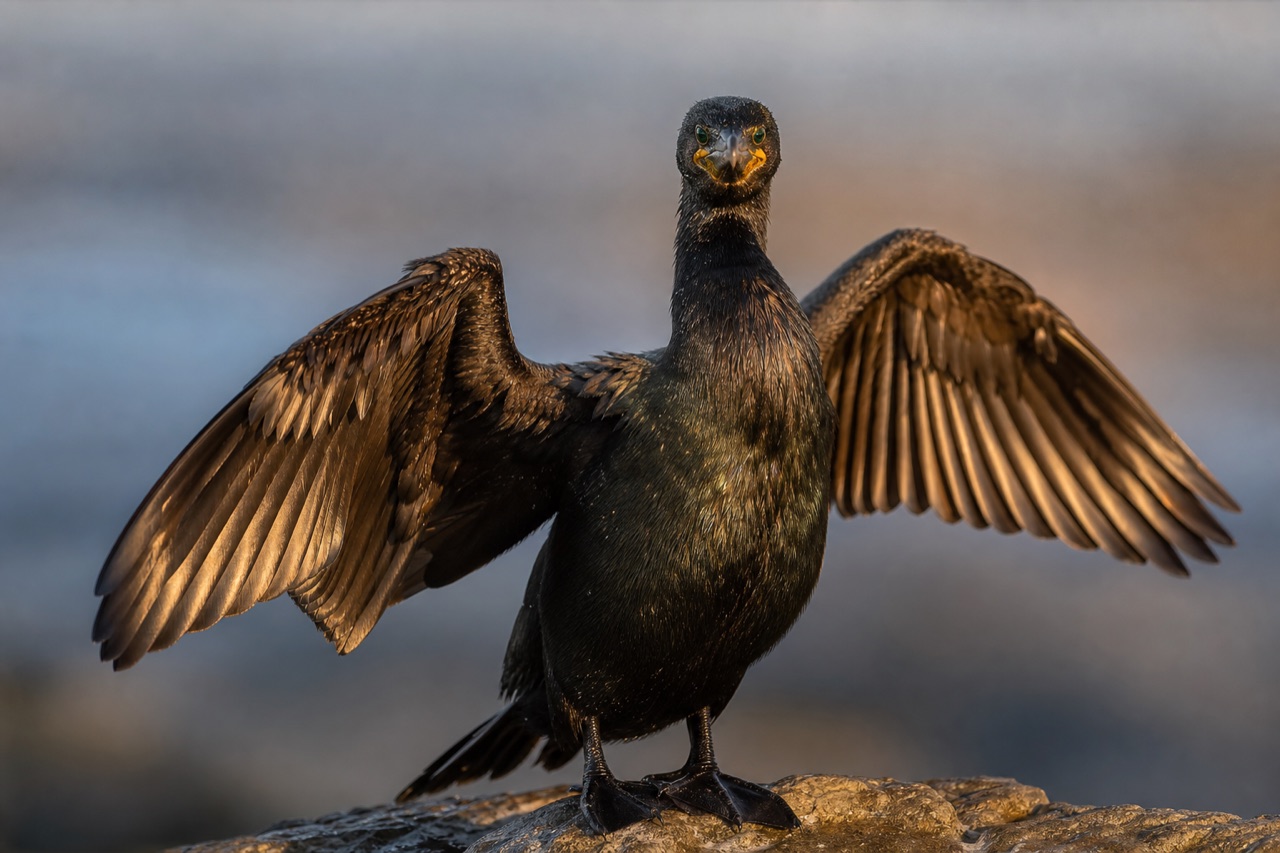
AI-generated educational wildlife portrait — World Animal Rescue Network · AI visualisation, not a photograph
In brief
The great cormorant (Phalacrocorax carbo) is a large black fish-eating bird that dives underwater, dries its wings after swimming, nests in tree or cliff colonies, and is widespread on British coasts and inland waters — with local conflict over fish consumption.
Also in Animals A to Z · Animals that start with C
By WARN Research & Conservation Team Last updated
The great cormorant is a large, black fish-eating bird with a hooked bill, webbed feet set far back on the body and a habit of standing with wings outstretched after diving — drying feathers that are not fully waterproof, unlike those of most waterbirds. It dives from the surface using powerful feet, pursues fish underwater and surfaces to swallow. Cormorants breed colonially in trees on lakes, on cliffs on coasts and on structures in estuaries — building stick nests in groups that can number hundreds of pairs. In Britain they are widespread on coasts and increasingly on inland lakes and rivers, where their fish consumption brings conflict with angling and aquaculture interests. Population trends in Europe recovered after historical persecution and pesticide damage — numbers increased through the late twentieth century. Conflict is local and economic rather than conservation-driven: cormorants eat fish that fisheries want. The bird itself is Least Concern globally, a successful generalist diver adapting to reservoirs, gravel pits and urban waterways as well as open coast. The conservation story and the fisheries story are different narratives applied to the same black bird on the harbour wall. Understanding cormorant biology — reduced feather waterproofing, colonial nesting, fish-only diet — separates legitimate fisheries management from persecution driven by misunderstanding of a native, recovered species.
Wing drying
Spreads wings after diving — feathers not fully waterproof
Underwater chase
Pursues fish by foot-propelled diving
Colonial
Nests in groups in trees, cliffs or structures
Fish diet
Exclusive fish-eater — source of fisheries conflict
Figures sourced from IUCN Red List — Phalacrocorax carbo, BTO — BirdFacts: Cormorant .
Cormorant: Quick Facts
| Length | 80–100 cm |
|---|---|
| Diet | Fish — caught by underwater diving |
| Wing drying | Feathers not fully waterproof |
| Nest | Stick platform in tree or cliff colony |
| British relative | Shag — smaller, coastal cliff nester |
| Population | Recovered in Europe; common on coast and inland water |
| Main human conflict | Fish consumption at fisheries and angling waters |
Scientific Classification
| Kingdom | Animalia |
|---|---|
| Phylum | Chordata |
| Class | Aves |
| Order | Suliformes |
| Family | Phalacrocoracidae |
| Genus | Phalacrocorax |
| Species | Phalacrocorax carbo |
Conservation Status
- IUCN Status
- Least Concern
- Population
- Large global population; widespread in Britain on coast and inland water
- Trend
- Increasing in parts of Europe after historical recovery
- Assessed
- 2018
- CITES
- Not listed
Not a conservation priority. Local fisheries conflict is economic management, not species recovery.
Did you know?
Cormorant feathers absorb water on purpose — less buoyancy underwater means better diving, but wings must dry between fishing trips.
Key Facts: Cormorant
- Cormorants are large black divers that eat fish exclusively, pursuing prey underwater.
- They stand with wings outstretched to dry after diving — feathers lack full waterproofing.
- Nest colonially in trees on lakes, on cliffs or on estuary structures.
- British populations recovered after historical persecution; now common on coast and inland water.
- Conflict with angling and fish farms is economic and local — cormorants eat stocked and wild fish.
- Smaller shag (Phalacrocorax aristotelis) is the coastal cliff breeder — do not confuse with cormorant.
- Least Concern globally — a generalist fish predator, not a conservation priority species.
Built for diving — not for floating
Cormorants carry less preen oil than ducks and grebes, so their feathers absorb water during dives. That reduces buoyancy — an advantage underwater where the bird walks and swims with foot propulsion pursuing fish — but means they must dry out after fishing. The wings-spread posture on rocks, buoys and trees is thermoregulation and drying, not merely display.
Dives last from tens of seconds to over a minute; cormorants take a wide size range of fish depending on availability. In freshwater they concentrate where fish aggregate — weirs, reservoir outflows, fish farm cages. On coast they forage in estuaries, harbours and shallow sea.
The hooked bill grips slippery prey; the bird surfaces, tosses the fish and swallows head-first. A skilled cormorant can take substantial daily weight in fish — which is exactly why fisheries notice them. The same diving efficiency that makes cormorants fascinating to watch makes them unpopular where stocked fish are the product.
Double-crested and other cormorant relatives occur globally — the great cormorant's success in western Europe reflects legal protection, abundant artificial water bodies and fish stocks that support generalist diving. Population growth on inland lakes is a post-recovery phenomenon, not an invasion of a new species.
Freshwater anglers sometimes confuse cormorants with goosanders or mergansers — all fish-eaters, but cormorants dive from the surface while mergansers are diving ducks with different ecology and legal status. Correct identification focuses fisheries concern on the species actually present.
Pygmy cormorant and other continental relatives do not breed in Britain — great cormorant is the default British record. Occasional shag-cormorant confusion on rocky coast is the main identification issue for coastal birdwatchers.
Colonies in trees and on cliffs
Great cormorants nest in colonies — stick nests in trees on lake islands, on cliff ledges on coasts, or on artificial structures. Colonies grow when food is reliable and shrink when disturbance or prey failure occurs. Breeding birds develop white thigh patches in season; juveniles are browner with pale underparts.
Inland tree colonies can damage nesting trees through accumulated guano — a management issue on nature reserves where cormorants colonise new water bodies. Coastal cliff colonies overlap with shags in some areas but cormorants use broader habitat.
The shag is the smaller, greener, cliff-nesting relative — breeding on rocky coasts, less often on inland water. Confusion between cormorant and shag is common; shag has a steep forehead and breeds on narrow ledges, cormorant is bulkier and uses trees inland. Telling them apart matters because population trends and habitat use differ — shag is more tied to rocky coast, cormorant is the generalist.
Cormorant digestion is fast — fish pass through quickly, which means cormorants must dive repeatedly through the day to meet energy needs. A cormorant at a weir may dive at intervals of minutes for hours, which makes the cumulative fish take visible to anglers even when individual catches seem small.
Tree-nesting cormorants damage island woodland on some lakes through guano — managers sometimes face trade-offs between cormorant conservation status and woodland habitat protection on the same reserve.
Fisheries conflict and population recovery
Cormorants were persecuted historically — shot, nest-destroyed, driven from fisheries. Populations in western Europe recovered through legal protection and reduced pesticide load. Numbers on inland waters increased as reservoirs and gravel pits provided new foraging and nesting habitat.
Modern conflict centres on fish farms, stocked trout rivers and commercial inland fisheries. Cormorants take fish at weirs and cages; anglers report reduced catch where cormorant numbers are high. Management includes scaring devices, limited licensed control in some jurisdictions, and habitat measures — not elimination, which would be ecologically disproportionate for a Least Concern species.
The conservation biology is separate from the economics: cormorants are native fish predators doing what they evolved to do. Fisheries that stock dense fish in open water attract predators predictably. Resolution is management and design — cages, refuges, scaring — rather than treating cormorants as invasive. Least Concern status reflects recovery, not absence of conflict.
Winter cormorant roosts on lakes and estuaries can hold hundreds of birds commuting to feeding sites at dawn. Roost disturbance or destruction forces birds to new water bodies — which can shift fisheries conflict from one angling water to another without reducing total cormorant numbers in the region.
Angling clubs stock fish that cormorants predictably take — the economic conflict is partly a product of stocking density and fish size at release, not cormorant population alone.
Watching cormorants — coast, river and reservoir
Cormorants are easy to watch — they sit conspicuously on rocks, buoys and dead trees, dive visibly and form commuting lines between roost and feeding areas at dawn and dusk. On rivers they perch on branches overhanging deep pools; on coast they raft in harbours.
For birdwatchers, flight silhouette is distinctive — long neck, straight bill, wings beating steadily, often low over water. Juvenile groups on estuaries in winter can number dozens.
They are not a garden bird except where large lakes lie nearby. Their story is waterbody ecology — fish stocks, wetland protection, and the human choice to stock fish where divers will find them. Least Concern status reflects success; local conflict reflects competition, not rarity. The wings spread on the post are drying; the bird beneath them is a recovered native predator, not a conservation emergency.
Photography and tourism value cormorants on harbour posts and rocky coasts — the wings-spread posture is iconic. That cultural visibility sits awkwardly beside fisheries hostility inland; the same species is admired on the coast and resented on a trout reservoir fifty miles away.
Cormorant flight lines at dawn — birds commuting from roost to feeding water — are predictable enough for fisheries to schedule scaring or protective measures, which is part of pragmatic coexistence on shared water bodies.
What WARN Does
WARN publishes free, sourced species education for coastal and freshwater birds people see daily. The cormorant dries its wings on your harbour wall — a fish predator recovered from persecution, now in local conflict with fisheries rather than global decline.
If this guide helps you understand wildlife and the pressures it faces, a gift to WARN supports habitat protection and free public education in our partner countries.
Cormorant: Frequently Asked Questions
Why do cormorants spread their wings?
What do cormorants eat?
What is the difference between cormorant and shag?
Are cormorants protected?
Are cormorants increasing?
Where do great cormorants live?
Are great cormorants dangerous?
How long do great cormorants live?
How big is a great cormorant?
Sources & References
Population figures, conservation status and biological facts on this page are drawn from authoritative scientific and intergovernmental sources.
Terms used on this page
Plain-English definitions, from our wildlife and conservation glossary.
Explore more animals
Discover more animals, their habitats and their conservation status in the WARN wildlife-guide library.
Enjoyed this Cormorant guide?
Receive appeal updates, animal-welfare news and published funding reports. Unsubscribe any time.
We only use your address for WARN updates. See our privacy policy.