Wildlife Guide · Sub-Saharan Africa & Savanna woodland, forest edge and riverine bush
Bushbaby
Galago senegalensis (É. Geoffroy, 1796) — family Galagidae
A primate the size of a squirrel with eyes too big for its face and legs that can leap six metres.
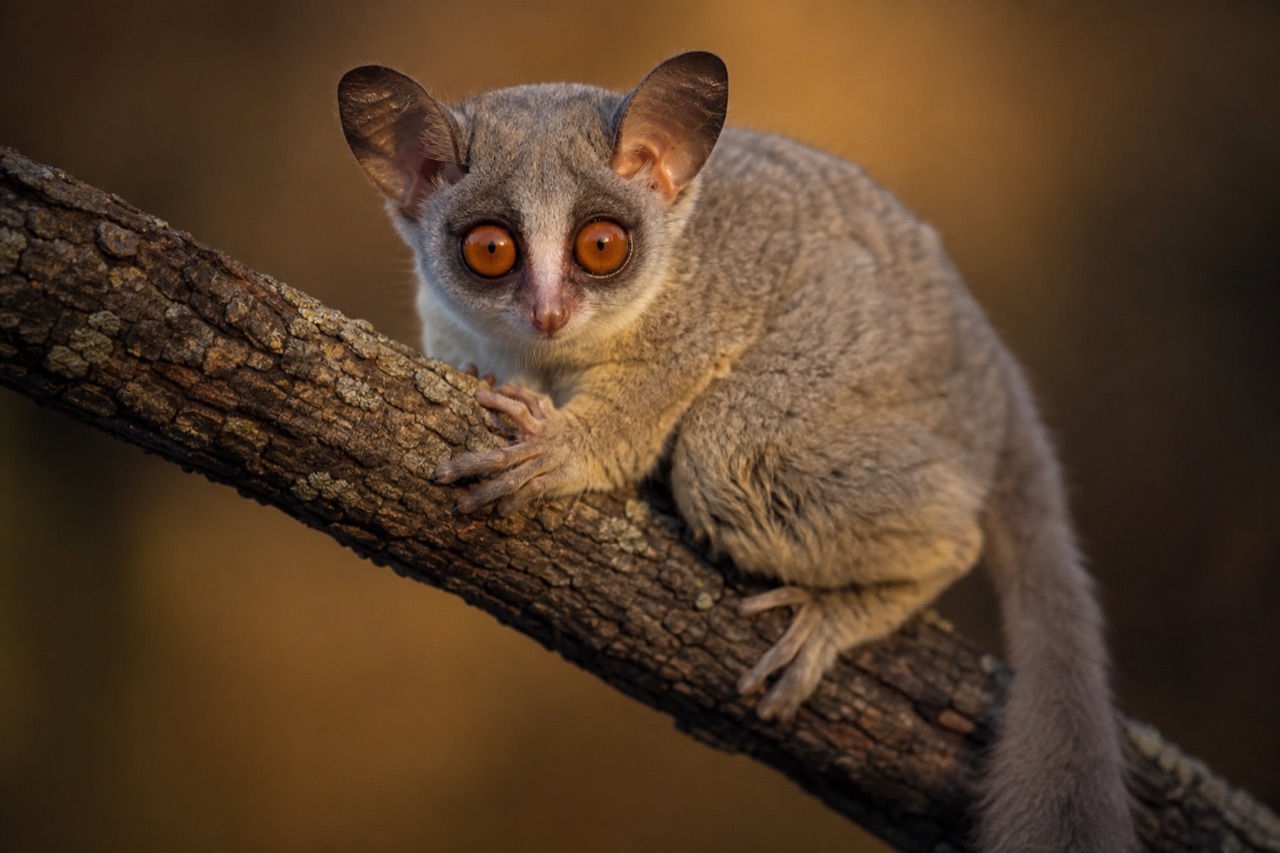
AI-generated educational wildlife portrait — World Animal Rescue Network · AI visualisation, not a photograph
In brief
Bushbabies (family Galagidae) are small nocturnal primates of sub-Saharan Africa; the Senegal bushbaby (Galago senegalensis) weighs under 300 g, has eyes roughly the size of its brain, and can leap six metres between branches.
Also in Animals A to Z · Animals that start with B
By WARN Research & Conservation Team Last updated
Bushbabies — also called galagos — are small nocturnal primates of sub-Saharan Africa, named for the child-like cries that carry through woodland at night. The best-known species, the Senegal bushbaby, weighs less than 300 g but possesses enormous eyes — each eye is roughly the same size as its brain — and hind legs powerful enough to leap six metres between branches. Around twenty species exist across the family Galagidae, ranging from the tiny Rondo dwarf galago to the cat-sized brown greater galago. They are strictly nocturnal, feeding on insects, gum, fruit and small vertebrates, and they occupy a primate niche that lemurs and lorises occupy elsewhere. Most are Least Concern, though several less-known species are threatened by forest loss and fragmentation. Bushbabies are among the oldest lineages of primates — strepsirrhines, the branch that diverged from the monkey and ape line over fifty million years ago. Their combination of enormous night-vision eyes, powerful leaping legs and loud territorial calls makes them one of the most distinctive sounds of African woodland after dark, even if the animals themselves are rarely seen by day.
~20
Species in the family Galagidae
6 m
Maximum leap distance between branches
Eye ≈ brain
Each eye is roughly the size of the brain
Nocturnal
Strictly active at night across all species
Figures sourced from IUCN Red List — Galago senegalensis, IUCN Red List — Galagidae .
Bushbaby: Quick Facts
| Weight | 200–300 g (Senegal bushbaby) |
|---|---|
| Family | Galagidae — around 20 species |
| Eyes | Each roughly the size of the brain |
| Leap | Up to 6 m between branches |
| Activity | Strictly nocturnal |
| Diet | Insects, tree gum, fruit, small vertebrates |
| Range | Sub-Saharan Africa — savanna woodland and forest edge |
Scientific Classification
| Kingdom | Animalia |
|---|---|
| Phylum | Chordata |
| Class | Mammalia |
| Order | Primates |
| Suborder | Strepsirrhini |
| Family | Galagidae |
| Species | Galago senegalensis (Senegal bushbaby) |
Conservation Status
- IUCN Status
- Least Concern
- Population
- Unknown; considered common within suitable habitat
- Trend
- Stable for most species; decreasing for several restricted-range species
- Assessed
- 2019
- CITES
- Appendix II (Galago senegalensis)
Most galago species are Least Concern, but forest loss threatens several lesser-known species with restricted ranges, including the Critically Endangered Rondo dwarf galago.
Did you know?
Each bushbaby eye is roughly the same size as its brain — not because the brain is small, but because the visual system demands that much neural investment for life in near-total darkness.
Key Facts: Bushbaby
- Bushbabies, or galagos, are small nocturnal primates of sub-Saharan Africa in the family Galagidae.
- The Senegal bushbaby weighs under 300 g but can leap six metres between branches using powerful hind legs.
- Their enormous eyes — each roughly the size of their brain — are adaptations for night vision.
- They feed on insects, tree gum, fruit and small vertebrates, and are strictly nocturnal.
- Around twenty species exist; most are Least Concern but several lesser-known species face forest loss.
- Their loud, child-like calls at night are the origin of the name 'bushbaby'.
- They occupy the same ecological niche as lorises and some lemurs — small nocturnal primate insectivores.
Eyes built for darkness
Bushbaby eyes dominate the face — large, round and forward-facing, with a tapetum lucidum behind the retina that reflects light back through the photoreceptors, doubling sensitivity in low light. Each eye is roughly the same volume as the animal's brain, which is not a coincidence: vision is the primary sense, and the neural investment follows.
Their ears are independently mobile and large, capable of pinpointing insect prey by sound alone. Combined with hypersensitive whiskers and a keen sense of smell, bushbabies navigate and hunt in near-total darkness. They are among the most thoroughly nocturnal of all primates, emerging after sunset and retreating to tree hollows or dense vegetation before dawn.
The tapetum lucidum produces the eyeshine visible when light catches a bushbaby at night — a green or orange glow that is the same mechanism producing eyeshine in cats, dogs and other nocturnal mammals. In bushbabies, the effect is particularly striking because the eyes are so large relative to the head. The visual system processes motion and depth in conditions where a diurnal primate would be effectively blind, which is why bushbabies can leap six metres between branches in near-total darkness without hesitation.
Leaps that cover six metres
Bushbaby hind legs are disproportionately long and muscular — roughly twice the length of the forelimbs — and adapted for vertical clinging and leaping, a locomotion style called saltation. A Senegal bushbaby can leap six metres between branches, using its tail for balance and its hands to grab on landing.
The power-to-weight ratio is extraordinary for a mammal. Elastic energy stored in tendons during crouch contributes to launch, and the landing is cushioned by flexible ankles and grasping hands with moist pads that grip bark. This is not an animal that walks between trees — it launches, and the forest it inhabits must have sufficient branch spacing and connectivity to make those launches possible.
When moving on the ground or along branches, bushbabies use a hopping gait — both hind feet together, then the forelimbs — that is distinctive and efficient for an animal of this size. Their locomotion is adapted for fine-branch niche: the outer twigs and small branches where larger primates cannot follow, and where insect prey is abundant but hard for heavier animals to reach. Loss of woodland connectivity breaks this locomotion entirely — a bushbaby cannot cross open ground between isolated tree patches.
A family of around twenty species
Galagidae contains around twenty species across sub-Saharan Africa, from the tiny Rondo dwarf galago — one of the smallest primates — to the brown greater galago, which weighs over a kilogram. Senegal bushbaby is among the best-known, ranging across West and East African savanna woodland from Senegal to Kenya.
Most galago species are Least Concern, but several lesser-known species with restricted ranges are threatened. The Rondo dwarf galago of Tanzania is Critically Endangered, confined to a few coastal forest fragments totalling less than a hundred square kilometres. Forest loss across East Africa affects species that depend on connected woodland canopy for their leaping locomotion — a gap in the trees is not an inconvenience but a barrier that can isolate populations permanently.
Taxonomy of the family has been revised repeatedly as genetic studies reveal hidden diversity. Several species previously considered subspecies of the Senegal bushbaby are now recognised as separate species, each with a narrower range and potentially greater conservation concern than the Least Concern listing of the best-known species implies. The bushbaby family is likely more diverse, and more locally threatened, than the familiar Least Concern label for *Galago senegalensis* suggests.
Gum, insects and the night economy
Bushbabies are dietary generalists of the night forest. Insects — grasshoppers, moths, beetles — are the primary protein source, caught by hand or pounced on from branches. Tree gum, oozing from Acacia and other species, provides carbohydrate and is accessed by scraping with specialised incisors that are shaped like a fine-toothed comb. Gum feeding can occupy much of a foraging night during dry seasons in the savanna.
Fruit and small vertebrates supplement the diet seasonally. Gum-feeding is particularly important in dry seasons when insects are scarce — bushbabies return to the same gum-producing trees repeatedly, and the ability to exploit this resource may be one reason they persist in savanna woodland where fruit availability is seasonal. A bushbaby that finds a reliable gum tree will defend access to it within its territory.
Their loud vocalisations — cries, croaks and chattering that sound startlingly like a human infant — serve territorial and social functions. Pairs or small family groups occupy overlapping home ranges, and the calls that give bushbabies their name advertise presence to rivals and mates across the dark woodland. A bushbaby calling at night is claiming space, not expressing distress — though the sound reliably startles people hearing it for the first time. In many African communities, the call is a familiar part of the soundscape; in Western popular culture, it is often misidentified as an owl or an unknown animal crying in distress.
What WARN Does
WARN publishes free, sourced species education for nocturnal species that most people hear but never see. Bushbabies are common in African woodland but poorly known outside their range — the kind of animal where free accurate information helps people understand a continent's biodiversity beyond the flagship species.
If this guide helps you understand wildlife and the pressures it faces, a gift to WARN supports habitat protection and free public education in our partner countries.
Bushbaby: Frequently Asked Questions
Why are they called bushbabies?
How far can a bushbaby leap?
Why do bushbabies have such big eyes?
Are bushbabies monkeys?
What do bushbabies eat?
Where do bushbabies live?
Are bushbabies dangerous?
How big is a bushbaby?
How long do bushbaby / galago / lesser galagos live?
Sources & References
Population figures, conservation status and biological facts on this page are drawn from authoritative scientific and intergovernmental sources.
Terms used on this page
Plain-English definitions, from our wildlife and conservation glossary.
Latest Bushbaby Stories
Quick, fact-checked reads on the bushbaby — amazing facts, key questions and the threats it faces.
Species
Tiger vs Lion: 7 Key Differences Between the Two Biggest Cats
Tigers are bigger, stripier and solitary; lions are social and live in prides. Here's how the two largest cats really differ in size, habitat and behaviour.
Read the storySpecies
12 Astonishing Facts About the Pangolin, the World's Only Scaly Mammal
From a tongue anchored near its pelvis to scales that weigh a fifth of its body, the pangolin is one of nature's strangest mammals. Here are 12 facts that explain why.
Read the storySpecies
How Big Is a Pangolin — and How Long Is Its Tongue?
Pangolins range from house-cat size to over 30 kg, and the largest have a tongue longer than their entire body. Here are the real numbers.
Read the storyExplore more animals
Discover more animals, their habitats and their conservation status in the WARN wildlife-guide library.
Enjoyed this Bushbaby guide?
Receive appeal updates, animal-welfare news and published funding reports. Unsubscribe any time.
We only use your address for WARN updates. See our privacy policy.