Wildlife Guide · Oceans & North America
Blue Crab
Callinectes sapidus
The swift swimming crab of Atlantic estuaries
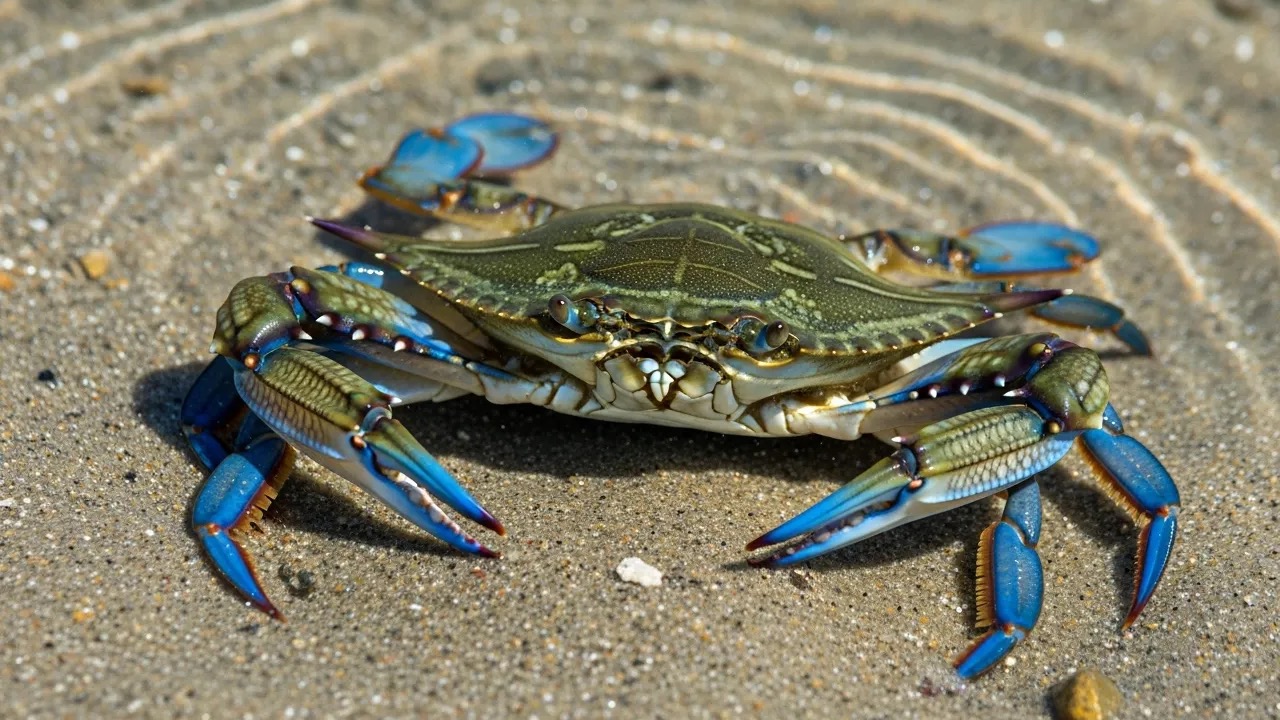
Photo: NOAA-JMA / Wikimedia Commons (CC BY 4.0)
In brief
The blue crab (Callinectes sapidus) is a swift swimming crab of the western Atlantic, abundant in the brackish estuaries of the United States east coast and Gulf of Mexico. It has a broad shell up to about 23 cm (9 in) across and a pair of flattened rear legs that let it swim sideways through the water.
Also in Animals A to Z · Animals that start with B
By WARN Research & Conservation Team Last updated
The blue crab (Callinectes sapidus) is a swift swimming crab of the western Atlantic, abundant in the brackish estuaries of the United States east coast and Gulf of Mexico. It has a broad shell up to about 23 cm (9 in) across and a pair of flattened rear legs that let it swim sideways through the water. An omnivore that lives three to four years, it is listed as Least Concern.
0.23 m
Typical length
450 g
Typical weight
1.5 km/h
Top speed
4 yrs
Lifespan
Figures sourced from Wikipedia — Blue Crab, Wikidata — Blue Crab .
Blue Crab: Quick Facts
| Scientific name | Callinectes sapidus |
|---|---|
| Diet | Omnivore (fish, mollusks, plants, carrion) |
| Habitat | Estuaries and coastal waters of the western Atlantic |
| Lifespan | 3–4 years |
| Size | Shell up to about 23 cm (9 in) across |
| Top speed | Swims sideways with paddle-shaped legs |
| Conservation status | Least Concern (IUCN) |
Scientific Classification
| Kingdom | Animalia |
|---|---|
| Phylum | Arthropoda |
| Class | Malacostraca |
| Order | Decapoda |
| Family | Portunidae |
| Genus | Callinectes |
Conservation Status
- IUCN Status
- Least Concern (IUCN Red List category)
- Population
- Global population not compiled for this guide
- Trend
- See the IUCN Red List assessment
- Assessed
- See the IUCN Red List assessment
- CITES
- See CITES appendices
Conservation figures are drawn from the IUCN Red List and CITES; this guide links to the authoritative sources rather than restating population counts.
Key Facts: Blue Crab
- Unlike most crabs, the blue crab is a strong swimmer rather than a purely bottom-dwelling walker.
- Blue crabs live along the western Atlantic, from Nova Scotia south through the Gulf of Mexico and down to Argentina, with their heartland in the estuaries of Chesapeake Bay and the US east coast.
- The blue crab is an opportunistic omnivore that eats almost anything it can catch or scavenge.
Swimming and body plan
Unlike most crabs, the blue crab is a strong swimmer rather than a purely bottom-dwelling walker. Its last pair of legs is flattened into broad paddles that beat rapidly, propelling the crab sideways through open water. On the seabed it also crawls on its walking legs, but the swimming paddles let it cover distance quickly and escape predators. The shell can reach about 23 cm (9 in) from spine to spine, and the crab weighs up to roughly 0.45 kg (1 lb).
Habitat and range
Blue crabs live along the western Atlantic, from Nova Scotia south through the Gulf of Mexico and down to Argentina, with their heartland in the estuaries of Chesapeake Bay and the US east coast. They thrive in the brackish mixing zone where rivers meet the sea, tolerating a wide range of salinity. Adults move between deeper, saltier water and shallow grassy flats depending on the season and their stage of life. Seagrass beds and marsh edges offer both feeding grounds and shelter for moulting individuals.
Diet and feeding
The blue crab is an opportunistic omnivore that eats almost anything it can catch or scavenge. Its menu includes small fish, clams, mussels and other molluscs, worms, plant matter, and carrion. Powerful claws let it crush shellfish, while it also scours the bottom for decaying material, helping to clean the estuary. This broad diet makes the blue crab an important link in the coastal food web.
Life cycle and reproduction
Female blue crabs mate only once, shortly after their final moult into adulthood, and store sperm to fertilise multiple batches of eggs. A female carries a spongy egg mass beneath her abdomen, sometimes holding two million eggs, and migrates to saltier water near the sea mouth to release the larvae. The tiny larvae drift in the plankton before settling and growing through a series of moults. Blue crabs typically live three to four years.
Fisheries and human use
The blue crab supports one of the most valuable shellfish fisheries on the US Atlantic and Gulf coasts, and its scientific name sapidus means "savoury" or "tasty". Crabs caught just after moulting, while their new shell is still soft, are sold as prized soft-shell crabs. Chesapeake Bay in particular has a long crabbing culture built around the species. Careful management of catch limits and female crabs helps keep the fishery sustainable.
Conservation status
The blue crab is listed as Least Concern and remains widespread and common across its range. Populations do rise and fall with fishing pressure, water quality, and habitat condition in estuaries such as Chesapeake Bay. Loss of seagrass and pollution can reduce local numbers, so monitoring and catch limits are used to keep stocks healthy. Overall the species is not considered threatened.
What WARN Does
WARN does not run a dedicated blue crab programme — this guide is part of the World Animal Rescue Network's free educational library. The blue crab is currently widespread and not globally threatened, and this guide helps readers understand the pressures that can change that. Building public understanding of species like the blue crab supports the broader conservation awareness that underpins WARN's partner-led rescue work across its network.
If clear, science-based wildlife guides like this help you understand and value animals, please consider supporting the World Animal Rescue Network's educational and rescue work so we can keep producing them.
Blue Crab: Frequently Asked Questions
Can blue crabs swim?
How big do blue crabs get?
What do blue crabs eat?
Where do blue crabs live?
How long do blue crabs live?
What is a soft-shell crab?
Are blue crabs dangerous?
Sources & References
Population figures, conservation status and biological facts on this page are drawn from authoritative scientific and intergovernmental sources.
Terms used on this page
Plain-English definitions, from our wildlife and conservation glossary.
Latest Blue Crab Stories
Quick, fact-checked reads on the blue crab — amazing facts, key questions and the threats it faces.
Species
Why Are Sea Turtles Endangered? The Threats — and How to Help
Sea turtles have survived for more than 100 million years, yet within a few human generations most species have been pushed toward extinction. Here is what is driving the decline — bycatch, plastic, poaching and lost nesting beaches — and what actually helps.
Read the storySpecies
12 Amazing Facts About the Humpback Whale, the Ocean's Great Singer
From hours-long songs that only males sing to flippers longer than any other whale, here are 12 genuinely surprising facts about the humpback whale.
Read the storySpecies
How Big Is a Humpback Whale? Size, Weight and Strength Explained
Humpback whales reach 14 to 16 metres and weigh up to 30 tonnes, with the longest flippers of any whale. Here's how their size, weight and power really compare.
Read the storyExplore more animals
Discover more animals, their habitats and their conservation status in the WARN wildlife-guide library.
Enjoyed this Blue Crab guide?
Receive appeal updates, animal-welfare news and published funding reports. Unsubscribe any time.
We only use your address for WARN updates. See our privacy policy.