Wildlife Guide · Sulawesi, Indonesia & Wallacea — northeastern peninsula forests
Crested Black Macaque
Macaca nigra (Desmarest, 1822) — family Cercopithecidae
A Critically Endangered monkey that became famous for a selfie it did not benefit from.
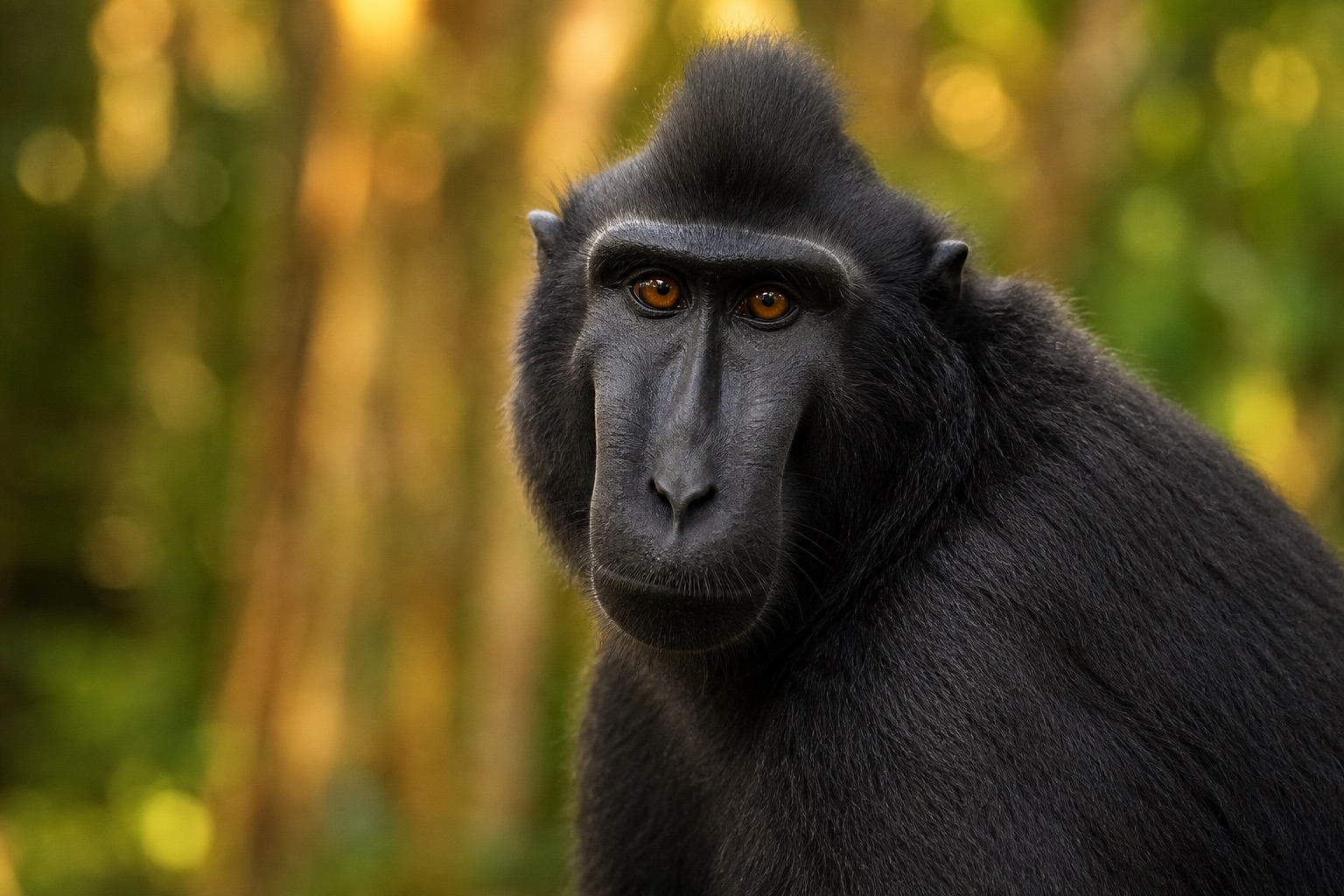
AI-generated educational wildlife portrait — World Animal Rescue Network · AI visualisation, not a photograph
In brief
The crested black macaque (Macaca nigra) is a Critically Endangered all-black monkey endemic to northeastern Sulawesi, threatened by hunting and forest loss; it became famous through 2011 selfie photographs, but copyright law does not protect the species from decline.
Also in Animals A to Z · Animals that start with C
How you can help
You can support the related appeal — read its purpose, recipient status and fund terms first — or give once to where it is needed most. Sharing accurate information helps too.
By WARN Research & Conservation Team Last updated
The crested black macaque — Macaca nigra — is a forest monkey endemic to northeastern Sulawesi, entirely black with a short crest, long limbs and a pinkish bare face. It is listed Critically Endangered, with populations collapsed from hunting, forest conversion and capture for bushmeat and the pet trade. Remaining groups are concentrated in a few forest blocks including Tangkoko and other protected areas, but enforcement is uneven and forest outside reserves continues to shrink. The species became globally famous in 2011 when a camera triggered by a macaque at Tangkoko produced grinning self-portraits that circulated as the monkey selfie. A long copyright dispute followed over who owned the image; courts held that non-human animals cannot hold copyright. The legal argument obscured the biological one: the monkey in the photograph belongs to a species with a sharply declining population on an island losing forest — not a meme with a happy ending.
CR
Critically Endangered — steep population decline
Endemic
Northeastern Sulawesi only
All black
Crest, coat and skin tones — pinkish bare face
2011
Selfie camera-trap images brought global attention
Figures sourced from IUCN Red List — Macaca nigra, BBC — monkey selfie copyright ruling .
Crested Black Macaque: Quick Facts
| IUCN status | Critically Endangered |
|---|---|
| Range | Northeastern Sulawesi only |
| Appearance | All black with short crest; pinkish bare face |
| Social system | Multimale-multifemale groups |
| Fame | 2011 camera-trap selfie images |
| Main threats | Hunting; forest conversion; pet trade |
Scientific Classification
| Kingdom | Animalia |
|---|---|
| Phylum | Chordata |
| Class | Mammalia |
| Order | Primates |
| Family | Cercopithecidae |
| Genus | Macaca |
| Species | Macaca nigra |
Conservation Status
- IUCN Status
- Critically Endangered
- Population
- Steep decline — exact numbers uncertain
- Trend
- Decreasing
- Assessed
- 2016
- CITES
- Appendix II
Viral selfie fame in 2011 did not reduce hunting or forest loss. Populations remain concentrated in a few forest blocks.
Did you know?
United States courts ruled the 2011 crested black macaque selfies could not be owned by the monkey — copyright requires human authorship — while the species itself remained Critically Endangered on Sulawesi.
Key Facts: Crested Black Macaque
- The crested black macaque is Critically Endangered, endemic to northeastern Sulawesi, with populations collapsed from hunting and forest conversion.
- It is entirely black with a short crest and pinkish facial skin, living in social groups in lowland rainforest.
- Remaining populations are concentrated in a few forest areas; forest outside protected blocks continues to be cleared and hunted.
- In 2011 a macaque triggered a camera at Tangkoko and produced selfie images that went viral worldwide.
- Copyright litigation over the selfies concluded that animals cannot hold copyright — the legal outcome did not benefit the species or its habitat.
- Hunting for bushmeat and capture for trade, plus forest conversion on Sulawesi, remain the threats that matter — not the photograph.
Critically Endangered on Sulawesi
Macaca nigra occurs only on northeastern Sulawesi. Historical range extended across more lowland forest than remains today; hunting and clearance have removed populations from much of the peninsula. Social groups need large home ranges with fruiting trees and sleeping sites; fragmented forest supports fewer groups and increases conflict at forest edges.
The Critically Endangered listing reflects sharp decline, not rarity of photographs. Tangkoko and other sites where tourists see macaques are not representative — animals there are habituated and partially protected, while forest elsewhere on the peninsula is cleared or hunted without the same visibility.
Ecology and behaviour
Crested black macaques live in multimale-multifemale groups, foraging for fruit, leaves, insects and crops where forest meets farmland. They are terrestrial more than arboreal compared with many forest monkeys, which exposes them to snares and hunting dogs.
Short crests, all-black pelage and pale pink ischial callosities distinguish them from other Sulawesi macaques. Males are larger and carry larger canines. Reproduction is slow relative to body size — single infants, long dependency — so population recovery from hunting requires years of reduced mortality, not merely a protected area on a map.
The selfie story, corrected
In 2011 wildlife photographer David Slater left a camera in Tangkoko; a crested black macaque pressed the shutter and produced several sharp self-portraits. The images spread online as the monkey selfie.
A dispute followed over copyright ownership, including a claim that the macaque should own the image. United States courts ruled that copyright requires human authorship — animals cannot hold copyright. The case consumed years of legal argument and fundraising unrelated to forest protection on Sulawesi.
The corrected framing: the monkey is a Critically Endangered species; the selfie brought fame without habitat funding or hunting enforcement. Viral attention is not conservation.
Hunting, trade and forest conversion
Sulawesi macaques are hunted for bushmeat and captured for local pet trade. Black macaques are conspicuous and group-living, which makes them vulnerable to drive hunting and snares. Forest conversion for crops and plantations removes fruit sources and sleeping trees.
Protection requires enforced hunting bans in remaining forest, connectivity between reserves, and reduced demand for pet macaques. Tourist sites that feed macaques for photographs create dependency and disease risk — a separate problem from the copyright case but part of the same human interface. The species needs forest standing and guns absent more than it needs another headline.
What WARN Does
WARN publishes free, sourced species education, including where viral fame obscures decline. The crested black macaque is Critically Endangered on Sulawesi; the 2011 selfie copyright dispute did not slow hunting or forest loss — those remain the pressures that determine whether the species persists.
If this guide helps you understand wildlife and the pressures it faces, a gift to WARN supports habitat protection and free public education in our partner countries.
How can I help save the crested black macaque?
Explore practical ways to support the crested black macaque, from everyday choices and sharing reliable information to reviewing a related appeal before giving.
Explore ways to support
Read the related appeal’s purpose, recipient status and fund terms. Choose an affordable gift after checking what is proposed and what has been reported.
Ease the pressures
Avoid the wildlife trade and souvenirs, never buy wild animals as pets, and choose sustainable, habitat-friendly products — the threats behind the crested black macaque's decline fall when demand does.
Spread the word
Share accurate, sourced information about the crested black macaque. Wider awareness is what turns concern into lasting protection.
Crested Black Macaque: Frequently Asked Questions
How can I help save the crested black macaque?
What is the crested black macaque?
Why is the black macaque famous?
Can a monkey hold copyright?
Are crested black macaques endangered?
Where do crested black macaques live?
What threatens crested black macaques?
What do crested black macaques eat?
How long do crested black macaques live?
How big is a crested black macaque?
Sources & References
Population figures, conservation status and biological facts on this page are drawn from authoritative scientific and intergovernmental sources.
Terms used on this page
Plain-English definitions, from our wildlife and conservation glossary.
Explore more animals
Discover more animals, their habitats and their conservation status in the WARN wildlife-guide library.
Enjoyed this Crested Black Macaque guide?
Receive appeal updates, animal-welfare news and published funding reports. Unsubscribe any time.
We only use your address for WARN updates. See our privacy policy.