Wildlife Guide · Worldwide except Antarctica & Most diverse in temperate and arid regions; critical in both wild and farmed landscapes
Bee
Superfamily Apoidea — roughly 20,000 species; family Apidae includes honey bees, bumblebees and stingless bees
Twenty thousand species, one famous hive — and most of them live alone.
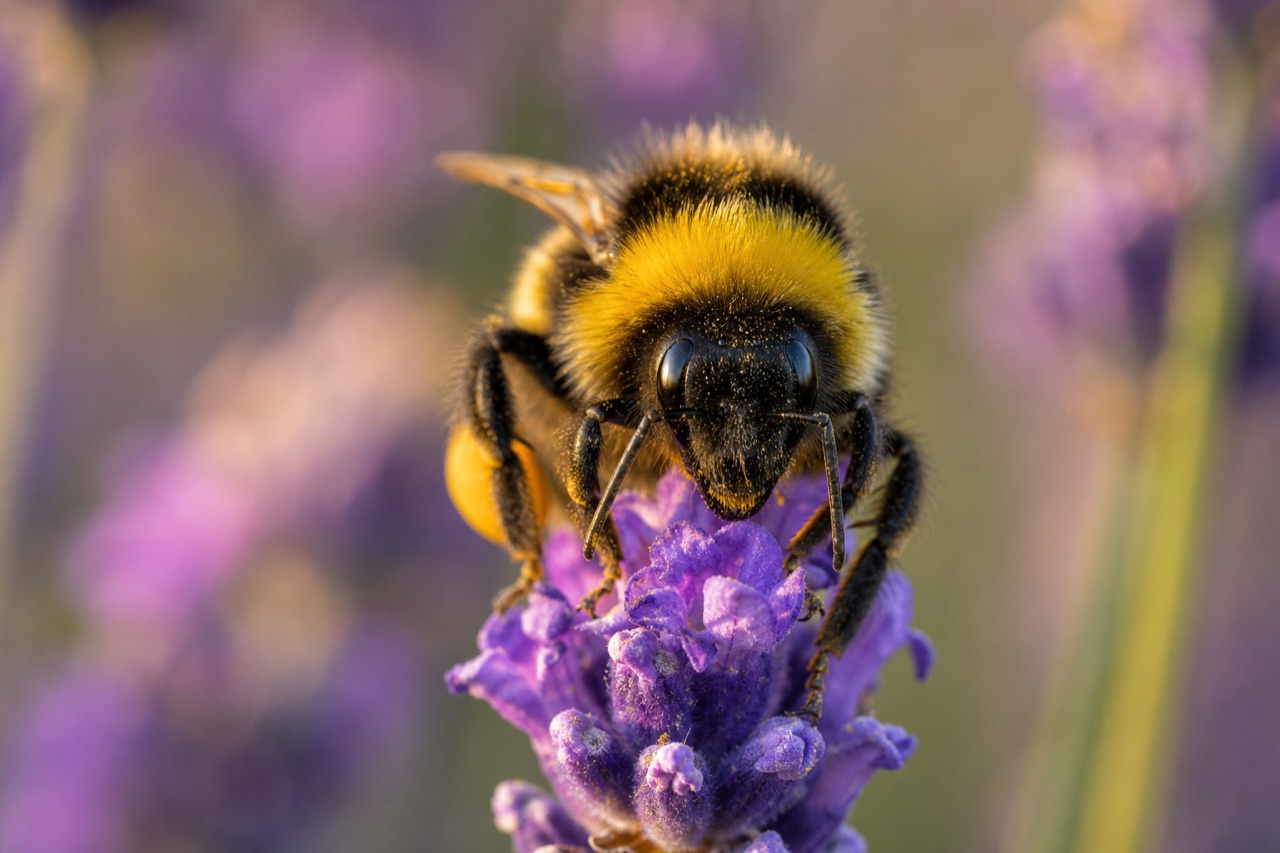
AI-generated educational wildlife portrait — World Animal Rescue Network · AI visualisation, not a photograph
In brief
Bees (superfamily Apoidea) comprise roughly 20,000 species — mostly solitary nesters, not honey-bee-style colonies — and are essential pollinators; wild bee declines are a separate and often more urgent concern than managed honey bee colony losses.
Also in Animals A to Z · Animals that start with B
By WARN Research & Conservation Team Last updated
When people say 'bee', they usually picture a honey bee — Apis mellifera, the managed western honey bee kept in hives worldwide. That one species is the tip of a much larger iceberg. The superfamily Apoidea contains roughly 20,000 bee species, and the overwhelming majority are solitary: a single female digs or occupies a nest, provisions cells with pollen and nectar, lays eggs and dies before her offspring emerge. No queen, no workers, no honey stores, no waggle dance. Bees evolved from wasp ancestors that switched from carnivory to feeding their larvae pollen. That dietary shift drove co-evolution with flowering plants — bees are among the most important pollinators on Earth, and many plants depend on specific bee species for reproduction. Bumblebees buzz-pollinate flowers that hide pollen inside anthers; leafcutter bees cut neat discs from leaves to line nests; mason bees use mud; sweat bees nest in bare ground. Each lifestyle fills a different niche in the same landscape. This page is the bee group overview. WARN's separate honey bee guide covers Apis mellifera in depth — livestock, colony biology and the distinction between managed honey bees and declining wild pollinators. Understanding bees as a diverse superfamily rather than as a single hive species is the starting point for any serious pollinator conservation.
~20,000
Bee species worldwide
~90%
Solitary — one female per nest, no workers
7–11
Honey bee species in genus Apis; one dominates beekeeping
Buzz
Bumblebees vibrate flowers to release hidden pollen
Figures sourced from IUCN Red List — Bombus, FAO — pollinators and pollination .
Bee: Quick Facts
| Species count | ~20,000 worldwide |
|---|---|
| Social species | Few — most bees are solitary |
| Key role | Pollination of wild and crop plants |
| Nesting | Soil, stems, wood cavities, walls |
| Honey bee species | 7–11 in genus Apis; one dominates beekeeping |
| Main threats | Habitat loss, pesticides, disease spillover |
Scientific Classification
| Kingdom | Animalia |
|---|---|
| Phylum | Arthropoda |
| Class | Insecta |
| Order | Hymenoptera |
| Superfamily | Apoidea |
| Major families | Apidae, Andrenidae, Halictidae, Megachilidae, Colletidae |
Conservation Status
- IUCN Status
- Varies by species — group page
- Population
- Not applicable at superfamily level
- Trend
- Declining for many wild species in intensively farmed regions; insufficient data overall
- Assessed
- Assessed species-by-species; most are unassessed
- CITES
- Not listed
Wild bee declines are documented regionally, especially for bumblebees and habitat specialists. Managed honey bee colony numbers are a separate metric and do not indicate wild bee status.
Did you know?
Leafcutter bees cut neat circular discs from rose and lilac leaves with their mandibles and carry them tucked under the abdomen to line nest cells — one of the easiest bee signs to spot in a garden.
Key Facts: Bee
- Most bee species are solitary — only a few hundred are truly social.
- Honey bees (Apis mellifera) are one species among thousands; see WARN's honey bee guide for that species specifically.
- Wild bees — mining bees, mason bees, leafcutters, bumblebees — face habitat loss, pesticides and disease spillover from managed hives.
- Many bees are pollen specialists, tied to particular plant families; lose the flower, lose the bee.
- Bare ground, dead stems, and pesticide-free continuous bloom support wild bees more than adding honey bee hives.
- Bumblebees are social but annual — only mated queens overwinter; colonies do not persist like honey bees.
Pollination and plant partnerships
Bees and flowering plants shaped each other over roughly 100 million years. Bee vision extends into ultraviolet, which makes nectar guides on petals visible as landing patterns humans cannot see. Flower shapes match bee bodies — long corollas for long-tongued bees, tight fits that force contact with anthers, colour signals tuned to bee preference for blue, yellow and ultraviolet.
Specialisation can be extreme. Some bees collect pollen from only one plant genus; the loss of that plant removes the bee regardless of other flowers in the landscape. Generalist bees visit many species but may still prefer certain families. Orchard agriculture depends on a handful of bee species brought in for pollination services — a dependency that becomes visible when cold, wet springs keep bees inactive during brief bloom windows.
Pollinator decline is not one problem. Managed honey bee colony losses reflect Varroa mites, pesticides and forage quality — a beekeeping crisis. Wild bee declines reflect habitat loss, nesting-site shortage, pesticide load and climate mismatch between flower phenology and bee emergence. Solutions overlap — pesticide reduction and flower-rich landscapes help both — but adding hives does not substitute for wild bee habitat.
What helps wild bees
Wild bee conservation is habitat conservation at small scales. Leave bare ground patches for mining bees — lawn, mulch and paving remove nesting substrate. Retain dead stems and beetle holes for cavity nesters; cut stem sections can be bundled horizontally in sheltered spots. Plant a succession of native flowers from early spring through autumn so something is always in bloom. Avoid systemic insecticides, particularly neonicotinoids, which persist in plant tissue and pollen.
Farm margins, roadside verges and garden corners that are left unsprayed function as bee reservoirs in otherwise intensive landscapes. Local native plants support local native bees better than exotic ornamentals chosen only for appearance. The goal is not maximum flower beauty but continuous, accessible forage and safe nesting across the season.
This group page complements WARN's honey bee guide, which addresses Apis mellifera specifically. Keeping the distinction clear — managed livestock versus wild biodiversity — is how pollinator messaging stays honest and effective.
Reading bee diversity in the field
Identifying bees beyond honey bees and bumblebees rewards close observation. Mining bees often have hairy bodies and nest in bare soil patches — look for small holes with mounded spoil in spring. Mason bees are stout, fast fliers visiting fruit blossoms; many have metallic blue or green sheen. Leafcutter bees carry pollen on the abdomen underside rather than the hind leg, and may show truncated leaf edges on garden roses.
Bumblebees are the large, fuzzy, loud fliers of summer borders — queens emerge early, workers mid-season. Males often have yellow faces and patrol without returning to a nest. Hoverflies mimic bee appearance but have large compound eyes meeting at the top of the head and only one pair of wings — they are flies, not bees, and do not sting.
Recording what visits your garden through citizen-science schemes contributes data on shifting phenology and species presence. The practical outcome is better advice on which plants and nesting features actually work locally, rather than generic 'plant lavender' lists that ignore regional bee faunas.
What WARN Does
WARN publishes free, sourced species education where public campaigns and ecological reality often diverge. 'Save the bees' usually means honey bees; the steeper declines are often among wild solitary bees and bumblebees that need habitat, not hives.
If this guide helps you understand wildlife and the pressures it faces, a gift to WARN supports habitat protection and free public education in our partner countries.
Bee: Frequently Asked Questions
How many bee species are there?
How is a bee different from a honey bee?
Are bees endangered?
How long do bees live?
How big is a bee?
Are bees dangerous?
Sources & References
Population figures, conservation status and biological facts on this page are drawn from authoritative scientific and intergovernmental sources.
Terms used on this page
Plain-English definitions, from our wildlife and conservation glossary.
Explore more animals
Discover more animals, their habitats and their conservation status in the WARN wildlife-guide library.
Enjoyed this Bee guide?
Receive appeal updates, animal-welfare news and published funding reports. Unsubscribe any time.
We only use your address for WARN updates. See our privacy policy.
Social bees beyond the honey bee
True eusociality — overlapping generations, cooperative brood care and reproductive division of labour — evolved multiple times in bees but remains rare. Honey bees (Apis) are the best known, with perennial colonies and tens of thousands of workers. Stingless bees (Meliponini) are tropical and subtropical social bees with complex nest architecture and communication, culturally important in Mesoamerica and parts of Asia and Australia.
Bumblebees (Bombus) occupy a middle ground. Colonies are annual — a queen founds alone in spring, workers appear mid-season, new queens and males are produced in late summer, and only mated queens hibernate. Colony sizes are modest compared with honey bees, typically dozens to a few hundred workers. Bumblebees are essential pollinators of tomatoes, blueberries and many wildflowers because they buzz-pollinate — vibrating their flight muscles to shake pollen loose from poricidal anthers.
Many bumblebee species are declining in Europe and North America from habitat fragmentation, pesticide exposure and pathogen spillover from commercial bumblebee rearing for greenhouse pollination. Several species are now Red Listed regionally even when the genus as a whole is not globally threatened.