Wildlife Guide · Temperate coastal waters worldwide & Summer surface feeding off Britain, Ireland and the north-east Atlantic
Basking Shark
Cetorhinus maximus (Gunnerus, 1765) — family Cetorhinidae
The second-largest fish on Earth, filtering an Olympic pool of water every couple of hours.
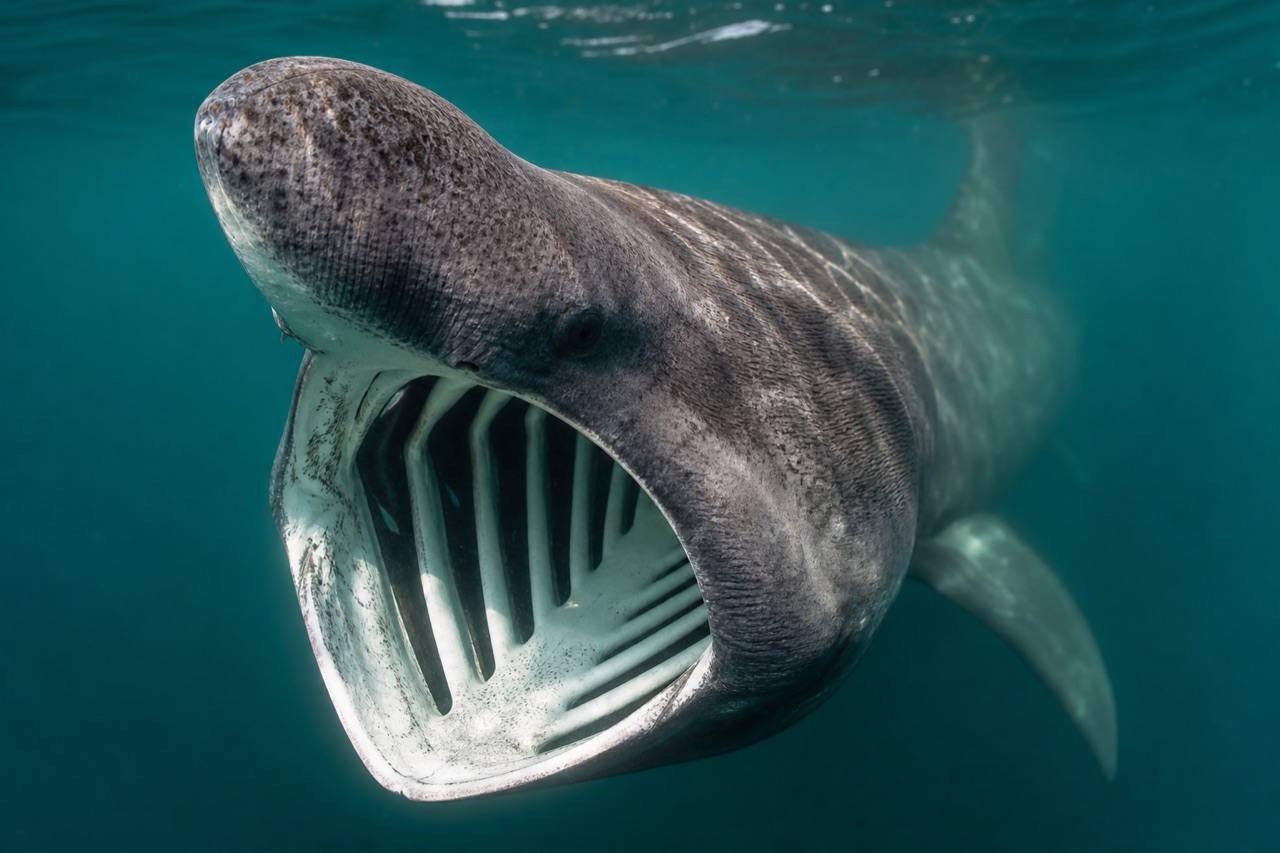
AI-generated educational wildlife portrait — World Animal Rescue Network · AI visualisation, not a photograph
In brief
The basking shark (Cetorhinus maximus) is the second-largest fish on Earth at around 10 metres, an entirely harmless filter feeder that strains plankton at the surface, and is listed as Endangered.
Also in Animals A to Z · Animals that start with B
How you can help
You can support the related appeal — read its purpose, recipient status and fund terms first — or give once to where it is needed most. Sharing accurate information helps too.
By WARN Research & Conservation Team Last updated
The basking shark is the second-largest fish alive, reaching around 10 metres, and it feeds by swimming slowly at the surface with its mouth open, straining plankton through enormous gill rakers. The name comes from that habit — it appears to be basking in the sun. It is entirely harmless. Its teeth are tiny and unused, and it has no interest in anything larger than a copepod. Despite that, the species was hunted heavily for liver oil and remains Endangered, recovering slowly from a century of exploitation.
~10 m
Maximum length — second only to the whale shark
Passive
Filters by swimming; no active suction, unlike whale sharks
~1 m
Mouth width when feeding
18 yr
Approximate age at maturity
Figures sourced from IUCN Red List — Cetorhinus maximus, CITES Appendices .
Basking Shark: Quick Facts
| Maximum length | ~10 m |
|---|---|
| Feeding | Passive filtering — requires forward motion |
| Diet | Zooplankton, principally copepods |
| Age at maturity | Around 18 years |
| Historic use | Hunted for liver oil |
| Trade status | CITES Appendix II |
Scientific Classification
| Kingdom | Animalia |
|---|---|
| Phylum | Chordata |
| Class | Chondrichthyes |
| Order | Lamniformes |
| Family | Cetorhinidae |
| Genus | Cetorhinus |
| Species | Cetorhinus maximus |
Conservation Status
- IUCN Status
- Endangered
- Population
- Unknown; north-east Atlantic populations severely reduced by historic fishing
- Trend
- Decreasing
- Assessed
- 2018
- CITES
- Appendix II
Surface feeding makes them unusually vulnerable to vessel strikes. Protection requires international coordination because individuals cross ocean basins.
Did you know?
Basking sharks were once thought to hibernate on the seabed through winter; satellite tags showed they simply move deeper and keep feeding.
Key Facts: Basking Shark
- Basking sharks are the second-largest fish, after whale sharks.
- They filter passively, relying on forward motion rather than suction.
- They are completely harmless, with tiny unused teeth.
- Liver oil hunting removed large numbers through the twentieth century.
- They are Endangered and recover slowly, maturing at around 18 years.
Passive filtering
A basking shark cruises with its mouth wide open, water passing over gill rakers that comb out plankton before it exits through the gill slits. Unlike whale sharks, which can hold station and actively suction, basking sharks rely entirely on forward motion, which is why they are so often seen moving slowly at the surface.
The rakers are shed and regrown, and feeding is seasonal: basking sharks track plankton blooms, appearing predictably in some coastal waters through summer and largely disappearing in winter.
Where they go in winter
Their winter movements were a long-standing mystery, and it was once proposed that they hibernated on the seabed. Satellite tagging resolved it: basking sharks move to deeper water and continue feeding at depth, and some undertake long migrations, including transatlantic crossings.
This matters for protection, because a species that crosses ocean basins cannot be safeguarded by one country's rules alone.
A century of liver oil
Basking sharks were hunted intensively for the oil in their enormous livers, used for lamp fuel, lubricants and industrial processes. Fisheries in the north-east Atlantic took very large numbers, and local populations collapsed and in some cases have still not recovered.
Because the species matures at around 18 years and produces few young, recovery is measured in decades. Protection is now widespread across their range, and the species is CITES Appendix II listed.
Modern pressures
Direct hunting is largely over, but basking sharks are still killed as bycatch in nets, struck by vessels while feeding at the surface, and disturbed at aggregation sites by boat traffic.
Surface feeding is the vulnerability: an animal that spends hours moving slowly just below the waterline is exactly the animal a boat is most likely to hit. Speed restrictions and approach rules at known feeding sites are the practical protection.
What WARN Does
WARN publishes free, sourced species education for animals whose recovery depends on decisions taken far from where the public sees them. Basking sharks cross ocean basins, so their protection depends on coordination between countries — and on boat operators observing approach limits at summer feeding sites.
If this guide helps you understand wildlife and the pressures it faces, a gift to WARN supports habitat protection and free public education in our partner countries.
How can I help save the basking shark?
Explore practical ways to support the basking shark, from everyday choices and sharing reliable information to reviewing a related appeal before giving.
Explore ways to support
Read the related appeal’s purpose, recipient status and fund terms. Choose an affordable gift after checking what is proposed and what has been reported.
Ease the pressures
Avoid the wildlife trade and souvenirs, never buy wild animals as pets, and choose sustainable, habitat-friendly products — the threats behind the basking shark's decline fall when demand does.
Spread the word
Share accurate, sourced information about the basking shark. Wider awareness is what turns concern into lasting protection.
Basking Shark: Frequently Asked Questions
How can I help save the basking shark?
Are basking sharks dangerous?
How big do basking sharks get?
Do basking sharks hibernate in winter?
Why were basking sharks hunted?
Are basking sharks endangered?
What do basking sharks eat?
Where do basking sharks live?
How long do basking sharks live?
Sources & References
Population figures, conservation status and biological facts on this page are drawn from authoritative scientific and intergovernmental sources.
Terms used on this page
Plain-English definitions, from our wildlife and conservation glossary.
Explore more animals
Discover more animals, their habitats and their conservation status in the WARN wildlife-guide library.
Enjoyed this Basking Shark guide?
Receive appeal updates, animal-welfare news and published funding reports. Unsubscribe any time.
We only use your address for WARN updates. See our privacy policy.