Wildlife Guide · Indo-Pacific mangroves and estuaries & From India to northern Australia and Melanesia
Archerfish
Toxotes jaculatrix (Pallas, 1767) — family Toxotidae
A fish that shoots insects off leaves with a jet of water — and corrects for refraction.
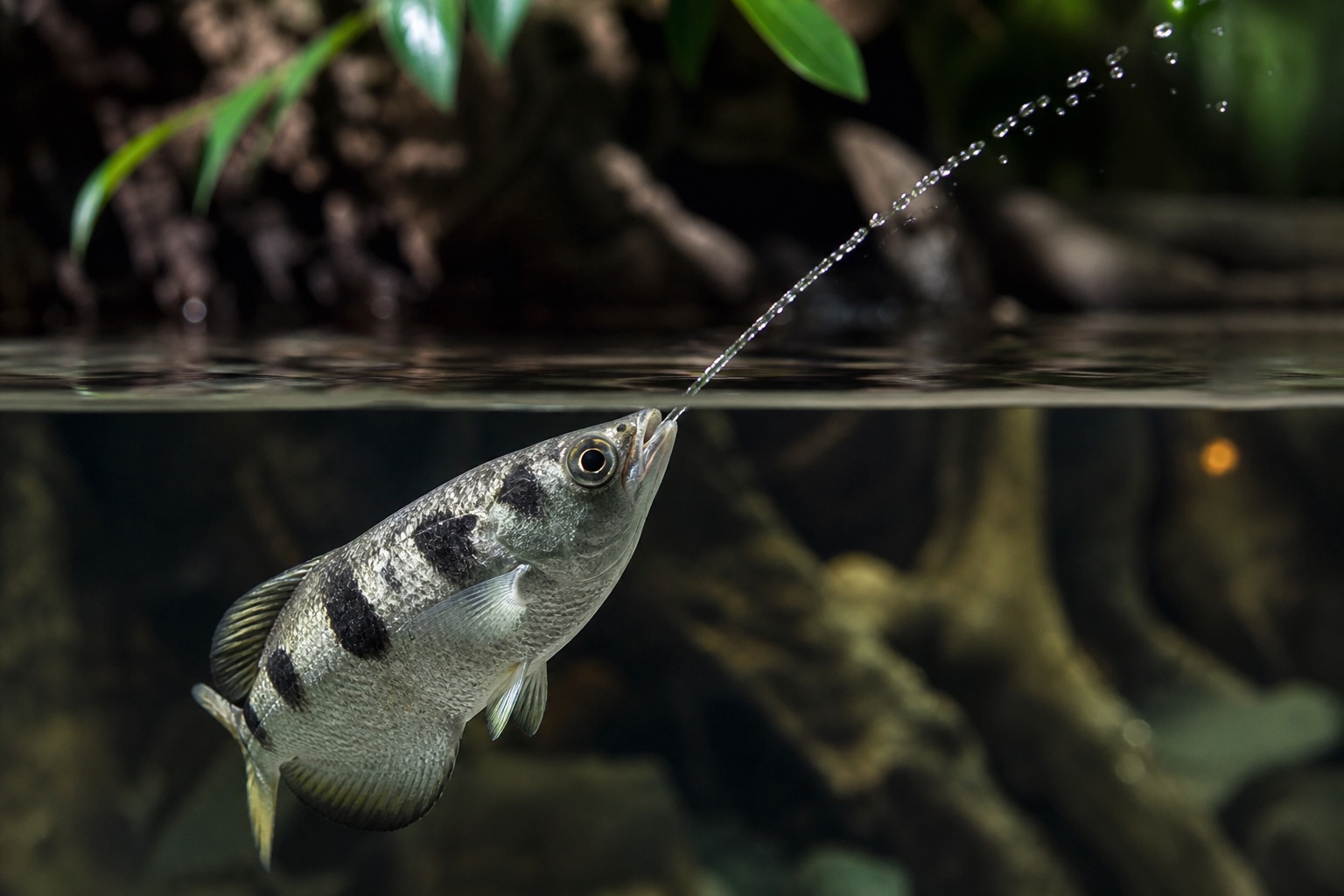
AI-generated educational wildlife portrait — World Animal Rescue Network · AI visualisation, not a photograph
In brief
The banded archerfish (Toxotes jaculatrix) is a brackish-water fish of Indo-Pacific mangroves that knocks down aerial prey by spitting a targeted water jet, compensating for optical refraction at the surface; it grows to about 20–30 cm and is listed as Least Concern.
Also in Animals A to Z · Animals that start with A
By WARN Research & Conservation Team Last updated
Archerfish solve a problem no other fish is famous for: hitting terrestrial prey above the waterline. The banded archerfish spits a jet of water from its mouth with enough force to knock insects, spiders and small lizards from overhanging vegetation into the water, where they are swallowed immediately. The jet is not a random splash — the fish adjusts aim for the bending of light at the air–water interface, so the strike lands where the prey actually sits rather than where it appears from below. Archerfish are mangrove and estuary specialists, living in brackish shallow water where overhanging roots and leaves concentrate prey. Several Toxotes species share the spitting behaviour; Toxotes jaculatrix is the best-studied and the one most often kept in aquaria. Schools sometimes shoot at the same target, though the first successful knock-down usually wins the meal.
20–30 cm
Typical adult length
Up to ~3 m
Documented shooting range for knocking down prey
Refraction
Aim adjusted for light bending at the water surface
Brackish
Mangrove estuaries and coastal freshwater
Figures sourced from IUCN Red List — Toxotes jaculatrix, Schuster et al. — archerfish shooting and refraction (reviewed in comparative cognition literature), FishBase — Toxotes jaculatrix .
Archerfish: Quick Facts
| Length | About 20–30 cm |
|---|---|
| Diet | Aerial insects and invertebrates knocked down by water jets |
| Habitat | Mangrove estuaries and brackish coastal water |
| Range | Indo-Pacific from India to northern Australia |
| Special skill | Spitting water jets with refraction correction |
| Salinity | Tolerates fresh to full marine water |
| IUCN status | Least Concern |
Scientific Classification
| Kingdom | Animalia |
|---|---|
| Phylum | Chordata |
| Class | Actinopterygii |
| Order | Centrarchiformes |
| Family | Toxotidae |
| Genus | Toxotes |
| Species | Toxotes jaculatrix |
Conservation Status
- IUCN Status
- Least Concern
- Population
- No reliable global estimate
- Trend
- Unknown; declining locally with mangrove loss
- Assessed
- 2019
- CITES
- Not listed
The listing reflects a wide range. Mangrove clearance for aquaculture and coastal development removes the overhanging vegetation archerfish hunting requires.
Did you know?
Archerfish do not shoot at where prey appears to be — they aim above the image to correct for refraction, hitting a target they cannot physically see in its true location without learning the optics.
Key Facts: Archerfish
- Archerfish knock aerial prey into the water by spitting a forceful jet from the mouth, then swallow the item as it falls or floats.
- The banded archerfish compensates for refraction — the prey is not where it appears from underwater — and learns to hit targets at varying heights.
- Toxotes jaculatrix lives in mangrove estuaries and coastal streams from India through Southeast Asia to northern Australia.
- Multiple archerfish may shoot at one prey item; the fish that causes the knock-down usually captures the food.
- The jet is produced by compressing the tongue against a groove in the roof of the mouth, with precise muscular control of mouth opening.
- Mangrove clearance across Southeast Asia is the main habitat threat despite a Least Concern listing for this species.
How the water jet works
An archerfish does not simply expel water. It places its lips at the surface, forms a tube with the tongue against a groove in the palate, and drives water out in a series of pulses that merge into a focused jet travelling above the surface. High-speed video shows the jet narrowing as it travels — a fluid-dynamic trick that concentrates force on impact.
Experiments with Toxotes jaculatrix and related species demonstrate that fish can hit targets up to several body lengths above the water, with accuracy improving through experience. Young fish miss more often; adults that hunt daily from fixed positions under overhangs learn the geometry of their patch. The behaviour is innate but refined by learning, which is why aquaria display archerfish shooting at insects on sticks placed above the tank.
Aiming through refraction
Light bends where air meets water. A grasshopper on a leaf above the surface is not located along the straight line the fish sees from below — it sits higher than the apparent position. Archerfish consistently aim above the apparent image, which means they compensate for refraction rather than shooting at what their eyes first report.
Laboratory work suggests they use learning and stereoscopic vision from their position at the surface rather than a fixed innate correction angle. Different heights and distances require different offsets. That flexibility matters because mangrove prey sits at unpredictable heights on roots, leaves and trunks. A fish that could only hit at one distance would waste most shots.
Life in mangrove estuaries
Archerfish tolerate a wide salinity range — pure freshwater to full seawater — but are most associated with mangrove edges, brackish lagoons and lower river reaches where overhanging vegetation meets shallow water. They hunt in daylight, often in small groups, and take insects, spiders, small crustaceans and fallen fruit as well as shot prey.
Breeding occurs in estuaries; eggs and larvae drift in coastal water. Mangrove roots provide cover from larger fish predators and concentrate the aerial invertebrates archerfish exploit. Where mangroves are cleared for aquaculture ponds and coastal development, archerfish lose both cover and the overhanging foraging substrate their hunting method requires.
Status and aquarium trade
Toxotes jaculatrix is listed as Least Concern with a wide Indo-Pacific range. No global population estimate exists; the species remains common in intact mangrove systems. Local declines track habitat loss rather than targeted fishery pressure — archerfish are not a major food fish, though they appear in the aquarium trade.
Captive archerfish need brackish water, overhead cover and floating or suspended prey to express natural shooting behaviour. Wild collection for aquaria is a minor pressure relative to mangrove clearance, but provenance matters for any species tied to threatened coastal habitat.
What WARN Does
WARN publishes free, sourced education for mangrove-linked species because coastal wetland loss proceeds faster than most reference sites update. Archerfish depend on the exact mangrove edge habitat being converted for aquaculture across Southeast Asia.
If this guide helps you understand wildlife and the pressures it faces, a gift to WARN supports habitat protection and free public education in our partner countries.
Archerfish: Frequently Asked Questions
What do archerfish eat?
Where do archerfish live?
Are archerfish dangerous to humans?
How long do archerfish live?
How big do archerfish get?
How do archerfish aim correctly?
Are archerfish endangered?
Sources & References
Population figures, conservation status and biological facts on this page are drawn from authoritative scientific and intergovernmental sources.
Terms used on this page
Plain-English definitions, from our wildlife and conservation glossary.
Explore more animals
Discover more animals, their habitats and their conservation status in the WARN wildlife-guide library.
Enjoyed this Archerfish guide?
Receive appeal updates, animal-welfare news and published funding reports. Unsubscribe any time.
We only use your address for WARN updates. See our privacy policy.