Wildlife Guide · Arabian Peninsula — desert and gravel plains of Oman, Saudi Arabia, UAE and Jordan
Arabian Oryx
Oryx leucoryx (Pallas, 1777) — family Bovidae
The antelope that went extinct in the wild and came back — a case study in what captive breeding can achieve.
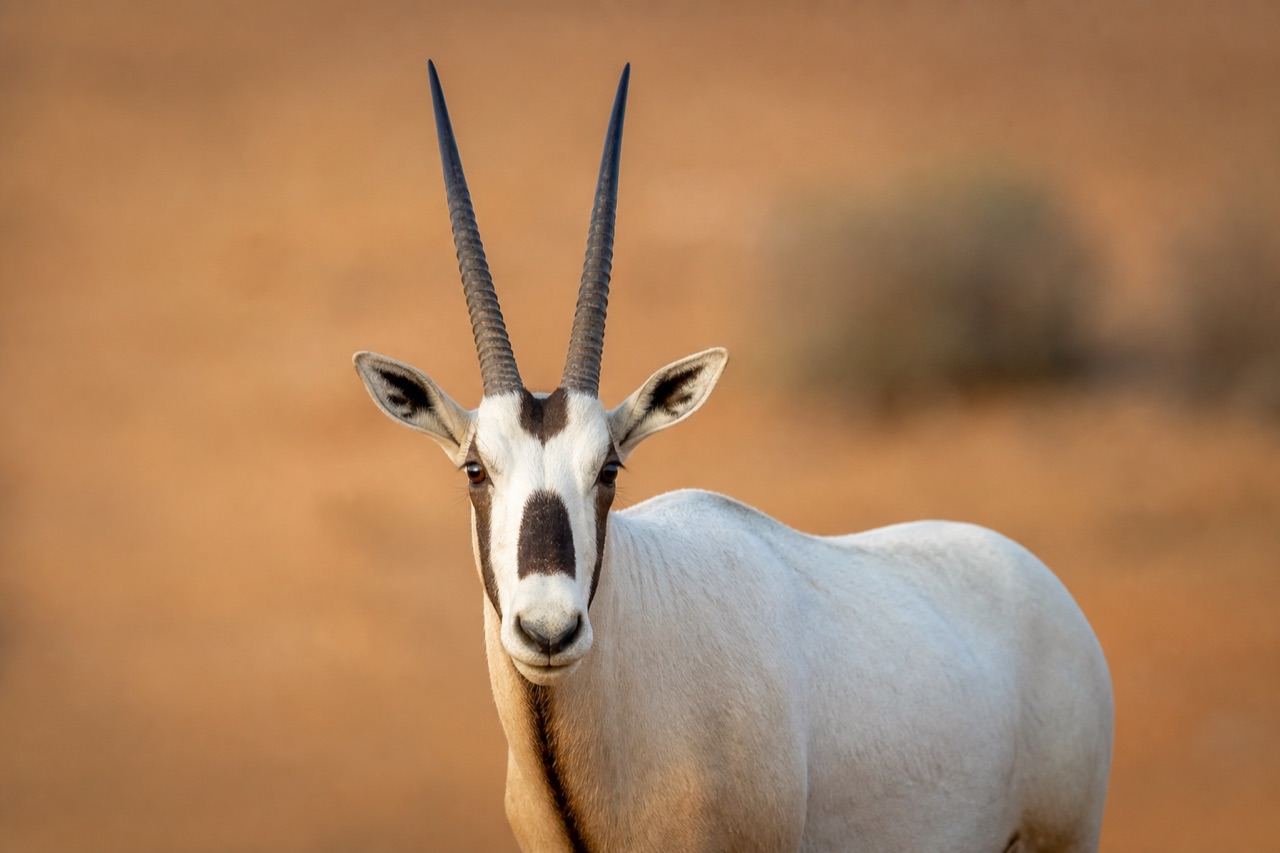
AI-generated educational wildlife portrait — World Animal Rescue Network · AI visualisation, not a photograph
In brief
The Arabian oryx (Oryx leucoryx) is a desert antelope of the Arabian Peninsula that was Extinct in the Wild by the 1970s and restored through captive breeding and reintroduction; it is now Vulnerable with a growing but still small wild population.
Also in Animals A to Z · Animals that start with A
How you can help
You can support the related appeal — read its purpose, recipient status and fund terms first — or give once to where it is needed most. Sharing accurate information helps too.
By WARN Research & Conservation Team Last updated
The Arabian oryx is a white antelope of the desert Arabian Peninsula, with dark markings on the face and legs and long, straight horns that can reach over 70 cm. It is adapted to some of the hottest, driest habitat on Earth: pale coat reflecting radiation, ability to tolerate body temperatures that would distress most mammals, and behaviour that minimises activity during peak heat. It is also the species that defines 'Extinct in the Wild' as a conservation category. By the early 1970s, hunting and habitat loss had eliminated the last wild Arabian oryx. Captive populations in zoos and private collections — descended from a handful of founders — were bred and reintroduced, starting in Oman in 1982. The species now exists in the wild again, though numbers remain modest and the Vulnerable listing reflects how recently the recovery began. The Arabian oryx recovery is frequently cited as proof that captive breeding can save a species. That claim is largely justified — but it comes with qualifications. Every wild oryx descends from a tiny founder pool, reintroduced populations require active protection from poaching, and the desert habitat they need is under pressure from overgrazing, development and climate change across the Peninsula.
Extinct in Wild
Status by the early 1970s — restored through reintroduction
1982
First reintroduction to Oman from captive-bred stock
Vulnerable
Current IUCN status — wild population still rebuilding
70+ cm
Horn length in adult males
Figures sourced from IUCN Red List — Oryx leucoryx, CITES Appendices .
Arabian Oryx: Quick Facts
| Weight | 65–75 kg |
|---|---|
| Habitat | Desert and gravel plains of the Arabian Peninsula |
| Historical status | Extinct in the Wild by the early 1970s |
| Reintroduction | From 1982 in Oman; now also Saudi Arabia, UAE, Jordan |
| Horns | Long, straight; over 70 cm in males |
| Heat adaptation | White coat, elevated body temperature tolerance |
| Main threats | Poaching, habitat degradation, genetic bottleneck |
Scientific Classification
| Kingdom | Animalia |
|---|---|
| Phylum | Chordata |
| Class | Mammalia |
| Order | Artiodactyla |
| Family | Bovidae |
| Genus | Oryx |
| Species | Oryx leucoryx |
Conservation Status
- IUCN Status
- Vulnerable
- Population
- Over 1,000 in the wild across reintroduced populations; larger numbers in captivity
- Trend
- Increasing in reintroduced populations
- Assessed
- 2020
- CITES
- Appendix I
The first species to have been restored from Extinct in the Wild through captive breeding and reintroduction. Wild populations are growing but remain small and actively managed.
Did you know?
The Arabian oryx was the first species to be restored from Extinct in the Wild to a wild population through captive breeding — every wild oryx alive today descends from animals that survived only in captivity.
Key Facts: Arabian Oryx
- The Arabian oryx was Extinct in the Wild by the early 1970s and restored through captive breeding and reintroduction.
- Reintroduction began in Oman in 1982; wild populations now exist in Oman, Saudi Arabia, UAE and Jordan.
- It is listed Vulnerable — recovered from Extinct in the Wild but the wild population remains relatively small.
- Pale coat, heat tolerance and behavioural adaptations allow survival in extreme desert heat.
- Hunting was the primary historical cause of extinction; habitat loss and poaching remain risks.
- The recovery is one of the clearest examples of captive breeding enabling wild restoration.
- Extinct in the Wild is an IUCN category meaning a species survives only in captivity — the Arabian oryx no longer qualifies.
Extinct in the Wild — what that means
The IUCN category 'Extinct in the Wild' (EW) applies when a species survives only in captivity, cultivation or as a naturalised population well outside its original range. It is not the same as Extinct: the species' genes and biology persist, but the wild population is gone. The Arabian oryx reached this point by the early 1970s, when the last wild animals were killed in Oman — victims of uncontrolled hunting with modern vehicles and firearms across a desert that offered no cover.
A captive safety net preserved the species. Animals held in zoos, private reserves and the 'World Herd' assembled in the United States maintained a breeding population descended from perhaps nine founders. From those captive animals, reintroduction programmes rebuilt wild populations. The oryx is the flagship example of EW recovery, though it remains Vulnerable because wild numbers are still modest and the genetic base is narrow.
The EW category matters because it describes a specific, recoverable state — not the end of a species but the absence of a wild population. Several other species have since passed through EW and back, including the Przewalski's horse and the black-footed ferret. The Arabian oryx was the first, and its story established the template that captive breeding programmes still follow today.
Built for desert heat
Arabian oryx inhabit gravel plains and sandy desert where summer temperatures exceed 50°C. Their white coat reflects solar radiation rather than absorbing it. They can allow body temperature to rise significantly above normal mammalian levels — reducing the need to sweat and lose precious water — and then dissipate accumulated heat during cooler night hours when they feed and move.
They obtain moisture from food: roots, tubers, buds and desert melons supply enough water that free drinking is not required, though oryx will drink when water is available after rain. Herds are small and nomadic, moving in response to rainfall and the green flush that follows it. Long straight horns are used in dominance contests between males and as defence, though large predators are scarce in their habitat.
Arabian oryx also dig. They excavate shallow depressions in shade — under acacia trees or rock overhangs — where surface sand is cooler, and rest during the hottest hours. This behavioural thermoregulation, combined with physiological tolerance of elevated body temperature, allows survival in conditions that would kill most ungulates within hours. Reintroduced oryx in Oman and Saudi Arabia have demonstrated that these adaptations remain intact in captive-bred animals released back into desert habitat.
The reintroduction story
The first reintroduction released captive-bred oryx into the desert of central Oman in 1982, in the Jiddat al-Harasis region. The programme succeeded: animals bred, herds grew, and the model was replicated. Saudi Arabia established the Mahazat as-Sayd Protected Area; the United Arab Emirates created the Arabian Oryx Sanctuary in Abu Dhabi; Jordan released oryx into Wadi Rum.
Wild populations now number in the low thousands across the Peninsula — a genuine recovery from zero, but not yet a secure one. The Vulnerable listing reflects this: the species exists in the wild again, but populations are small, fragmented and vulnerable to poaching, habitat degradation and inbreeding if not actively managed. Every wild Arabian oryx alive today descends from a captive population that was itself descended from a very small founder group.
Reintroduction is not a one-time event. Ongoing management includes anti-poaching patrols, supplementary feeding during drought, veterinary monitoring and genetic management across herds. The Arabian oryx in the wild is a managed wild population, not a self-sustaining one — and that distinction matters for how the recovery is understood and for what future reintroduction programmes can realistically promise.
What still threatens them
Hunting caused the original extinction and remains the primary risk to reintroduced populations. Even where legal protection exists, poaching for meat and trophies occurs. In Oman, where the first reintroduction took place, poaching pressure has required sustained anti-poaching effort to maintain the wild herd. Vehicle access to desert areas has made poaching easier than it was when the last wild oryx were killed in the 1970s.
Habitat degradation from overgrazing by domestic camels and goats, road construction and oil infrastructure reduces the desert range available. Fencing for ranching and military installations fragments the landscape. Climate change brings longer droughts and more extreme heat events that stress reintroduced herds already living at the physiological limit. A drought year can force oryx to range further from protected areas, increasing exposure to poaching and road traffic.
The genetic bottleneck is a quieter but persistent concern. Captive founder populations were small, and reintroduced herds descend from that narrow base. Managed breeding programmes monitor genetic diversity and exchange animals between herds, but the long-term health of the wild population depends on maintaining connectivity and continuing active protection — neither of which can be assumed indefinitely across a region undergoing rapid development. The Arabian oryx recovery demonstrates what captive breeding can achieve; it also demonstrates that recovery is a process, not an event, and that the work does not stop when the first animals are released.
What WARN Does
WARN publishes free, sourced species education including the conservation concepts behind the headlines. The Arabian oryx is the textbook case for Extinct in the Wild and recovery through reintroduction — a story worth telling accurately because it shapes what people believe is possible.
If this guide helps you understand wildlife and the pressures it faces, a gift to WARN supports habitat protection and free public education in our partner countries.
How can I help save the arabian oryx?
Explore practical ways to support the arabian oryx, from everyday choices and sharing reliable information to reviewing a related appeal before giving.
Explore ways to support
Read the related appeal’s purpose, recipient status and fund terms. Choose an affordable gift after checking what is proposed and what has been reported.
Ease the pressures
Avoid the wildlife trade and souvenirs, never buy wild animals as pets, and choose sustainable, habitat-friendly products — the threats behind the arabian oryx's decline fall when demand does.
Spread the word
Share accurate, sourced information about the arabian oryx. Wider awareness is what turns concern into lasting protection.
Arabian Oryx: Frequently Asked Questions
How can I help save the arabian oryx?
Was the Arabian oryx really extinct?
What does Extinct in the Wild mean?
How was the Arabian oryx saved?
Are Arabian oryx endangered?
Where do Arabian oryx live now?
Are arabian oryxs dangerous?
How long do arabian oryxs live?
Sources & References
Population figures, conservation status and biological facts on this page are drawn from authoritative scientific and intergovernmental sources.
Terms used on this page
Plain-English definitions, from our wildlife and conservation glossary.
Explore more animals
Discover more animals, their habitats and their conservation status in the WARN wildlife-guide library.
Enjoyed this Arabian Oryx guide?
Receive appeal updates, animal-welfare news and published funding reports. Unsubscribe any time.
We only use your address for WARN updates. See our privacy policy.