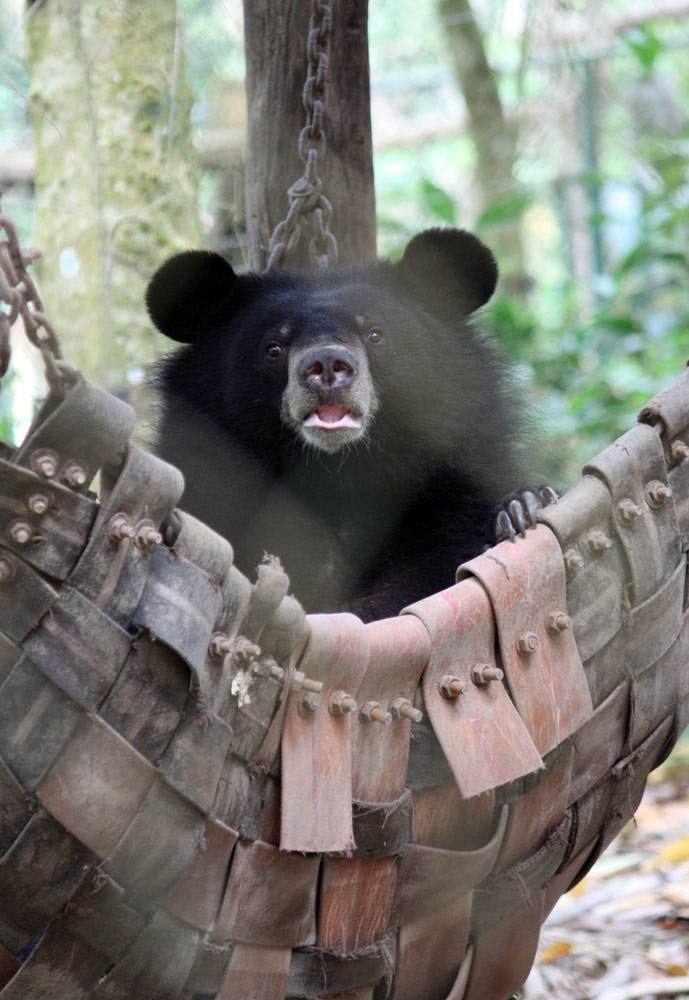
A sun bear with sleek black fur and a distinctive cream-coloured chest crescent climbing a rainforest tree in Southeast Asia
Species

· INDONESIA, MALAYSIA, VIETNAM, THAILAND, CAMBODIA · 10 min read

The Sun Bear: The World's Smallest Bear and the World's Most Overlooked

In brief

The sun bear (Helarctos malayanus) is the smallest of the world's eight bear species, a Vulnerable forest bear of mainland Southeast Asia and the Greater Sunda Islands; populations are estimated to have declined by at least 30% over the last three decades because of deforestation, the illegal pet trade and the bear-bile industry.

Weight adults rarely exceed
70 kg Weight adults rarely exceed
Bear species worldwide — this is the smallest
8 Bear species worldwide — this is the smallest
IUCN Red List status
Vulnerable IUCN Red List status

What are the key takeaways from this briefing?

  • Smallest of the eight extant bear species — adults rarely exceed 70 kg.
  • Listed as Vulnerable on the IUCN Red List; CITES Appendix I.
  • Range covers Indonesia, Malaysia, Vietnam, Thailand and Cambodia; Indonesia and Malaysia are in WARN's current partner network.
  • Three biggest threats: deforestation, the illegal pet trade in cubs, and the bear-bile industry.
  • Often confused with the larger Asiatic black bear (moon bear); both species are exploited for bile.

The sun bear (Helarctos malayanus) is the smallest bear species in the world. Adults rarely exceed 70 kg, with a sleek black coat, a distinctive U-shaped or crescent-shaped cream chest patch, and an unusually long tongue adapted for extracting insects and honey. It is sometimes called the "honey bear" or "Malayan sun bear."

Sun bears live across Southeast Asia — Indonesia, Malaysia, Vietnam, Thailand and Cambodia — with Indonesia and Malaysia in WARN's current partner network, which makes them one of the more directly relevant species for the kind of work our launch programmes are being built to support.

What makes sun bears unique?

  • Smallest of the eight extant bear species, with a body length of 120-150 cm.
  • Diet is omnivorous but unusually insect-heavy — termites, beetle larvae and bee colonies are major food sources.
  • One of the most arboreal bears: they build daytime nests in trees and rest 5-10 m above ground.
  • Critically dependent on dipterocarp lowland rainforest, which is the most heavily logged forest type in Southeast Asia.

Why sun bears are Vulnerable?

  • Deforestation. Sun bear habitat overlaps almost exactly with the highest-demand timber and palm-oil concessions in Borneo, Sumatra, Peninsular Malaysia and the lower Mekong. UNEP reports consistent annual primary-forest loss across all five range countries.
  • Illegal pet trade. Sun bear cubs are taken from killed mothers and sold openly in some urban wildlife markets. They grow large, strong and dangerous, and are routinely abandoned to wildlife authorities within 2-3 years of capture.
  • Bear-bile industry. Sun bear gall bladders are trafficked into the same traditional-medicine market that drives the bile-farming of Asiatic black bears (moon bears) in Vietnam, Laos and China. The World Organisation for Animal Health (WOAH) has identified bear-bile farming as a serious welfare and biosecurity concern.
  • Snares and conflict killing. Snares set for bushmeat species regularly catch sun bears as bycatch; bears that raid bee-hives or crops are killed in retaliation.

What should you know about rescue work?

Most rescued sun bears in the region come from one of three sources: confiscation from the pet trade, surrender from defunct bile farms, or rescue from wildlife markets. Almost none can be released — most have been hand-reared, have skeletal deformities from cage life, or carry diseases that disqualify them from soft-release. They become lifetime sanctuary residents.

How WARN fits in?

Sun bears are not yet a stand-alone WARN appeal, but they will be a major beneficiary of our planned Southeast Asia anti-trafficking and sanctuary support work. Our orangutan appeal in Borneo, our dog and cat meat trade briefing in Vietnam and Cambodia, and our planned Indonesia and Malaysia deployments will all operate in the same forests, against the same traffickers, and through the same partner networks that rescue sun bears.

Sources: IUCN Red List, CITES Appendix I, UNEP-WCMC, WOAH bear-bile policy positions.

Is it true that smallest of the eight extant bear species — adults rarely exceed 70 kg?

Smallest of the eight extant bear species — adults rarely exceed 70 kg. That scale is ecology, not a pet-shop talking point. Sun bear needs room to use a body like that in INDONESIA, which is why habitat fragmentation hits so hard.

Is it true that listed as Vulnerable on the IUCN Red List; CITES Appendix I?

Listed as Vulnerable on the IUCN Red List; CITES Appendix I. A fact list is not an IUCN assessment. Sun bear still needs habitat, enforcement and honest funding — see the full species guide rather than stopping at trivia.

Is it true that range covers Indonesia, Malaysia, Vietnam, Thailand and Cambodia; Indonesia and Malaysia are in WARN's current partner network?

Range covers Indonesia, Malaysia, Vietnam, Thailand and Cambodia; Indonesia and Malaysia are in WARN's current partner network. A fact list is not an IUCN assessment. Sun bear still needs habitat, enforcement and honest funding — see the full species guide rather than stopping at trivia.

Is it true that three biggest threats: deforestation, the illegal pet trade in cubs, and the bear-bile industry?

Three biggest threats: deforestation, the illegal pet trade in cubs, and the bear-bile industry. A fact list is not an IUCN assessment. Sun bear still needs habitat, enforcement and honest funding — see the full species guide rather than stopping at trivia.

Is it true that often confused with the larger Asiatic black bear (moon bear); both species are exploited for bile?

Often confused with the larger Asiatic black bear (moon bear); both species are exploited for bile. Often confused with the larger Asiatic black bear (moon bear); both species are exploited for bile is one of the details people actually search for about Sun bear.

Is it true that smallest of the eight extant bear species, with a body length of 120-150 cm?

Smallest of the eight extant bear species, with a body length of 120-150 cm. That scale is ecology, not a pet-shop talking point. Sun bear needs room to use a body like that in INDONESIA, which is why habitat fragmentation hits so hard.

Is it true that diet is omnivorous but unusually insect-heavy — termites, beetle larvae and bee colonies are major food sources?

Diet is omnivorous but unusually insect-heavy — termites, beetle larvae and bee colonies are major food sources. Diet is why Sun bear ranges the way it does in INDONESIA. Treat feeding ecology as a field fact, not a reason to keep the animal.

Is it true that one of the most arboreal bears: they build daytime nests in trees and rest 5-10 m above ground?

One of the most arboreal bears: they build daytime nests in trees and rest 5-10 m above ground. One of the most arboreal bears: they build daytime nests in trees and rest 5-10 m above ground is one of the details people actually search for about Sun bear.

Is it true that critically dependent on dipterocarp lowland rainforest, which is the most heavily logged forest type in Southeast Asia?

Critically dependent on dipterocarp lowland rainforest, which is the most heavily logged forest type in Southeast Asia. Critically dependent on dipterocarp lowland rainforest, which is the most heavily logged forest type in Southeast Asia is one of the details people actually search for about Sun bear.

Is it true that deforestation. Sun bear habitat overlaps almost exactly with the highest-demand timber and palm-oil concessions in Borneo, Sumatra, Peninsular Malaysia and the lower Mekong. UNEP reports consistent annual primary-forest loss across all five range countries?

Deforestation. Sun bear habitat overlaps almost exactly with the highest-demand timber and palm-oil concessions in Borneo, Sumatra, Peninsular Malaysia and the lower Mekong. UNEP reports consistent annual primary-forest loss across all five range countries. A fact list is not an IUCN assessment.

Is it true that illegal pet trade. Sun bear cubs are taken from killed mothers and sold openly in some urban wildlife markets. They grow large, strong and dangerous, and are routinely abandoned to wildlife authorities within 2-3 years of capture?

Illegal pet trade. Sun bear cubs are taken from killed mothers and sold openly in some urban wildlife markets. They grow large, strong and dangerous, and are routinely abandoned to wildlife authorities within 2-3 years of capture. A fact list is not an IUCN assessment.

What is this briefing not?

This briefing is not a substitute for the full Sun bear wildlife guide, not a pet-care manual, and not a first-person field dispatch. It is a desk-researched explainer for people who searched a specific question about Sun bear. The setting is INDONESIA, MALAYSIA, VIETNAM, THAILAND, CAMBODIA.

The Sun Bear: The World's Smallest Bear and the World's Most Overlooked sits in the newsroom as a species explainer. It is not a Field notes dispatch from a partner clinic, and it is not a reason to keep Sun bear. Location context: INDONESIA, MALAYSIA, VIETNAM, THAILAND, CAMBODIA.

Who should skip this page?

Skip this page if you wanted a complete IUCN-style species profile, veterinary advice, or permission to keep Sun bear as a pet. You will not find those here. Read the wildlife guide next if you need status, range and sources in one place.

Skip it if you needed veterinary instructions, a travel itinerary, or a fundraising story dressed up as science. The skip is the point: a page that cannot say no is not a guide.

How does this briefing compare to the full species guide?

This page answers the search in the headline. The wildlife guide answers status, threats, and what is actually known. Use both; do not cite the listicle as if it were the Red List. The sun bear is the smallest bear species on earth and one of the least understood.

Claims this briefing actually stands behind
Takeaway
Smallest of the eight extant bear species — adults rarely exceed 70 kg.
Listed as Vulnerable on the IUCN Red List; CITES Appendix I.
Range covers Indonesia, Malaysia, Vietnam, Thailand and Cambodia; Indonesia and Malaysia are in WARN's current partner network.
Three biggest threats: deforestation, the illegal pet trade in cubs, and the bear-bile industry.

What is the catch with a short wildlife briefing?

The catch with wildlife listicles is that a true fact can still be the wrong takeaway. “Amazing” is not the same as “safe to keep”, and a number without a source is trivia. Every figure on this page should be read against the cited IUCN or zoo pages, not against a screenshot.

Factory “12 facts” pages elsewhere on the web pad the same three sentences. Here each heading is a real question, each answer is meant to stand alone, and the sources at the end are the audit trail. If a number is not on this page or in those sources, we did not invent it.

What should you do after reading this?

Use this briefing to answer the question in the title, then go to the species guide for status and sources. If you want to help Sun bear, fund habitat and enforcement — do not buy the animal. The sun bear (Helarctos malayanus) is the smallest of the world's eight bear species, a Vulnerable forest bear of mainland Southeast Asia and the Greater Sunda Islands; populations are estimated to have declined by at least 30% over the last three decades because of deforestation, the illegal pet trade and the bear-bile industry.

If you want to support WARN’s partner work, donate knowing we are a community interest company, not a registered charity. If you want the animal itself, you have the wrong page.

Read the verdict on the first screen, the skip-if before you share the page, and the sources at the end before you quote a number. That is the whole contract of this briefing.

What do people ask about this briefing?

Is this Sun bear briefing a complete species guide?
No. It is a newsroom explainer for a specific search. Status, range and the full source list live on the wildlife guide where one exists. The briefing is set in INDONESIA, MALAYSIA, VIETNAM, THAILAND, CAMBODIA. The sun bear is the smallest bear species on earth and one of the least understood.
Should you keep a Sun bear as a pet after reading this?
No. Amazing facts are not a care plan. Wild animals belong in wild habitat; buying one, posing with one, or sharing selling ads all worsen the trade. Location context on this page is INDONESIA, MALAYSIA, VIETNAM, THAILAND, CAMBODIA. The sun bear is the smallest bear species on earth and one of the least understood.
Who should skip this Sun bear page?
Anyone who needed veterinary advice, a full IUCN profile, or permission to handle the animal. This page will tell you to leave if that is you. The sun bear is the smallest bear species on earth and one of the least understood.
What is the one-line answer on Sun bear?
The sun bear (Helarctos malayanus) is the smallest of the world's eight bear species, a Vulnerable forest bear of mainland Southeast Asia and the Greater Sunda Islands; populations are estimated to have declined by at least 30% over the last three decades because of deforestation, the illegal pet trade and the bear-bile industry.
Where is this Sun bear briefing set?
The location context is INDONESIA, MALAYSIA, VIETNAM, THAILAND, CAMBODIA. That is geography for the story, not a claim that WARN runs a programme in every place named. The sun bear is the smallest bear species on earth and one of the least understood.
Where does WARN work on Sun bear?
Only claim a programme where this site already names one. This briefing is desk research about Sun bear in INDONESIA, MALAYSIA, VIETNAM, THAILAND, CAMBODIA; it does not invent a field team to match the headline. Read the species guide and appeals for funded work.
Is it true that smallest of the eight extant bear species — adults rarely exceed 70 kg?
Smallest of the eight extant bear species — adults rarely exceed 70 kg. The sun bear is the smallest bear species on earth and one of the least understood. Listed as Vulnerable, it survives in fragmented forests across Southeast Asia — including Indonesia and Malaysia in WARN's partner network.
Is it true that listed as Vulnerable on the IUCN Red List; CITES Appendix I?
Listed as Vulnerable on the IUCN Red List; CITES Appendix I. The sun bear is the smallest bear species on earth and one of the least understood. Listed as Vulnerable, it survives in fragmented forests across Southeast Asia — including Indonesia and Malaysia in WARN's partner network.
W

WARN Research & Conservation Team

World Animal Rescue Network

Published Updated 10 min read · 1,875 words
Share
Support animal rescue