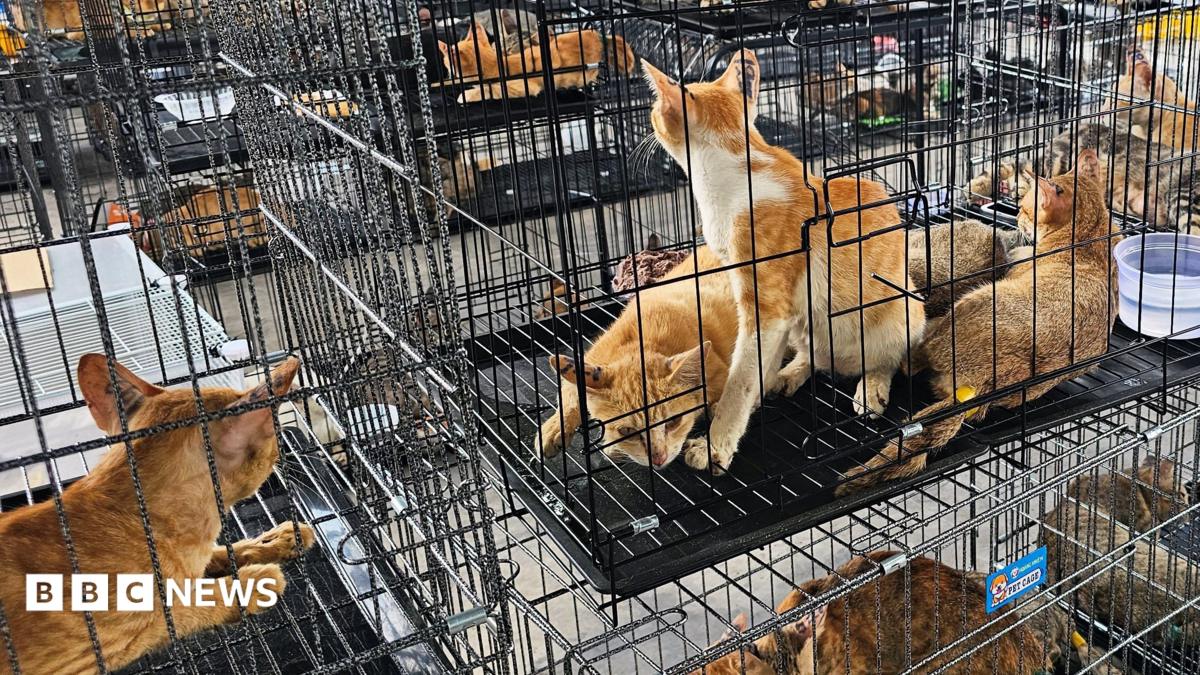
Stray dog looking out from a wire enclosure in Southeast Asia
Briefings

· VIETNAM · CAMBODIA · INDONESIA · 12 min read

Ten Million Dogs and Cats: The Hidden Scale of Southeast Asia's Meat Trade

In brief

An estimated ten million dogs and cats are killed for human consumption across Southeast Asia each year — many of them stolen pets, moved across borders in conditions that breed rabies and other zoonoses. Investigations across Vietnam, Cambodia and Indonesia point to an estimated ten million dogs and cats slaughtered for meat each year — many of them stolen pets.

What are the key takeaways from this briefing?

  • Open-source welfare investigations estimate roughly ten million dogs and cats are killed for meat across Vietnam, Cambodia and Indonesia each year.
  • Many of the animals are stolen pets, not strays.
  • WHO estimates roughly 59,000 human rabies deaths each year worldwide, almost all from dog bites — and unsanitary supply routes are a recognised amplification risk.
  • Major cities including Hanoi and Siem Reap have introduced bans or formal commitments to end the trade.
  • Effective reform requires alternative-livelihood support for slaughterhouse workers, not punitive measures on individuals.

The dog and cat meat trade in Southeast Asia is one of the largest and least visible animal welfare crises in the world today. Multi-country open-source investigations published in 2020 estimate that around ten million dogs and cats are slaughtered for meat every year across Vietnam, Cambodia and Indonesia alone. Many of the animals taken into the trade are not strays. They are stolen pets.

What should you know about the problem at a glance?

The figures in this section are drawn from open-source welfare investigations published in 2020, which remain the most comprehensive publicly-available dataset on the trade.

  • Vietnam: an estimated five million dogs and one million cats slaughtered for meat each year.
  • Cambodia: an estimated three million dogs killed for meat each year, with the capital Phnom Penh identified as a regional hotspot.
  • Indonesia: the remaining share of the regional total of approximately ten million animals per year, concentrated in specific regional markets.
  • Documented transport conditions include journeys of 18 hours or more without food or water, sometimes across national borders from Laos and southern China.
  • Documented slaughter methods include drowning, hanging, beating and blowtorching — practices that fall far below any accepted humane-slaughter standard.

What should you know about stolen pets, not strays?

The most overlooked aspect of the trade is how the supply chain actually works. Field reporting from the same investigations shows demand outstrips the available stray population, so collectors — locally known as "dog catchers" — sweep up pet dogs and cats from yards, doorways and village streets. Owners frequently watch their animals being taken, and in Vietnam in particular investigators have documented a rise in confrontations between pet owners and collectors. Reform pressure is increasingly coming from inside the affected communities, not from outside them.

Is it true that a public health problem as well as a welfare one?

The trade poses serious public health risks alongside the welfare ones. Animals of unknown origin are mixed together at high density in live markets and backyard slaughter points, often with no sanitary controls. That combination is well understood by epidemiologists as a route for rabies transmission and for the emergence of novel zoonotic diseases — a concern the World Health Organization has long raised about unregulated live animal markets in general. Rabies remains endemic across much of the region, and dog-mediated transmission is the dominant pathway worldwide (WHO, Rabies Fact Sheet). Removing the meat trade is, among other things, one of the most effective rabies-control measures available.

What the data also shows?

Public attitudes are shifting. A 2020 survey of residents in Hanoi reported that 60% of respondents had eaten dog meat at least once, while 44% said they would refuse it in future. Younger urban residents in particular are turning away from the practice, and several cities in the region — including Hoi An and Siem Reap — have publicly moved to end the trade within their boundaries. The cultural picture is more complicated than the headline number suggests, and reform is already underway in places.

Where rescue fits in?

Frontline rescue cannot end the meat trade on its own. What it can do is intercept animals at known transport choke-points, support local veterinary services to treat survivors of seizures, and help build the sanctuary capacity needed for confiscated animals — many of whom are deeply traumatised but recoverable. Effective programmes pair veterinary triage with mass vaccination, neutering and community education, so that improvements in welfare and improvements in public health move forward together.

What WARN is preparing to do?

Our planned Southeast Asia programme is being designed to fund mobile veterinary triage for animals recovered from transport seizures, support shelter capacity for confiscated dogs and cats, and contribute to large-scale community vaccination drives in the regions most affected by rabies. We are launching this work in 2026 and we need supporter funding to begin.

What should you know about sources?

  • Open-source welfare investigations published in 2020, covering annual slaughter figures, country breakdowns, transport conditions, slaughter methods, and the Hanoi public-opinion survey cited in this dispatch.
  • World Health Organization, Rabies Fact Sheet. Source for the statement that dog-mediated transmission is the dominant pathway for human rabies worldwide.

Is it true that open-source welfare investigations estimate roughly ten million dogs and cats are killed for meat across Vietnam, Cambodia and Indonesia each year?

Open-source welfare investigations estimate roughly ten million dogs and cats are killed for meat across Vietnam, Cambodia and Indonesia each year. Diet is why Dog meat consumption ranges the way it does in VIETNAM · CAMBODIA · INDONESIA. Treat feeding ecology as a field fact, not a reason to keep the animal.

Is it true that many of the animals are stolen pets, not strays?

Many of the animals are stolen pets, not strays. Many of the animals are stolen pets, not strays is one of the details people actually search for about Dog meat consumption. It holds as a field note from VIETNAM · CAMBODIA · INDONESIA; it is not a care sheet and not a substitute for the species guide.

WHO estimates roughly 59,000 human rabies deaths each year worldwide, almost all from dog bites — and unsanitary supply routes are a recognised amplification risk?

WHO estimates roughly 59,000 human rabies deaths each year worldwide, almost all from dog bites — and unsanitary supply routes are a recognised amplification risk. WHO estimates roughly 59,000 human rabies deaths each year worldwide, almost all from dog bites — and unsanitary supply routes are a recognised amplification risk is one of the details people actually search for about Dog meat consumption.

Is it true that major cities including Hanoi and Siem Reap have introduced bans or formal commitments to end the trade?

Major cities including Hanoi and Siem Reap have introduced bans or formal commitments to end the trade. A fact list is not an IUCN assessment. Dog meat consumption still needs habitat, enforcement and honest funding — see the full species guide rather than stopping at trivia.

Is it true that effective reform requires alternative-livelihood support for slaughterhouse workers, not punitive measures on individuals?

Effective reform requires alternative-livelihood support for slaughterhouse workers, not punitive measures on individuals. Effective reform requires alternative-livelihood support for slaughterhouse workers, not punitive measures on individuals is one of the details people actually search for about Dog meat consumption. It holds as a field note from VIETNAM · CAMBODIA · INDONESIA; it is not a care sheet and not a substitute for the species guide.

Is it true that vietnam: an estimated five million dogs and one million cats slaughtered for meat each year?

Vietnam: an estimated five million dogs and one million cats slaughtered for meat each year. Diet is why Dog meat consumption ranges the way it does in VIETNAM · CAMBODIA · INDONESIA. Treat feeding ecology as a field fact, not a reason to keep the animal.

Is it true that cambodia: an estimated three million dogs killed for meat each year, with the capital Phnom Penh identified as a regional hotspot?

Cambodia: an estimated three million dogs killed for meat each year, with the capital Phnom Penh identified as a regional hotspot. Diet is why Dog meat consumption ranges the way it does in VIETNAM · CAMBODIA · INDONESIA. Treat feeding ecology as a field fact, not a reason to keep the animal.

Is it true that indonesia: the remaining share of the regional total of approximately ten million animals per year, concentrated in specific regional markets?

Indonesia: the remaining share of the regional total of approximately ten million animals per year, concentrated in specific regional markets. Indonesia: the remaining share of the regional total of approximately ten million animals per year, concentrated in specific regional markets is one of the details people actually search for about Dog meat consumption.

Is it true that documented transport conditions include journeys of 18 hours or more without food or water , sometimes across national borders from Laos and southern China?

Documented transport conditions include journeys of 18 hours or more without food or water , sometimes across national borders from Laos and southern China. Documented transport conditions include journeys of 18 hours or more without food or water , sometimes across national borders from Laos and southern China is one of the details people actually search for about Dog meat consumption.

Is it true that documented slaughter methods include drowning, hanging, beating and blowtorching — practices that fall far below any accepted humane-slaughter standard?

Documented slaughter methods include drowning, hanging, beating and blowtorching — practices that fall far below any accepted humane-slaughter standard. Documented slaughter methods include drowning, hanging, beating and blowtorching — practices that fall far below any accepted humane-slaughter standard is one of the details people actually search for about Dog meat consumption.

Is it true that open-source welfare investigations published in 2020, covering annual slaughter figures, country breakdowns, transport conditions, slaughter methods, and the Hanoi public-opinion survey cited in this dispatch?

Open-source welfare investigations published in 2020, covering annual slaughter figures, country breakdowns, transport conditions, slaughter methods, and the Hanoi public-opinion survey cited in this dispatch. Open-source welfare investigations published in 2020, covering annual slaughter figures, country breakdowns, transport conditions, slaughter methods, and the Hanoi public-opinion survey cited in this dispatch is one of the details people actually search for about Dog meat consumption.

What is this briefing not?

This briefing is not a substitute for the full Dog meat consumption wildlife guide, not a pet-care manual, and not a first-person field dispatch. It is a desk-researched explainer for people who searched a specific question about Dog meat consumption.

Ten Million Dogs and Cats: The Hidden Scale of Southeast Asia's Meat Trade sits in the newsroom as a briefings explainer. It is not a Field notes dispatch from a partner clinic, and it is not a reason to keep Dog meat consumption. Location context: VIETNAM · CAMBODIA · INDONESIA.

Who should skip this page?

Skip this page if you wanted a complete IUCN-style species profile, veterinary advice, or permission to keep Dog meat consumption as a pet. You will not find those here. Read the wildlife guide next if you need status, range and sources in one place.

Skip it if you needed veterinary instructions, a travel itinerary, or a fundraising story dressed up as science. The skip is the point: a page that cannot say no is not a guide.

How does this briefing compare to the full species guide?

This page answers the search in the headline. The wildlife guide answers status, threats, and what is actually known. Use both; do not cite the listicle as if it were the Red List. Investigations across Vietnam, Cambodia and Indonesia point to an estimated ten million dogs and cats slaughtered for meat each year — many of them stolen pets.

Claims this briefing actually stands behind
Takeaway
Open-source welfare investigations estimate roughly ten million dogs and cats are killed for meat across Vietnam, Cambodia and Indonesia each year.
Many of the animals are stolen pets, not strays.
WHO estimates roughly 59,000 human rabies deaths each year worldwide, almost all from dog bites — and unsanitary supply routes are a recognised amplification risk.
Major cities including Hanoi and Siem Reap have introduced bans or formal commitments to end the trade.

What is the catch with a short wildlife briefing?

The catch with wildlife listicles is that a true fact can still be the wrong takeaway. “Amazing” is not the same as “safe to keep”, and a number without a source is trivia. Every figure on this page should be read against the cited IUCN or zoo pages, not against a screenshot.

Factory “12 facts” pages elsewhere on the web pad the same three sentences. Here each heading is a real question, each answer is meant to stand alone, and the sources at the end are the audit trail. If a number is not on this page or in those sources, we did not invent it.

What should you do after reading this?

Use this briefing to answer the question in the title, then go to the species guide for status and sources. If you want to help Dog meat consumption, fund habitat and enforcement — do not buy the animal. An estimated ten million dogs and cats are killed for human consumption across Southeast Asia each year — many of them stolen pets, moved across borders in conditions that breed rabies and other zoonoses.

If you want to support WARN’s partner work, donate knowing we are a community interest company, not a registered charity. If you want the animal itself, you have the wrong page.

Read the verdict on the first screen, the skip-if before you share the page, and the sources at the end before you quote a number. That is the whole contract of this briefing.

What do people ask about this briefing?

Is this Dog meat consumption briefing a complete species guide?
No. It is a newsroom explainer for a specific search. Status, range and the full source list live on the wildlife guide where one exists. The briefing is set in VIETNAM · CAMBODIA · INDONESIA. Investigations across Vietnam, Cambodia and Indonesia point to an estimated ten million dogs and cats slaughtered for meat each year — many of them stolen pets.
Should you keep a Dog meat consumption as a pet after reading this?
No. Amazing facts are not a care plan. Wild animals belong in wild habitat; buying one, posing with one, or sharing selling ads all worsen the trade. Location context on this page is VIETNAM · CAMBODIA · INDONESIA. Investigations across Vietnam, Cambodia and Indonesia point to an estimated ten million dogs and cats slaughtered for meat each year — many of them stolen pets.
Who should skip this Dog meat consumption page?
Anyone who needed veterinary advice, a full IUCN profile, or permission to handle the animal. This page will tell you to leave if that is you. Investigations across Vietnam, Cambodia and Indonesia point to an estimated ten million dogs and cats slaughtered for meat each year — many of them stolen pets.
What is the one-line answer on Dog meat consumption?
An estimated ten million dogs and cats are killed for human consumption across Southeast Asia each year — many of them stolen pets, moved across borders in conditions that breed rabies and other zoonoses. This briefing is set in VIETNAM · CAMBODIA · INDONESIA.
Where is this Dog meat consumption briefing set?
The location context is VIETNAM · CAMBODIA · INDONESIA. That is geography for the story, not a claim that WARN runs a programme in every place named. Investigations across Vietnam, Cambodia and Indonesia point to an estimated ten million dogs and cats slaughtered for meat each year — many of them stolen pets.
Where does WARN work on Dog meat consumption?
Only claim a programme where this site already names one. This briefing is desk research about Dog meat consumption in VIETNAM · CAMBODIA · INDONESIA; it does not invent a field team to match the headline. Read the species guide and appeals for funded work.
Is it true that open-source welfare investigations estimate roughly ten million dogs and cats are killed for meat across Vietnam, Cambodia and Indonesia each year?
Open-source welfare investigations estimate roughly ten million dogs and cats are killed for meat across Vietnam, Cambodia and Indonesia each year. Investigations across Vietnam, Cambodia and Indonesia point to an estimated ten million dogs and cats slaughtered for meat each year — many of them stolen pets.
Is it true that many of the animals are stolen pets, not strays?
Many of the animals are stolen pets, not strays. Investigations across Vietnam, Cambodia and Indonesia point to an estimated ten million dogs and cats slaughtered for meat each year — many of them stolen pets. Here is what the trade looks like and what reform now requires.
W

WARN Research & Conservation Team

World Animal Rescue Network

Published Updated 12 min read · 2,236 words
Share
Support animal rescue