Wildlife Guide · Worldwide except Antarctica & Lawns, heath, coast, deserts and forest floors
Wolf Spider
Family Lycosidae — over 2,900 described species worldwide
The spider that carries its egg sac on the spinnerets — then carries the spiderlings on its back.
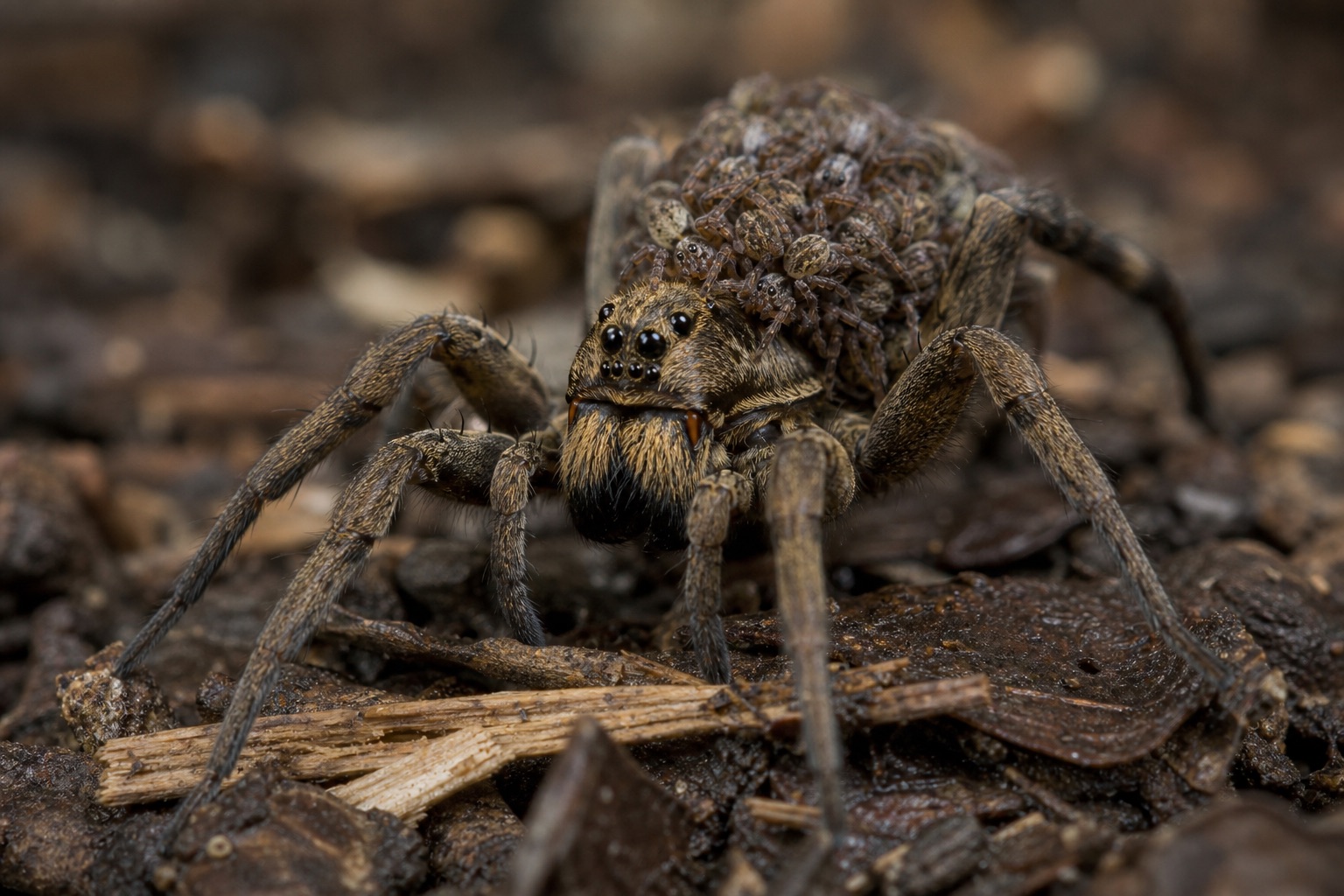
AI-generated educational wildlife portrait — World Animal Rescue Network · AI visualisation, not a photograph
In brief
Wolf spiders (family Lycosidae) are fast ground-hunting spiders with over 2,900 described species worldwide; females carry egg sacs on their spinnerets and then carry spiderlings on their backs, and their eyes reflect torchlight at night.
Also in Animals A to Z · Animals that start with W
By WARN Research & Conservation Team Last updated
Wolf spiders belong to the family Lycosidae, one of the most successful spider radiations on land. They are ground hunters: fast, hairy, with eight eyes arranged in three rows that include two large forward-facing ones giving unusually good vision for a spider. They do not build prey-capture webs. They run down prey or wait at burrow entrances, which is why the name 'wolf spider' stuck. What separates them in the public mind is maternal behaviour. A female attaches her egg sac to her spinnerets and carries it until the eggs hatch. The spiderlings then climb onto her abdomen and ride there for days before dispersing — a sight that alarms gardeners who do not recognise what they are seeing. Shine a torch across lawn or leaf litter at night and the tapetum behind those eyes returns green or orange eyeshine, the same trick used to locate mammals — except here the eyes belong to an invertebrate predator doing useful pest control for free.
2,900+
Described lycosid species
8 eyes
Three rows — including large forward-facing pair
Egg sac
Carried attached to spinnerets until hatching
Eyeshine
Tapetum reflects torchlight — green or orange at night
Figures sourced from World Spider Catalog — Lycosidae, IUCN Red List .
Wolf Spider: Quick Facts
| Body length | Often 1–2 cm in common species; larger in tropics |
|---|---|
| Diet | Ground-dwelling insects and invertebrates |
| Habitat | Lawns, heath, coast, forest litter, burrows |
| Web use | No prey-capture web — active hunter |
| Reproduction | Egg sac on spinnerets; spiderlings ride on back |
| Night field mark | Eyeshine in torchlight |
Scientific Classification
| Kingdom | Animalia |
|---|---|
| Phylum | Arthropoda |
| Class | Arachnida |
| Order | Araneae |
| Family | Lycosidae |
| Genera | Pardosa, Hogna, Lycosa and many others |
| Species | Over 2,900 described worldwide |
Conservation Status
- IUCN Status
- Not Evaluated
- Population
- Not applicable at family level
- Trend
- Unknown for most species; habitat loss affects specialists
- Assessed
- Most species unassessed
- CITES
- Not listed
Common garden and lawn species appear secure. Cave, dune and island endemics may be threatened without ever receiving a Red List entry.
Did you know?
A female wolf spider carries her egg sac on her spinnerets until it hatches, then carries the spiderlings on her abdomen for days — one of the most visible cases of spider parental care, and the reason gardeners sometimes see a large spider covered in tiny ones.
Key Facts: Wolf Spider
- Wolf spiders (Lycosidae) hunt on the ground without prey-capture webs.
- Females attach the egg sac to their spinnerets and carry it until the young hatch.
- Spiderlings then ride on the mother's abdomen for several days before dispersing.
- Eight eyes in three rows give better vision than most spiders; eyeshine is visible at night.
- They eat insects and other small invertebrates and are generally harmless to humans.
- Most species are widespread and unassessed; cave and island endemics face habitat pressure.
Hunting on foot rather than from a web
Lycosids are cursorial hunters. The body is typically stout and low, legs long for sprinting, and the chelicerae deliver venom tuned for insects and other arthropods. Some species occupy silk-lined burrows and ambush from the entrance; others roam openly across lawns, beaches and forest litter. Silk is used for retreats, egg sacs and draglines, not as an aerial trap.
That ecology places wolf spiders among the dominant ground-level predators in many habitats. A healthy lawn at night may hold dozens patrolling for crickets, ants and beetle larvae. Pesticide applications that eliminate them often see pest insects rebound because the predator community recovers more slowly.
Egg sacs and spiderlings on the back
After mating, a female wolf spider produces an egg sac woven from silk, fertilises the eggs inside it, and attaches the sac to her spinnerets. She carries it everywhere — still hunting, still avoiding predators — until the spiderlings emerge. They then climb onto her abdomen and remain there for a period that varies by species, sometimes a week or more, before ballooning or walking away.
The behaviour is maternal investment without feeding: the female does not eat her young, and the young gain protection and thermal stability during a vulnerable stage. To a human observer the mass of tiny spiders on a larger spider looks alarming. It is one of the more visible examples of parental care among arachnids.
Eyeshine and the three-row eye layout
Wolf spider eyes are arranged in three rows: four small eyes on the bottom row, two large forward-facing eyes above them, and two smaller eyes on top. The large anterior median eyes give acute vision used to track prey and mates. A reflective tapetum behind the retina produces eyeshine when light enters the eyes — the same mechanism that makes cat eyes glow in headlights.
Sweeping a torch low across grass at night reveals green or orange points of light at spider eye height. The trick works on wolf spiders worldwide and is a standard field method for estimating abundance. It also makes the point that these are visually oriented animals, not the blind crawlers of caricature.
Bites, fear and what is actually at risk
Wolf spiders can bite if trapped against skin, and the bite may cause local pain and swelling in sensitive individuals. They are not medically significant spiders in the way widow or recluse species can be. Most encounters end with the spider running away.
Conservation concern concentrates on habitat specialists — cave-dwelling lycosids, dune endemics, single-island species — rather than the common garden forms people meet. Those widespread species remain valuable as indicators of insect abundance and pesticide load. Killing a female carrying spiderlings removes a season's brood and a working predator in one gesture.
What WARN Does
WARN publishes free arachnid education that separates alarming appearance from actual risk. Wolf spiders are among the spiders most often killed out of mistaken identity; understanding the egg-sac and spiderling behaviour prevents unnecessary destruction of a harmless pest controller.
If this guide helps you understand wildlife and the pressures it faces, a gift to WARN supports habitat protection and free public education in our partner countries.
Wolf Spider: Frequently Asked Questions
What do wolf spiders eat?
Where do wolf spiders live?
Are wolf spiders dangerous?
How long do wolf spiders live?
How big do wolf spiders get?
Why do wolf spiders glow in torchlight?
Sources & References
Population figures, conservation status and biological facts on this page are drawn from authoritative scientific and intergovernmental sources.
Terms used on this page
Plain-English definitions, from our wildlife and conservation glossary.
Explore more animals
Discover more animals, their habitats and their conservation status in the WARN wildlife-guide library.
Enjoyed this Wolf Spider guide?
Receive appeal updates, animal-welfare news and published funding reports. Unsubscribe any time.
We only use your address for WARN updates. See our privacy policy.