Wildlife Guide · New Zealand & Offshore islands and mainland sanctuaries
Weta
Deinacrida spp. and related genera — family Anostostomatidae
New Zealand's giant flightless crickets — among the heaviest insects on Earth.
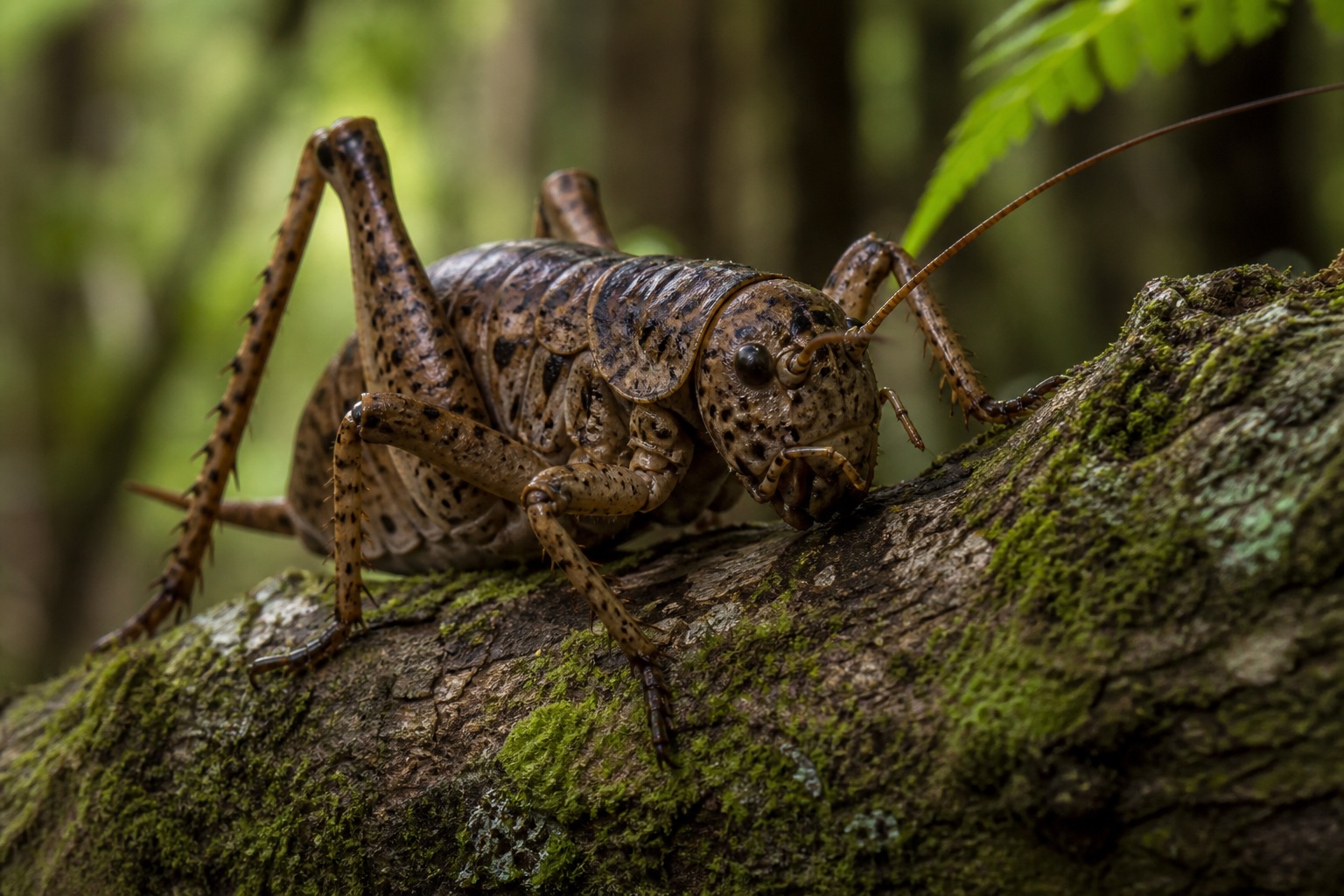
AI-generated educational wildlife portrait — World Animal Rescue Network · AI visualisation, not a photograph
In brief
Giant weta (Deinacrida and related New Zealand genera) are among the heaviest insects at up to about 35 g, flightless orthopterans endemic to New Zealand; introduced mammals devastated populations and several species are threatened though not all are individually assessed.
Also in Animals A to Z · Animals that start with W
By WARN Research & Conservation Team Last updated
Weta are large flightless orthopterans endemic to New Zealand — not crickets in the garden sense but related anostostomatids that fill ecological niches elsewhere occupied by rodents. Giant weta of genus Deinacrida can weigh more than 35 grams — heavier than a house sparrow — and exceed 10 centimetres in body length with legs extended. Maori knew weta well; European arrival brought rats, stoats and cats that devastated ground-dwelling populations. Several giant weta species are now restricted to predator-free islands and fenced sanctuaries. Tree weta live in suburban gardens in drilled holes; giant weta require intensive protection.
~35 g
Recorded mass for large female giant weta — among heaviest insects
Flightless
Wings reduced; cannot fly
NZ only
Endemic to New Zealand archipelago
Predators
Rats and stoats drove island extinctions
Figures sourced from IUCN Red List — Deinacrida heteracantha (wetapunga), Department of Conservation New Zealand — Weta, Te Papa — Giant weta .
Weta: Quick Facts
| Mass | Giant weta females up to about 35 g |
|---|---|
| Length | Up to roughly 10 cm body in giants |
| Flight | Flightless — wings reduced |
| Diet | Omnivorous — plants and invertebrates |
| Main threat | Introduced rats, stoats and cats |
| Conservation | Predator-free islands and sanctuaries |
| IUCN status | Varies — several species threatened |
Scientific Classification
| Kingdom | Animalia |
|---|---|
| Phylum | Arthropoda |
| Class | Insecta |
| Order | Orthoptera |
| Family | Anostostomatidae |
| Genus | Deinacrida (giant weta) and Hemideina (tree weta) |
| Endemic | New Zealand archipelago only |
Conservation Status
- IUCN Status
- Varies by species
- Population
- No single estimate; giant weta greatly reduced on mainland
- Trend
- Increasing on cleared islands; decreasing where predators remain
- Assessed
- Species-specific — e.g. Deinacrida heteracantha assessed Critically Endangered
- CITES
- Not listed
'Weta' covers common tree weta and Critically Endangered giants. Status must be read species by species, not assumed from the common name.
Did you know?
New Zealand's giant weta evolved as heavy as a sparrow on islands with no native ground mammals — then nearly vanished when rats learned they were easy prey.
Key Facts: Weta
- Giant weta (Deinacrida) are among the heaviest insects; large females can exceed 35 g.
- Weta are flightless orthopterans endemic to New Zealand, filling niches similar to small mammals elsewhere.
- Introduced rats, cats and stoats caused catastrophic declines; many populations survive only on predator-free islands.
- Tree weta (Hemideina) are smaller, live in groups in hollow branches, and remain common in gardens with dead wood.
- Giant weta are long-lived for insects — several years — and slow-breeding relative to size.
- Conservation relies on island eradications, fenced sanctuaries and captive breeding for the most threatened Deinacrida species.
Heavyweight insects on mammal-free islands
New Zealand evolved without native land mammals except bats. Flightless birds, giant weta and other invertebrates occupied ground and understorey roles. Deinacrida giant weta grew large because nothing hunted them on the ground at night — until rats arrived on ships.
Documented masses for Little Barrier Island giant weta and related species exceed 35 g for females — comparable to competing claims for goliath beetles and rhinoceros beetles depending on life stage measured. Body length up to roughly 10 cm plus leg span makes them unmistakable when encountered on sanctuary islands.
Tree weta versus giant weta
Not all weta are giants. Tree weta (Hemideina) live in social groups in hollow tree holes and flax stems, audible chewing from garages and bush edges across New Zealand. They are large by global insect standards but not record-breaking.
Giant weta require deep leaf litter, native vegetation and absence of mammalian predators. The contrast illustrates how the same common name covers species from backyard-common to island-endangered within one country.
Recovery on predator-free islands
Conservation success stories follow rat eradication. When islands are cleared of rodents, weta populations sometimes rebound dramatically within years. mainland sites use predator-proof fences and intensive trapping.
Captive breeding programmes support releases for the most threatened Deinacrida taxa. Public engagement — adopting a weta house in the garden for tree weta — differs from the intensive management giant species require.
Status species by species
IUCN assessments exist for some Deinacrida species as Critically Endangered or Endangered; others remain Not Evaluated. The genus-level guide must not imply uniform security — wetapunga (Deinacrida heteracantha) is among the most threatened, while tree weta remain widespread.
Climate change, fire and habitat fragmentation add pressure beyond predators. Accurate guides name which weta people mean, because 'weta' spans common garden residents and Critically Endangered giants.
What WARN Does
WARN publishes sourced education for island-endemic species whose recovery depends on predator removal. Giant weta are a standard example of how introduced mammals erase invertebrate giants that evolved without them.
If this guide helps you understand wildlife and the pressures it faces, a gift to WARN supports habitat protection and free public education in our partner countries.
Weta: Frequently Asked Questions
What do weta eat?
Where do weta live?
Are weta dangerous?
How long do weta live?
How big are giant weta?
Are weta the same as crickets?
Are weta endangered?
Sources & References
Population figures, conservation status and biological facts on this page are drawn from authoritative scientific and intergovernmental sources.
Terms used on this page
Plain-English definitions, from our wildlife and conservation glossary.
Explore more animals
Discover more animals, their habitats and their conservation status in the WARN wildlife-guide library.
Enjoyed this Weta guide?
Receive appeal updates, animal-welfare news and published funding reports. Unsubscribe any time.
We only use your address for WARN updates. See our privacy policy.