Wildlife Guide · Northern New Guinea & Yapen, Biak and Supiori islands
Victoria Crowned Pigeon
Goura victoria (Fraser, 1844) — family Columbidae
The largest pigeon on Earth, and one of the dodo's closest surviving relatives.
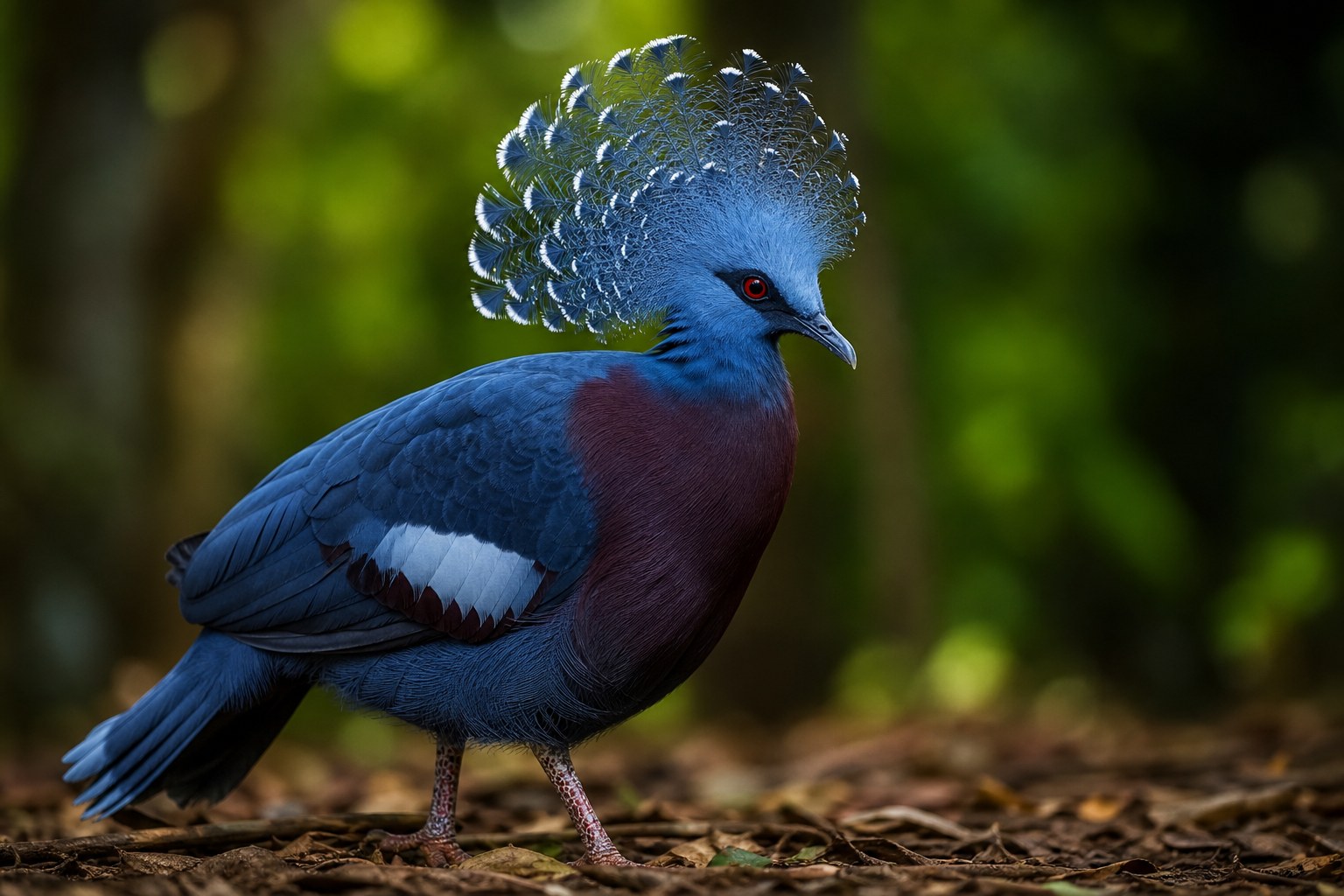
AI-generated educational wildlife portrait — World Animal Rescue Network · AI visualisation, not a photograph
In brief
The Victoria crowned pigeon (Goura victoria) is the world's largest pigeon at around 74 cm and 2.5 kg, found on the forest floor of northern New Guinea; it belongs to the same subfamily as the dodo, making it one of that species' closest living relatives, and is listed as Near Threatened.
Also in Animals A to Z · Animals that start with V
How you can help
You can support the related appeal — read its purpose, recipient status and fund terms first — or give once to where it is needed most. Sharing accurate information helps too.
By WARN Research & Conservation Team Last updated
The Victoria crowned pigeon is the largest pigeon alive — roughly the size of a turkey, deep slate blue, with a maroon breast and an extravagant fan-shaped crest of lacy blue feathers tipped in white. It walks the floor of northern New Guinea's lowland and swamp forests, feeding on fallen fruit and seeds, and flies only when it has to. Its significance goes beyond size. Crowned pigeons belong to the subfamily Raphinae, which also contained the dodo and the Rodrigues solitaire. That makes this bird among the closest living relatives of the most famous extinct animal on Earth, and its situation is uncomfortably familiar: a large, ground-dwelling, slow-breeding, trusting bird on islands where people hunt it.
~74 cm
Length — the largest pigeon species alive
~2.5 kg
Weight, roughly that of a small turkey
1 egg
Clutch size, as in most pigeons
Raphinae
The subfamily it shares with the dodo
Figures sourced from IUCN Red List — Goura victoria, Shapiro et al. (2002), Science — the dodo's place among pigeons, CITES Appendices .
Victoria Crowned Pigeon: Quick Facts
| Length | About 74 cm — the largest pigeon alive |
|---|---|
| Weight | Around 2.5 kg |
| Crest | Lacy blue, tipped white — unique among pigeons |
| Clutch | A single egg |
| Closest famous relative | The dodo, in the same subfamily Raphinae |
| Main threats | Hunting for meat and plumes; lowland forest clearance |
Scientific Classification
| Kingdom | Animalia |
|---|---|
| Phylum | Chordata |
| Class | Aves |
| Order | Columbiformes |
| Family | Columbidae |
| Genus | Goura |
| Species | Goura victoria |
Conservation Status
- IUCN Status
- Near Threatened
- Population
- No precise estimate; declining and increasingly patchy
- Trend
- Decreasing
- Assessed
- 2016
- CITES
- Appendix II
A lowland specialist with no montane refuge. Hunting has removed it from areas near settlements and logging roads, so its distribution is more fragmented than range maps suggest.
Did you know?
The dodo was a pigeon, and the Victoria crowned pigeon is in the same subfamily — so the closest thing alive to a dodo is a two-and-a-half-kilogram bird with a blue lace crown, still walking around the forests of New Guinea.
Key Facts: Victoria Crowned Pigeon
- The Victoria crowned pigeon is the largest pigeon species alive, at around 74 cm and 2.5 kg — comparable to a small turkey.
- Its lacy blue crest, tipped with white, is unique among pigeons and is raised in display and in alarm.
- It belongs to the subfamily Raphinae, which also contained the dodo and the Rodrigues solitaire, making it among the dodo's closest living relatives.
- It is primarily terrestrial, walking the forest floor feeding on fallen fruit, seeds and small invertebrates, and flying up to a branch mainly to roost or escape.
- Like most pigeons it lays a single egg, and both parents feed the chick on crop milk — a secretion produced by both sexes, which very few birds do.
- It is Near Threatened, hunted for meat and for its crest plumes, and losing lowland forest to logging and oil palm.
- It is unusually unafraid of people, which is a large part of why it is easy to hunt — the same trait that features in every account of the dodo.
The dodo connection
Genetic work has placed the dodo firmly within the pigeon family, with the Nicobar pigeon as its closest living relative and the crowned pigeons of New Guinea also within the same subfamily, Raphinae. The dodo was, in the phrase that surprises people most reliably, a very large flightless pigeon.
That makes the Victoria crowned pigeon more than a curiosity. It is a large, ground-dwelling, slow-breeding pigeon on tropical islands, unafraid of people, laying a single egg at a time. Every one of those traits appears in the account of why the dodo disappeared within about 64 years of European arrival on Mauritius. The crowned pigeon retains flight, which is a real difference — it can escape upward. But its life history offers no more capacity to absorb losses than the dodo's did, and the pressures on it are hunting and forest clearance rather than introduced rats. The resemblance is close enough to be worth stating plainly rather than treating as a novelty.
A pigeon the size of a turkey
Island environments frequently produce large-bodied forms of otherwise ordinary animals, and New Guinea's crowned pigeons are a clear case. With few ground predators historically, a heavy terrestrial bird was viable, and three Goura species evolved at a size no continental pigeon reaches.
The Victoria crowned pigeon spends most of its time walking, foraging for fallen fruit — figs especially — along with seeds and the occasional invertebrate. It flies reluctantly and usually only upward, to a roosting branch or away from a disturbance. Pairs and small groups forage together, and the birds are notably quiet apart from a deep booming call and a sharp wing clap given in display. Both parents incubate the single egg and both feed the chick on crop milk, a nutrient-rich secretion of the crop lining produced by males and females alike — a trait almost unique to pigeons among birds.
Why it is Near Threatened
Two pressures, both straightforward. The bird is hunted for meat, and it is exceptionally easy to hunt: large, ground-dwelling, slow to flush and — as observers consistently record — not much bothered by people approaching. It is also taken for its crest plumes, which are used in traditional dress. Hunting has removed it from areas near settlements and along logging roads, so its distribution is increasingly patchy within a range that still looks continuous on a map.
The second pressure is habitat. Northern New Guinea's lowland forest is being logged and converted to oil palm, and this is a lowland species with no montane refuge to retreat into. A single egg per clutch means slow replacement, so local populations that are hunted out do not readily refill. Its Near Threatened listing places it one category away from Vulnerable, and the trend is downward.
What WARN Does
WARN publishes free, sourced species education, including the links between what has already been lost and what is still here. The Victoria crowned pigeon sits in the dodo's own subfamily and shares most of the traits that made the dodo vulnerable, which makes it one of the most direct illustrations available of why the extinct-animals section on this site is not just history.
If this guide helps you understand wildlife and the pressures it faces, a gift to WARN supports habitat protection and free public education in our partner countries.
How can I help save the victoria crowned pigeon?
Explore practical ways to support the victoria crowned pigeon, from everyday choices and sharing reliable information to reviewing a related appeal before giving.
Explore ways to support
Read the related appeal’s purpose, recipient status and fund terms. Choose an affordable gift after checking what is proposed and what has been reported.
Ease the pressures
Avoid the wildlife trade and souvenirs, never buy wild animals as pets, and choose sustainable, habitat-friendly products — the threats behind the victoria crowned pigeon's decline fall when demand does.
Spread the word
Share accurate, sourced information about the victoria crowned pigeon. Wider awareness is what turns concern into lasting protection.
Victoria Crowned Pigeon: Frequently Asked Questions
How can I help save the victoria crowned pigeon?
What is the largest pigeon in the world?
Is the crowned pigeon related to the dodo?
Can Victoria crowned pigeons fly?
What do Victoria crowned pigeons eat?
Why is the Victoria crowned pigeon threatened?
Where do victoria crowned pigeons live?
Are victoria crowned pigeons dangerous?
How long do victoria crowned pigeons live?
How big is a victoria crowned pigeon?
Sources & References
Population figures, conservation status and biological facts on this page are drawn from authoritative scientific and intergovernmental sources.
Terms used on this page
Plain-English definitions, from our wildlife and conservation glossary.
Explore more animals
Discover more animals, their habitats and their conservation status in the WARN wildlife-guide library.
Enjoyed this Victoria Crowned Pigeon guide?
Receive appeal updates, animal-welfare news and published funding reports. Unsubscribe any time.
We only use your address for WARN updates. See our privacy policy.