Wildlife Guide · New Guinea & Far north Queensland, Australia
Tree Kangaroo
Genus Dendrolagus (Müller, 1840) — around 14 species
Kangaroos whose ancestors left the trees for the ground, then went back up again.
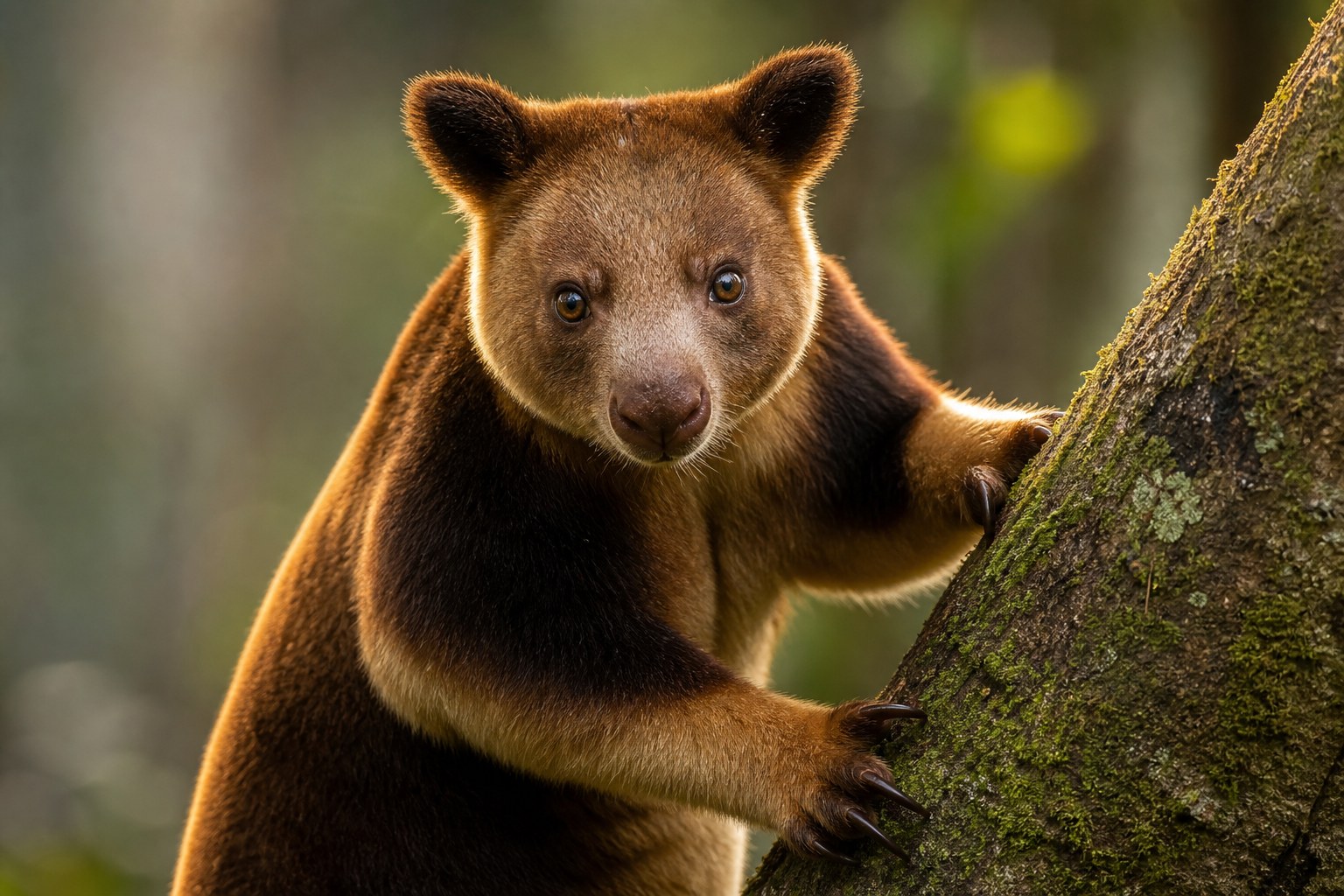
AI-generated educational wildlife portrait — World Animal Rescue Network · AI visualisation, not a photograph
In brief
Tree kangaroos are around 14 species of marsupial in the genus Dendrolagus that live in the rainforest canopies of New Guinea and far north Queensland; they descend from ground-dwelling kangaroos that returned to the trees, and several species are Endangered or Critically Endangered.
Also in Animals A to Z · Animals that start with T
How you can help
You can support the related appeal — read its purpose, recipient status and fund terms first — or give once to where it is needed most. Sharing accurate information helps too.
By WARN Research & Conservation Team Last updated
Tree kangaroos are the result of an evolutionary round trip. Early possum-like marsupials lived in trees; their descendants moved to the ground and became kangaroos and wallabies, rebuilt around hopping; and one lineage then returned to the canopy and had to undo a good deal of that specialisation. The compromises are visible. Tree kangaroos have shorter, broader hind feet than ground kangaroos, much stronger forelimbs, curved gripping claws, and a long tail used as a counterweight rather than a prop. Most importantly, they can move their hind legs independently — something a ground kangaroo cannot do — which lets them walk along a branch instead of being locked into hopping. They still look faintly wrong in a tree, and they are still extremely good at it.
~14
Species in the genus Dendrolagus
~18 m
Height from which one can leap to the ground unhurt
Independent
Hind leg movement — impossible for a ground kangaroo
Reversed
Their ancestors left the trees, then came back
Figures sourced from IUCN Red List — Dendrolagus matschiei, Tree Kangaroo Conservation Program — YUS Conservation Area, CITES Appendices .
Tree Kangaroo: Quick Facts
| Species | Around 14 in the genus Dendrolagus |
|---|---|
| Weight | Roughly 7–15 kg depending on species |
| Horizontal leap | About 9 m between trees |
| Drop to ground | Up to about 18 m without injury |
| Key adaptation | Hind legs move independently, allowing a walking gait |
| Main threats | Hunting with dogs, logging, oil palm and mining |
Scientific Classification
| Kingdom | Animalia |
|---|---|
| Phylum | Chordata |
| Class | Mammalia |
| Order | Diprotodontia |
| Family | Macropodidae |
| Genus | Dendrolagus |
| Species | Around 14 species |
Conservation Status
- IUCN Status
- Varies by species — several Endangered or Critically Endangered
- Population
- Unknown for most species; several have never been properly surveyed
- Trend
- Decreasing
- Assessed
- Varies by species
- CITES
- Appendix II
Over 90% of land in Papua New Guinea is held under customary tenure, so protection depends on landowning clans choosing it. The YUS Conservation Area is the model case.
Did you know?
The Wondiwoi tree kangaroo was not recorded once between 1928 and 2018, when a British botanist looking for rhododendrons photographed one on a mountain in West Papua. It is still known only from that single range.
Key Facts: Tree Kangaroo
- Tree kangaroos evolved from ground-dwelling kangaroos that returned to the canopy, reversing a major evolutionary transition.
- Unlike ground kangaroos, they can move their hind legs independently, which allows walking along branches rather than only hopping.
- They have shorter broader hind feet, much more powerful forelimbs and strongly curved claws compared with their ground-living relatives.
- They can leap around 9 m between trees, and drop as much as 18 m to the ground without injury.
- The tail is a counterweight for balance rather than a prop for sitting, which is the opposite of how a ground kangaroo uses it.
- Several species are Endangered or Critically Endangered, and at least one — the Wondiwoi tree kangaroo — went unrecorded for over 90 years before being photographed again in 2018.
- Hunting with dogs is the most immediate threat, because a tree kangaroo that descends to move between forest patches has no defence at ground level.
How do you rebuild a kangaroo for trees?
A ground kangaroo is a specialist. Its enormous hind feet, fused ankle joints and elastic tendons make hopping extraordinarily efficient over distance, but the hind legs move together as a unit and cannot be operated independently, which is why a kangaroo cannot walk in the ordinary sense.
That design is useless in a canopy. Tree kangaroos have partially reversed it: the hind feet are shorter and broader with roughened soles for grip, the ankles allow rotation, and crucially the legs can move separately, which permits a walking gait along a branch. The forelimbs, slight in a ground kangaroo, are heavily muscled and equipped with long curved claws for hauling the body upward. The tail, used by ground kangaroos as a fifth limb to lean on, becomes a long counterweight for balance. What emerges is an animal that climbs competently while still carrying the unmistakable frame of a hopping marsupial.
Dropping 18 metres
Tree kangaroos move between adjacent trees by leaping, covering around 9 metres horizontally. Their more remarkable ability is vertical: they can drop to the forest floor from as high as 18 metres and walk away.
The landing works because of loose skin, flexible joints, a low body density relative to their bulk and a controlled posture that spreads the impact through the hind limbs and tail. It is an escape strategy — a tree kangaroo pursued through the canopy can simply leave it. The limitation is what happens next. On the ground the animal is slow and clumsy, and where hunting dogs are present, descending is the point at which it becomes catchable. The escape that works against a canopy predator is precisely the behaviour that fails against dogs.
Which species are in trouble?
Most of them, though the data are poor. Matschie's tree kangaroo of the Huon Peninsula is Endangered, with a small range and continuing decline. The golden-mantled tree kangaroo is Critically Endangered, reduced to a fraction of its former range in Papua. The Wondiwoi tree kangaroo went unrecorded from 1928 until a mountaineer photographed one in 2018, and is known from a single mountain range.
Three pressures act together. Hunting with dogs is the most immediate, and has intensified as firearms and roads have spread. Logging and conversion to oil palm and mining remove canopy connectivity, forcing animals to the ground more often. And tree kangaroos reproduce slowly, with a single young at a time and a long period of dependency, so populations recover at a pace that cannot match the rate of loss. Several species have never been properly surveyed, which means the assessments understate rather than overstate the problem.
What is working
The clearest success is community-led. The YUS Conservation Area on Papua New Guinea's Huon Peninsula was established after landowning clans agreed to set aside territory for Matschie's tree kangaroo, pledging land they held under customary tenure. It became Papua New Guinea's first nationally recognised conservation area.
The design matters. In New Guinea the overwhelming majority of land is under customary ownership rather than state control, so conservation that does not have local landowners as the decision-makers has no legal or practical basis. YUS pairs protection with income — coffee and cocoa marketing, health and education services — so that the land set aside is not simply income forgone. It is the model most likely to work anywhere land tenure is customary, and it is why tree kangaroo conservation is discussed as a land-rights question as much as a wildlife one.
What WARN Does
WARN publishes free, sourced species education, including on the models of conservation that actually hold. Tree kangaroos are the clearest case in the region that protection depends on customary landowners choosing it — over 90% of New Guinea's land is held under customary tenure, so an approach that treats communities as obstacles rather than decision-makers cannot work there.
If this guide helps you understand wildlife and the pressures it faces, a gift to WARN supports habitat protection and free public education in our partner countries.
How can I help save the tree kangaroo?
Explore practical ways to support the tree kangaroo, from everyday choices and sharing reliable information to reviewing a related appeal before giving.
Explore ways to support
Read the related appeal’s purpose, recipient status and fund terms. Choose an affordable gift after checking what is proposed and what has been reported.
Ease the pressures
Avoid the wildlife trade and souvenirs, never buy wild animals as pets, and choose sustainable, habitat-friendly products — the threats behind the tree kangaroo's decline fall when demand does.
Spread the word
Share accurate, sourced information about the tree kangaroo. Wider awareness is what turns concern into lasting protection.
Tree Kangaroo: Frequently Asked Questions
How can I help save the tree kangaroo?
What is a tree kangaroo?
How are tree kangaroos different from ground kangaroos?
Can tree kangaroos really jump 18 metres to the ground?
Are tree kangaroos endangered?
Where do tree kangaroos live?
Are tree kangaroos dangerous?
How long do tree kangaroos live?
Sources & References
Population figures, conservation status and biological facts on this page are drawn from authoritative scientific and intergovernmental sources.
Terms used on this page
Plain-English definitions, from our wildlife and conservation glossary.
Explore more animals
Discover more animals, their habitats and their conservation status in the WARN wildlife-guide library.
Enjoyed this Tree Kangaroo guide?
Receive appeal updates, animal-welfare news and published funding reports. Unsubscribe any time.
We only use your address for WARN updates. See our privacy policy.