Wildlife Guide · Madagascar & North-eastern Madagascar — Antongil Bay area and surrounding forest
Tomato Frog
Dyscophus antongilii (Grandidier, 1877) — family Microhylidae
Bright red, round and sticky — a frog that glues predators' mouths shut.
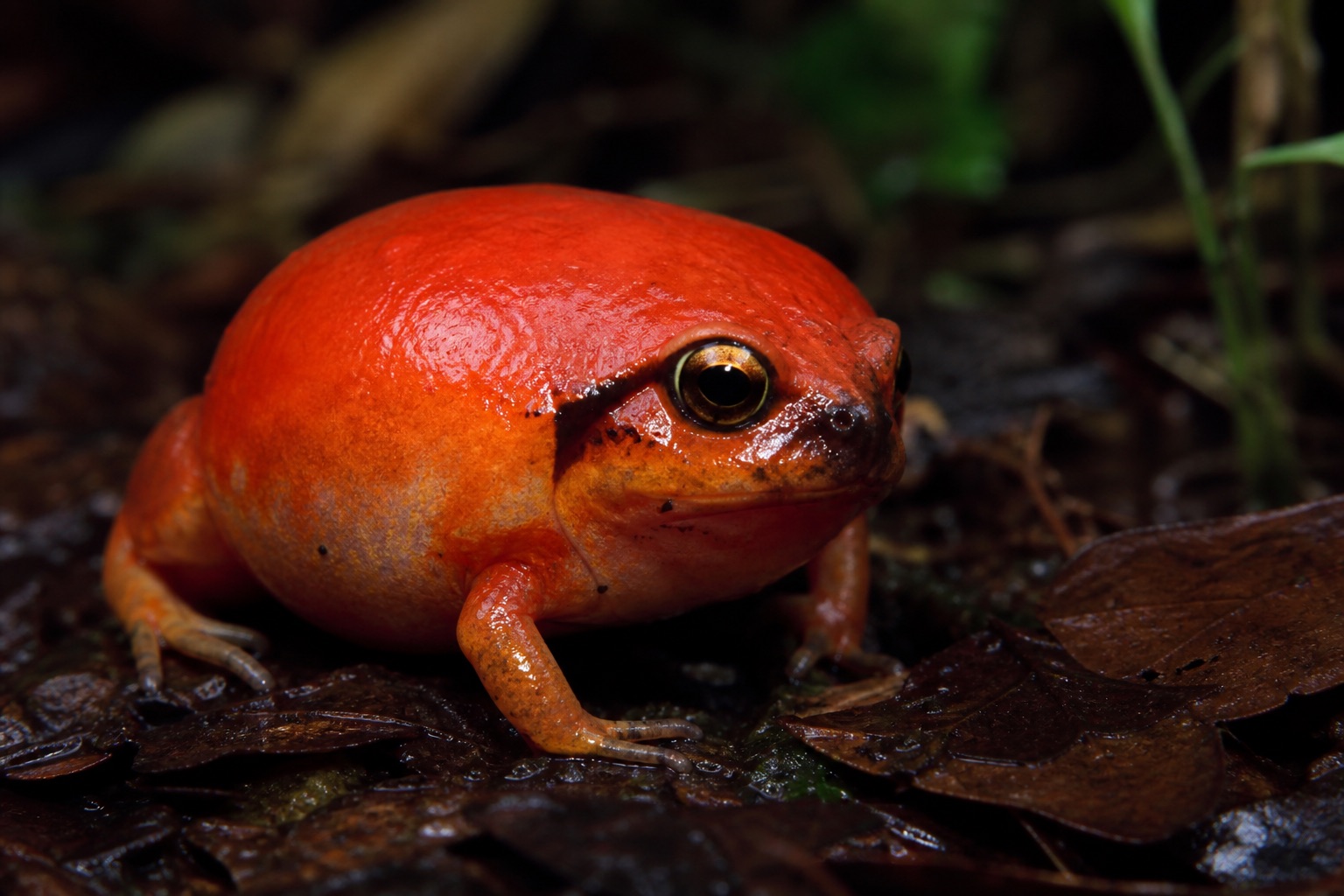
AI-generated educational wildlife portrait — World Animal Rescue Network · AI visualisation, not a photograph
In brief
The tomato frog (Dyscophus antongilii) is a bright red microhylid frog endemic to north-eastern Madagascar that secretes a glue-like defensive substance to immobilise predators' mouths; it is listed Near Threatened as an estimated 80–90% of the island's original forest has been lost.
Also in Animals A to Z · Animals that start with T
How you can help
You can support the related appeal — read its purpose, recipient status and fund terms first — or give once to where it is needed most. Sharing accurate information helps too.
By WARN Research & Conservation Team Last updated
Tomato frogs are round, bright red or orange microhylid frogs of Madagascar, named because they look like small tomatoes sitting on the forest floor. Dyscophus antongilii — the species most often called the tomato frog — is the largest and brightest, reaching up to 10 centimetres and flushing vivid red when disturbed. When threatened, tomato frogs secrete a thick white glue-like substance from skin glands. It is not a poison in the dart-frog sense — it is a defensive adhesive that can jam a predator's mouth shut or glue its eyes closed long enough for the frog to escape. Madagascar holds roughly 90% vertebrate endemism, and Dyscophus is one of several frog radiations found only there. An estimated 80–90% of the island's original forest has been lost, and D. antongilii is listed Near Threatened — losing humid forest around Antongil Bay to tavy, charcoal production and collection for the pet trade, in the same poverty-driven pattern that threatens every Malagasy forest species.
~90%
Share of Madagascar's vertebrates found nowhere else
~10 cm
Maximum body length in Dyscophus antongilii
Glue
Thick adhesive secretion — not a dart-frog alkaloid toxin
Near Threatened
IUCN status for Dyscophus antongilii
Figures sourced from IUCN Red List — Dyscophus antongilii, CITES Appendices .
Tomato Frog: Quick Facts
| Length | Up to about 10 cm in D. antongilii |
|---|---|
| Defence | Glue-like adhesive secretion from skin glands |
| Colour | Bright red or orange — aposematic warning |
| Range | North-eastern Madagascar (Antongil Bay area) |
| Endemism | Madagascar only — part of ~90% vertebrate endemism |
| Main threats | Forest loss; pet trade collection |
Scientific Classification
| Kingdom | Animalia |
|---|---|
| Phylum | Chordata |
| Class | Amphibia |
| Order | Anura |
| Family | Microhylidae |
| Genus | Dyscophus |
| Species | Dyscophus antongilii |
Conservation Status
- IUCN Status
- Near Threatened
- Population
- Unknown; declining with habitat
- Trend
- Decreasing
- Assessed
- 2004
- CITES
- Appendix II
Forest loss from tavy and charcoal is driven by rural poverty. Antongil Bay forest blocks need protection alongside trade regulation.
Did you know?
A tomato frog attacked by a snake can glue the snake's mouth shut with a thick white secretion — not poison, but adhesive strong enough to buy an escape.
Key Facts: Tomato Frog
- Tomato frogs (Dyscophus) are round, bright red or orange frogs endemic to Madagascar.
- When threatened they secrete a thick glue-like substance that can jam a predator's mouth or eyes shut.
- The secretion is adhesive, not a neurotoxin — a different defensive strategy from poison dart frogs.
- Madagascar holds roughly 90% vertebrate endemism; Dyscophus is part of the island's endemic frog fauna.
- Dyscophus antongilii is listed Near Threatened; an estimated 80–90% of original forest has been lost.
- Forest loss from tavy and charcoal production is driven by rural poverty; the pet trade adds collection pressure.
The glue defence
Most brightly coloured frogs advertise toxicity. Tomato frogs advertise stickiness. When grabbed or bitten, Dyscophus secretes a thick, white, viscous substance from parotoid and dorsal skin glands. The material is not a fast-acting poison — it is a defensive adhesive that glues the predator's mouth parts together or seals its eyes shut.
The frog sits still while the predator struggles to clear the glue, then hops away. The strategy works against snakes, birds and mammals that attack by biting. It is less effective against predators that swallow whole without chewing. The bright red colour is aposematic — a warning that handling this frog is a bad idea — but the mechanism is mechanical rather than chemical.
Three Dyscophus species
The genus Dyscophus contains three species, all Madagascar endemic. D. antongilii — the tomato frog proper — is the largest and reddest, from north-eastern Madagascar around Antongil Bay. D. guineti is similar but smaller, from the north-west. D. insularis occurs on Nosy Be and nearby islands.
All three share the glue defence and the round tomato-like shape. D. antongilii carries the highest profile and the Near Threatened listing, reflecting its restricted range and ongoing habitat loss. On an island where roughly 90% of vertebrates occur nowhere else, losing a genus takes a defensive system that exists nowhere else with it.
Forest loss around Antongil Bay
Dyscophus antongilii depends on humid lowland forest with leaf litter and standing water for breeding. The Antongil Bay region has lost substantial forest to tavy agriculture, logging and settlement expansion. An estimated 80–90% of Madagascar's original forest cover is gone island-wide, and the north-east is not exempt.
Tavy clears the understorey and leaf litter these frogs need. Charcoal production removes canopy trees that maintain humidity. The pressures are the same across Madagascar: rural poverty drives land clearing because families lack other income, and charcoal is often the only affordable cooking fuel. Conservation that works protects forest blocks, creates breeding ponds in community reserves, and addresses poverty through alternatives — not by blaming subsistence farmers without context.
Pet trade and chytrid
Tomato frogs are kept in captivity and exported under CITES Appendix II. Wild collection adds pressure on Near Threatened populations already losing habitat. Captive breeding reduces but does not eliminate wild take.
Like all amphibians, tomato frogs face the background threat of chytrid fungus, though Dyscophus has not been among the hardest-hit genera. The immediate pressure is habitat: a frog that breeds in forest pools cannot persist in cassava fields. Madagascar's amphibians as a class reflect the island's isolation — and its vulnerability as an estimated 80–90% of forest disappears.
What WARN Does
WARN publishes free, sourced species education across Madagascar's herps. Tomato frogs use glue, not poison — a defensive system found only on an island where roughly 90% of vertebrates occur nowhere else and forest loss driven by rural poverty continues.
If this guide helps you understand wildlife and the pressures it faces, a gift to WARN supports habitat protection and free public education in our partner countries.
How can I help save the tomato frog?
Explore practical ways to support the tomato frog, from everyday choices and sharing reliable information to reviewing a related appeal before giving.
Explore ways to support
Read the related appeal’s purpose, recipient status and fund terms. Choose an affordable gift after checking what is proposed and what has been reported.
Ease the pressures
Avoid the wildlife trade and souvenirs, never buy wild animals as pets, and choose sustainable, habitat-friendly products — the threats behind the tomato frog's decline fall when demand does.
Spread the word
Share accurate, sourced information about the tomato frog. Wider awareness is what turns concern into lasting protection.
Tomato Frog: Frequently Asked Questions
How can I help save the tomato frog?
Are tomato frogs poisonous?
Where do tomato frogs live?
Are tomato frogs endangered?
Can you keep a tomato frog as a pet?
Are tomato frogs dangerous?
How long do tomato frogs live?
How big is a tomato frog?
Sources & References
Population figures, conservation status and biological facts on this page are drawn from authoritative scientific and intergovernmental sources.
Terms used on this page
Plain-English definitions, from our wildlife and conservation glossary.
Latest Tomato Frog Stories
Quick, fact-checked reads on the tomato frog — amazing facts, key questions and the threats it faces.
Explore more animals
Discover more animals, their habitats and their conservation status in the WARN wildlife-guide library.
Enjoyed this Tomato Frog guide?
Receive appeal updates, animal-welfare news and published funding reports. Unsubscribe any time.
We only use your address for WARN updates. See our privacy policy.