Wildlife Guide · Tropical and warm-temperate oceans worldwide & Coastal shelves, reefs and open ocean
Tiger Shark
Galeocerdo cuvier (Péron & Lesueur, 1822) — family Galeocerdonidae
The ocean's least fussy large predator — and a serrated tooth that cuts turtle shell.
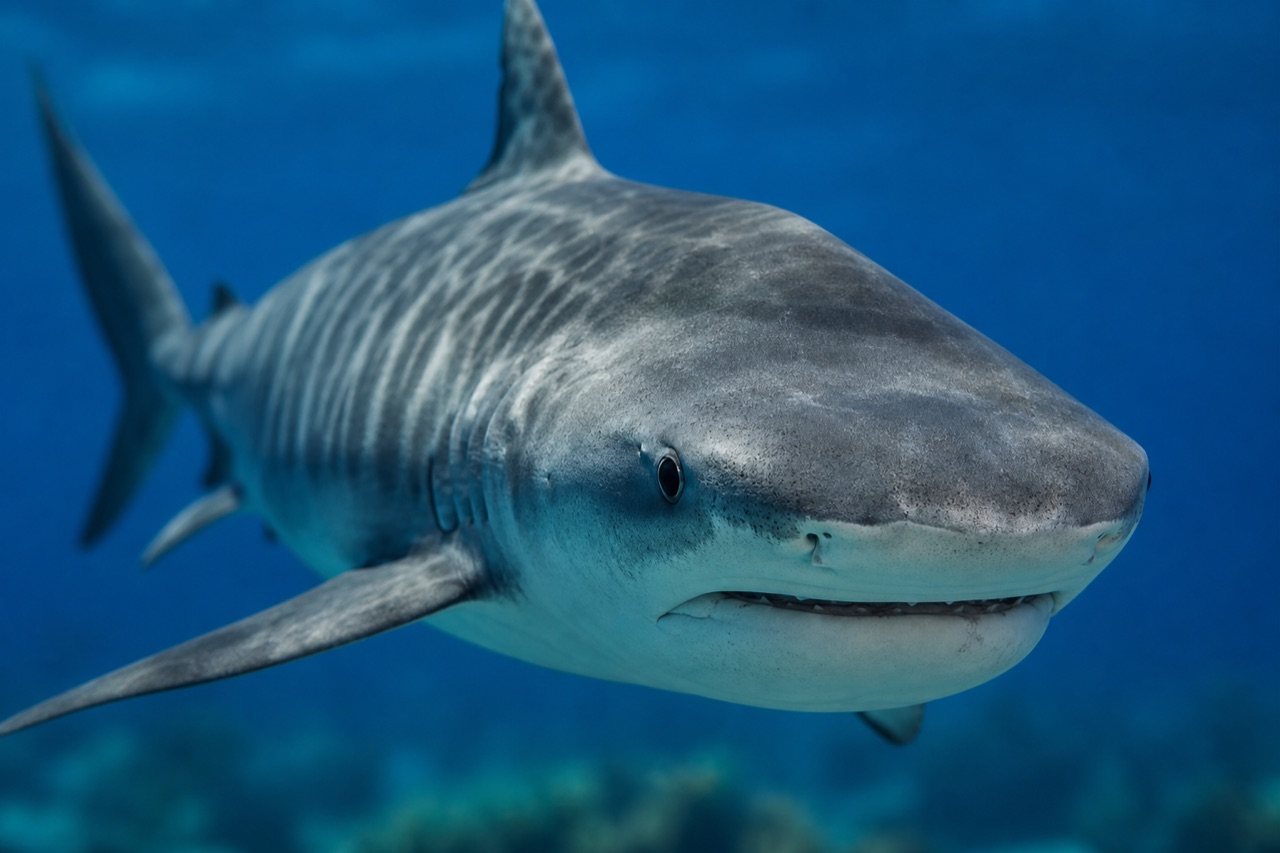
AI-generated educational wildlife portrait — World Animal Rescue Network · AI visualisation, not a photograph
In brief
The tiger shark (Galeocerdo cuvier) is a large generalist predator whose uniquely notched, heavily serrated teeth can cut through sea turtle shell, and which is listed as Near Threatened.
Also in Animals A to Z · Animals that start with T
How you can help
You can support the related appeal — read its purpose, recipient status and fund terms first — or give once to where it is needed most. Sharing accurate information helps too.
By WARN Research & Conservation Team Last updated
The tiger shark is a large coastal predator named for the dark vertical bars on young animals, which fade with age. It is the most generalist of the large sharks: stomach contents have included fish, turtles, seabirds, rays, other sharks, seals and dolphins, alongside indigestible human litter. What makes that diet possible is the tooth. Tiger shark teeth are broad, deeply notched and heavily serrated, with a shape suited to sawing through material other sharks cannot handle — including the shell of a sea turtle.
~5 m
Typical maximum length; large females can exceed it
Serrated
Notched teeth that saw through turtle shell
Generalist
The broadest diet of any large shark
Up to 80
Pups in a litter — high for a shark
Figures sourced from IUCN Red List — Galeocerdo cuvier, Smithsonian Ocean — Sharks .
Tiger Shark: Quick Facts
| Length | Typically up to ~5 m |
|---|---|
| Teeth | Notched and fully serrated — built for sawing |
| Diet | The broadest of any large shark |
| Litter size | Up to 80 pups |
| Ecological role | Shapes seagrass grazing through prey behaviour |
| Key threats | Fisheries, fin trade, shark control programmes |
Scientific Classification
| Kingdom | Animalia |
|---|---|
| Phylum | Chordata |
| Class | Chondrichthyes |
| Order | Carcharhiniformes |
| Family | Galeocerdonidae |
| Genus | Galeocerdo |
| Species | Galeocerdo cuvier |
Conservation Status
- IUCN Status
- Near Threatened
- Population
- Unknown; regional declines documented
- Trend
- Decreasing
- Assessed
- 2020
- CITES
- Not listed
Higher fecundity than most large sharks gives some resilience, but targeted fishing, bycatch and shark control mortality continue to reduce populations.
Did you know?
Where tiger sharks are present, dugongs and turtles avoid the most exposed seagrass — the sharks protect the meadow by changing behaviour, not by eating more grazers.
Key Facts: Tiger Shark
- Tiger sharks have the broadest diet of any large shark, including sea turtles.
- Their notched, heavily serrated teeth are shaped for sawing rather than piercing.
- The stripes that give them their name fade as the animal matures.
- Litters can reach 80 pups, unusually high for a shark.
- They are Near Threatened, taken in fisheries and finning and in shark control programmes.
The tooth that defines the diet
Most large sharks have teeth built to grip or to slice flesh. The tiger shark's are broad, cockscomb-shaped, deeply notched on one edge and serrated along their whole length — a saw rather than a blade.
That design lets a tiger shark cut through sea turtle shell, which almost no other predator can do, and to open large hard-bodied prey. It is the single anatomical feature that underwrites the species' reputation as an indiscriminate feeder.
A genuine generalist
Stomach content studies record an extraordinary range: bony fish, rays, other sharks, sea turtles, seabirds, sea snakes, squid, crustaceans, seals and dolphins, plus carrion. In some places seasonal prey drives their movements — tiger sharks gather where fledgling albatrosses first take to the water.
They also swallow indigestible human rubbish, which produced the old 'swimming dustbin' label. That habit is a symptom of an opportunistic feeding strategy rather than a lack of discrimination, and it makes them useful, if grim, samplers of marine litter.
Ecological role
As a large predator on turtles and dugongs, tiger sharks shape grazing behaviour in seagrass meadows. Where tiger sharks are present, grazers avoid the most exposed areas and seagrass persists; where sharks are removed, grazing intensifies and the meadow degrades.
This is a well-documented example of a predator's effect running through prey behaviour rather than prey numbers — the same mechanism described for wolves and elk, but underwater.
Pressures
Tiger sharks are taken as target catch and bycatch, and their fins enter the shark fin trade. They are also killed in shark control programmes using drumlines and nets, which remove large numbers of animals with little demonstrated effect on bite risk.
They are listed as Near Threatened. Their relatively high fecundity — litters can reach 80 pups — gives them more resilience than slow-breeding sharks such as the great white, but sustained fishing pressure still drives declines.
What WARN Does
WARN publishes free, sourced species education for the animals that are killed because of how they are perceived. Shark control programmes remove large numbers of tiger sharks with limited evidence of benefit, and accurate information about the actual level of risk is what shifts that policy.
If this guide helps you understand wildlife and the pressures it faces, a gift to WARN supports habitat protection and free public education in our partner countries.
How can I help save the tiger shark?
Explore practical ways to support the tiger shark, from everyday choices and sharing reliable information to reviewing a related appeal before giving.
Explore ways to support
Read the related appeal’s purpose, recipient status and fund terms. Choose an affordable gift after checking what is proposed and what has been reported.
Ease the pressures
Avoid the wildlife trade and souvenirs, never buy wild animals as pets, and choose sustainable, habitat-friendly products — the threats behind the tiger shark's decline fall when demand does.
Spread the word
Share accurate, sourced information about the tiger shark. Wider awareness is what turns concern into lasting protection.
Tiger Shark: Frequently Asked Questions
How can I help save the tiger shark?
Why is it called a tiger shark?
What do tiger sharks eat?
How can tiger sharks eat sea turtles?
Are tiger sharks dangerous to humans?
Are tiger sharks endangered?
Where do tiger sharks live?
How long do tiger sharks live?
How big is a tiger shark?
Sources & References
Population figures, conservation status and biological facts on this page are drawn from authoritative scientific and intergovernmental sources.
Terms used on this page
Plain-English definitions, from our wildlife and conservation glossary.
Explore more animals
Discover more animals, their habitats and their conservation status in the WARN wildlife-guide library.
Enjoyed this Tiger Shark guide?
Receive appeal updates, animal-welfare news and published funding reports. Unsubscribe any time.
We only use your address for WARN updates. See our privacy policy.