Wildlife Guide · Worldwide & Moss and freshwater films
Tardigrade
Phylum Tardigrada — water bears and moss piglets
A half-millimetre animal that shuts down its metabolism, dries out, and survives what would kill almost anything else — including the vacuum of space.
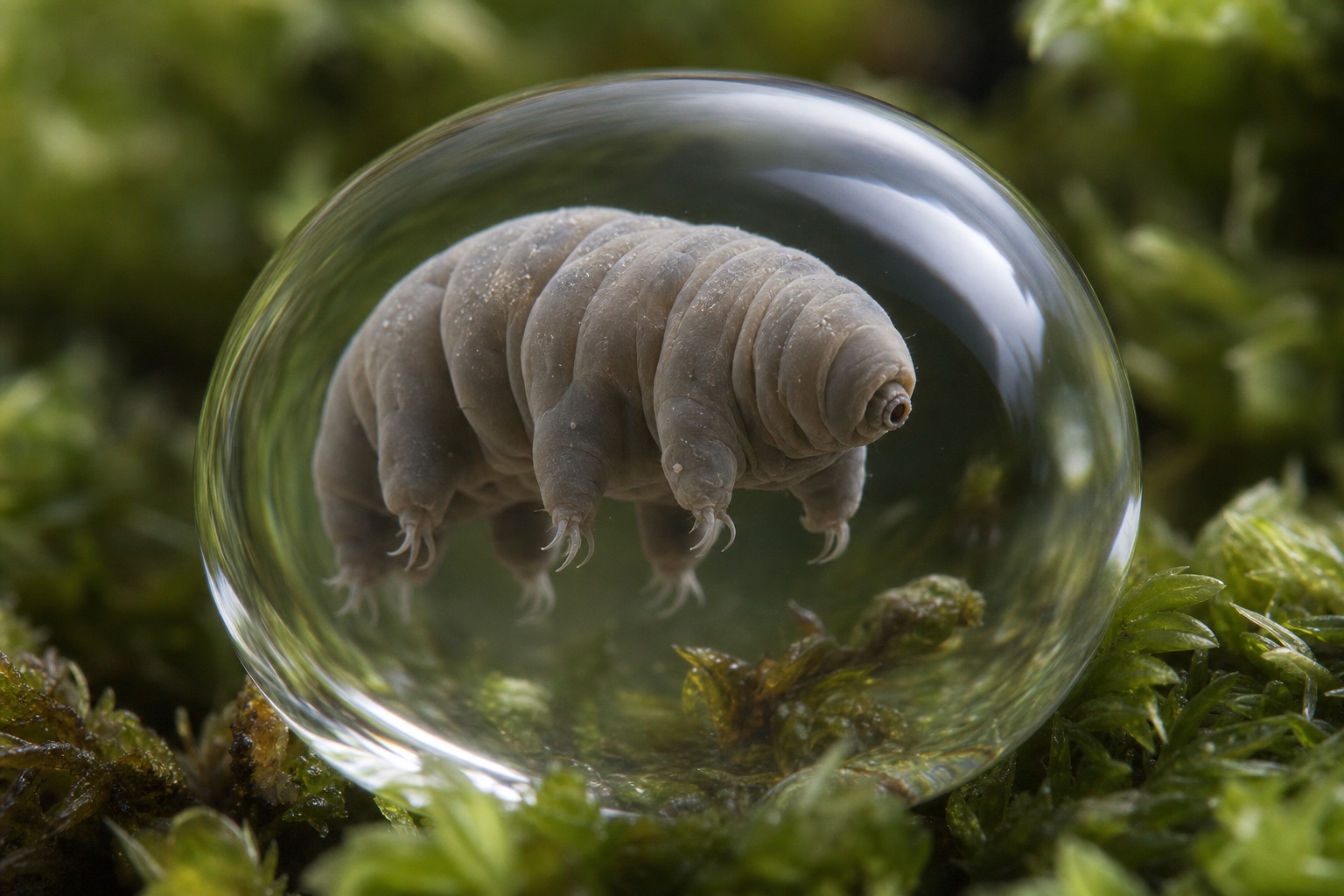
AI-generated educational wildlife portrait — World Animal Rescue Network · AI visualisation, not a photograph
In brief
A tardigrade is a microscopic invertebrate in the phylum Tardigrada, typically 0.3–0.5 mm long, that survives extreme drying, freezing and vacuum by entering cryptobiosis — a reversible shutdown of metabolism — and individuals exposed to open space on a 2007 orbital experiment were revived afterward.
Also in Animals A to Z · Animals that start with T
By WARN Research & Conservation Team Last updated
Tardigrades are microscopic invertebrates — typically 0.3 to 0.5 millimetres as adults — with a plump segmented body, four pairs of stout legs and a snout. They live in films of water on moss, lichen, soil and leaf litter, and in marine and freshwater sediments worldwide. There are more than 1,300 described species, and new ones are still being found. What makes them famous is cryptobiosis. When conditions turn hostile — desiccation, freezing, oxygen loss — tardigrades can expel most of their body water and enter a tun state, metabolism dropping to near zero. In that form they have survived laboratory exposure to vacuum, extreme cold and radiation far beyond what any vertebrate could tolerate. In September 2007, tardigrades on the outside of a European Space Agency FOTON-M3 mission spent ten days in open space and were revived afterward. They are not invulnerable — prolonged heat still kills them — but their hardiness is real and mechanistically understood, not folklore.
0.3–0.5 mm
Typical adult body length
~1,300
Described species — with more still being found
10 days
Open-space exposure survived on the 2007 FOTON-M3 mission
Cryptobiosis
Reversible metabolic shutdown in the tun state
Figures sourced from European Space Agency — tardigrades survive space exposure, National Museum of Natural History — tardigrade facts, Current Biology — cryptobiosis and desiccation tolerance (review context) .
Tardigrade: Quick Facts
| Body length | Typically 0.3–0.5 mm |
|---|---|
| Legs | Four pairs with claws — not six like insects |
| Habitat | Water films on moss, soil, lichen and sediments |
| Survival state | Cryptobiotic tun when desiccated |
| Space experiment | Revived after 2007 FOTON-M3 orbital exposure |
| IUCN status | Most species not individually assessed |
Scientific Classification
| Kingdom | Animalia |
|---|---|
| Phylum | Tardigrada |
| Class | Heterotardigrada and Eutardigrada (two main lineages) |
| Order | Varies by lineage — multiple orders described |
| Family | Varies — more than 140 genera described |
| Genus | Examples include Hypsibius, Milnesium, Ramazzottius |
| Species | More than 1,300 described; many await assessment |
Conservation Status
- IUCN Status
- Not Evaluated (phylum and most species)
- Population
- No population estimate exists
- Trend
- Unknown
- Assessed
- Not assessed for most species
- CITES
- Not listed
Tardigrades are widespread and rarely targeted by conservation programmes individually, but they illustrate how little is known about meiofauna abundance and how microhabitat loss from drying climates or pollution might affect even tolerant species.
Did you know?
Tardigrades moult like insects, but they often lay their eggs inside the shed cuticle — a discarded skin becomes a nursery.
Key Facts: Tardigrade
- Tardigrades are microscopic invertebrates in their own phylum, Tardigrada — not insects, not crustaceans.
- They live in water films on moss, soil and lichen, and in marine and freshwater sediments on every continent including Antarctica.
- Cryptobiosis lets them survive almost complete desiccation by curling into a dry tun with metabolism near zero.
- In the tun state, tardigrades have survived vacuum, temperatures near absolute zero and radiation doses that would kill humans — though they are not immortal and die under sustained high heat.
- The 2007 ESA FOTON-M3 experiment exposed tardigrades to open space for ten days; some were later rehydrated and revived.
- Most tardigrade species have not been individually assessed by the IUCN; their conservation status as a group is effectively unknown.
What cryptobiosis actually is
Cryptobiosis is not a vague superpower. It is a defined physiological state in which an organism's metabolic activity becomes undetectably low while structure is preserved. When a tardigrade's habitat dries, it loses water through its cuticle, retracts its legs, and forms a tun — a compact barrel shape protected by specialised proteins and sugars that replace water in cells and stabilise membranes.
Rehydration reverses the process if the tun has not been damaged. The animal uncurls, reabsorbs water and resumes feeding within hours. The same machinery helps some species survive freezing: ice crystals are excluded or tolerated in ways that rupture most animal cells. The limits are real. Tardigrades die at sustained high temperatures — roughly above 40 °C for many species — and a tun left dry for decades may fail to revive if storage conditions were poor.
The 2007 space exposure experiment
In September 2007, the European Space Agency's FOTON-M3 mission carried tardigrades of the species Richtersius coronifer and Milnesium tardigradum on the outside of the spacecraft, exposed to the vacuum of space, solar ultraviolet radiation and the temperature swings of low Earth orbit. The exposure lasted ten days.
After return, some individuals from both species were rehydrated and survived. The experiment demonstrated that cryptobiotic tardigrades can endure combined vacuum and radiation in space — not that tardigrades live naturally in orbit, but that their tun state protects against environmental extremes far beyond those of their mossy habitats. Subsequent work has explored which proteins — notably cytosolic abundant soluble proteins in some lineages — confer desiccation tolerance.
Where tardigrades live and what they eat
Most tardigrades are found in terrestrial microhabitats that hold water intermittently: moss cushions, lichen, rotting leaves and soil pores. Marine and freshwater species live in sediments. They are part of the meiofauna — animals too small to see clearly without magnification but abundant in almost every sampled environment.
Feeding is by piercing or sucking. Many species have a stylet in the mouth that punctures plant cells, algae or smaller invertebrates, and pharyngeal muscles pump in the contents. Life cycles include moulting — tardigrades shed their cuticle to grow — and eggs laid in the old cuticle or attached to substrate. Generation times range from days to months depending on species and temperature.
What WARN Does
WARN publishes free wildlife education that separates documented science from viral exaggeration. Tardigrade hardiness is real and mechanistically understood — accurate guides keep cryptobiosis from becoming folklore that crowds out species facing genuine extinction risk.
If this guide helps you understand wildlife and the pressures it faces, a gift to WARN supports habitat protection and free public education in our partner countries.
Tardigrade: Frequently Asked Questions
Are tardigrades dangerous to humans?
How long do tardigrades live?
How big is a tardigrade?
Did tardigrades really survive in space?
Sources & References
Population figures, conservation status and biological facts on this page are drawn from authoritative scientific and intergovernmental sources.
Terms used on this page
Plain-English definitions, from our wildlife and conservation glossary.
Latest Tardigrade Stories
Quick, fact-checked reads on the tardigrade — amazing facts, key questions and the threats it faces.
Guides
Pet Adoption vs. Animal Rescue: How to Help When You Can't Adopt
Pet adoption, cat adoption, dog adoption, puppies for adoption — they all matter. But what about the animals you cannot bring home?
Read the storyGuides
Giving in Memory of a Pet: A Complete Guide to Tribute Donations and Pet Memorials
How to give in memory of a much-loved pet, understand the chosen fund's terms and consider free ways to remember them. Recording a species does not automatically restrict a gift to that species.
Read the storySpecies
12 Amazing Facts About the Humpback Whale, the Ocean's Great Singer
From hours-long songs that only males sing to flippers longer than any other whale, here are 12 genuinely surprising facts about the humpback whale.
Read the storyExplore more animals
Discover more animals, their habitats and their conservation status in the WARN wildlife-guide library.
Enjoyed this Tardigrade guide?
Receive appeal updates, animal-welfare news and published funding reports. Unsubscribe any time.
We only use your address for WARN updates. See our privacy policy.