Wildlife Guide · Eastern and northern Australia & Southern New Guinea
Sugar Glider
Petaurus breviceps (Waterhouse, 1839) — family Petauridae
A possum that glides — membrane, big eyes, and a pet trade that exports trouble.
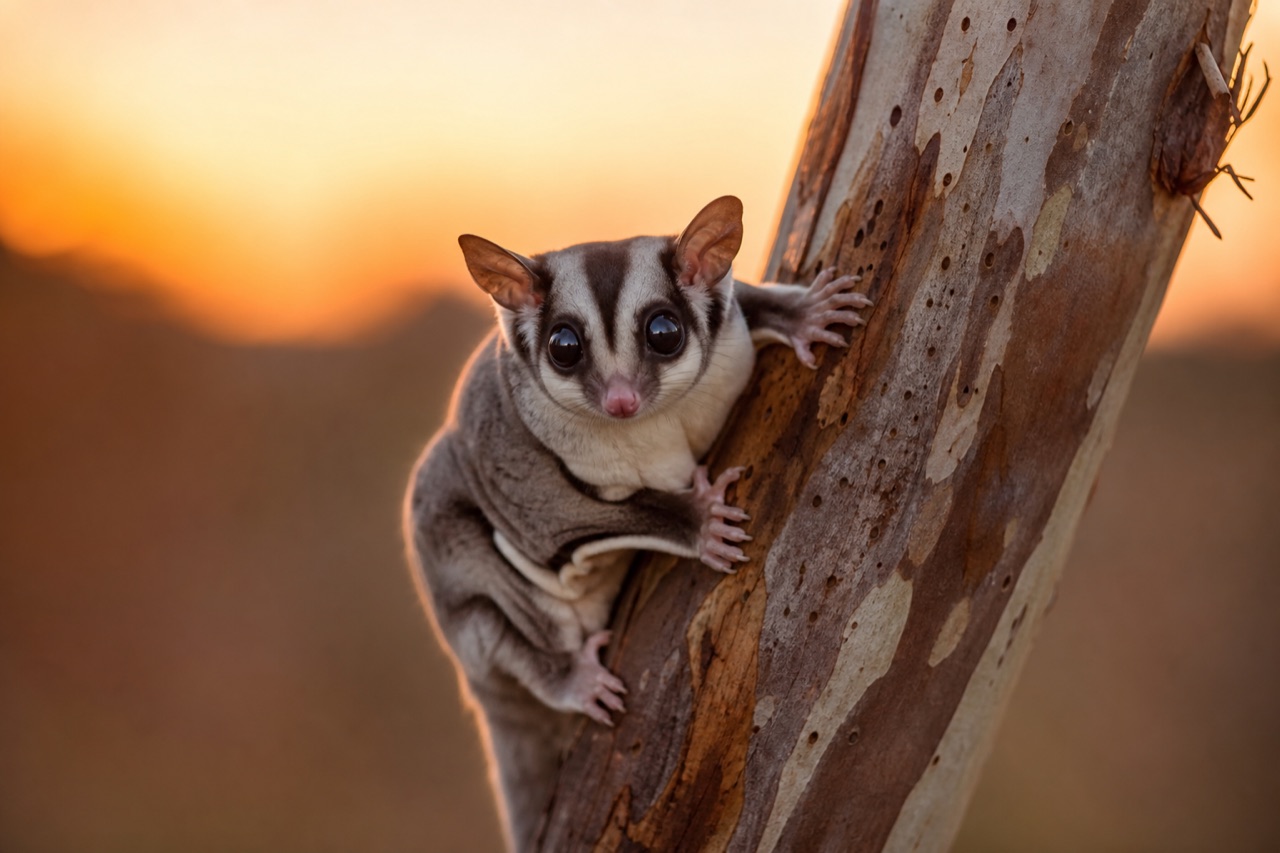
AI-generated educational wildlife portrait — World Animal Rescue Network · AI visualisation, not a photograph
In brief
The sugar glider (Petaurus breviceps) is a small nocturnal marsupial of Australia and New Guinea that glides on a skin membrane between trees — Least Concern in the wild but widely kept as an exotic pet with frequent welfare failures.
Also in Animals A to Z · Animals that start with S
By WARN Research & Conservation Team Last updated
The sugar glider is a small marsupial glider of eastern and northern Australia and southern New Guinea. It weighs roughly 100–160 g — smaller than a squirrel — with large eyes for nocturnal foraging, a bushy tail, and a patagium: a skin membrane stretching from wrist to ankle that lets it glide between trees for tens of metres. The name 'sugar' reflects a taste for sap and nectar; the diet also includes insects and tree gum. Socially, sugar gliders live in family groups sharing tree hollow nests. They are vocal — barks, crickets and soft chirps — and groom extensively. In the wild they are arboreal specialists dependent on hollow-bearing eucalyptus and acacia woodland. Logging that removes large trees, land clearing for agriculture and fire regimes that prevent hollow formation all reduce carrying capacity. Internationally, sugar gliders are among the most popular exotic mammal pets, bred in captivity in the United States, Asia and Europe. Wild-caught export from Australia is restricted; the pet trade relies on captive lines often descended from small founder populations. Welfare problems are common — incorrect diet, loneliness, inadequate space for gliding — and escaped or released pets occasionally appear outside native range. Australian wildlife law restricts export of native mammals; the sugar glider's global pet presence is almost entirely captive-bred abroad. That legal firewall protects wild populations but does not protect individual animals sold without adequate care instructions. Captive enrichment for sugar gliders should include climbing branches, nest boxes and opportunities to glide between perches — a metre of horizontal distance minimum between launch and landing points. Without that, muscles and behaviour atrophy in ways that vet bills later reveal. Wild sugar gliders mark territory with chest gland secretions and vocal duets at dawn — social communication that solitary pet keeping cannot replicate, which is one reason isolated animals self-mutilate. Rescue groups in pet-trade countries report gliders surrendered when owners discover the nocturnal noise, smell and social needs — a predictable pattern when sales omit honest husbandry briefing. Planting hollow-bearing trees takes decades; protecting existing old gums is the immediate conservation win for wild glider populations in cleared agricultural landscapes. Night-time wildlife cameras on Australian bush blocks often record sugar gliders visiting sap flows — a low-cost way landowners discover the species is already present before planting or installing nest boxes.
100–160 g
Adult weight
50+ m
Glides between trees using patagium
Nocturnal
Large eyes; active at night
Social
Family groups in shared tree hollows
Figures sourced from IUCN Red List — Petaurus breviceps, Australian Museum — sugar glider .
Sugar Glider: Quick Facts
| Weight | 100–160 g |
|---|---|
| Movement | Gliding on patagium |
| Activity | Nocturnal |
| Social | Family groups in hollows |
| IUCN status | Least Concern |
| Main threats | Hollow loss, land clearing; pet welfare globally |
Scientific Classification
| Kingdom | Animalia |
|---|---|
| Phylum | Chordata |
| Class | Mammalia |
| Infraclass | Marsupialia |
| Family | Petauridae |
| Genus | Petaurus |
| Species | Petaurus breviceps |
Conservation Status
- IUCN Status
- Least Concern
- Population
- Not quantified; widespread in suitable habitat
- Trend
- Decreasing locally with land clearing; stable overall
- Assessed
- 2016
- CITES
- Not listed
Hollow-bearing tree retention is the key wild conservation action. Pet trade welfare is a separate global issue.
Did you know?
Sugar gliders steer mid-glide by adjusting tail and body angle — controlled descent between trees, not flight, covering distances that would cost far more energy to climb-walk.
Key Facts: Sugar Glider
- Sugar gliders glide on a membrane (patagium) from wrist to ankle — they do not fly.
- Wild diet includes nectar, sap, gum and insects — not just fruit.
- They require tree hollows for nesting; hollow loss is the main habitat threat.
- Least Concern in Australia but locally affected by land clearing and logging.
- Popular exotic pet with high welfare failure rates — social, nocturnal, needs space to glide.
- Captive diet and loneliness are the commonest causes of pet health problems.
Gliding mechanics and arboreal life
Gliding is controlled descent, not powered flight. A sugar glider launches from a branch, spreads limbs to tense the patagium, and steers with tail and body angle. Typical glides cover 20–50 metres; longer glides are recorded downhill. The ability reduces ground exposure and energy cost of moving between scattered food trees.
Feet are adapted for climbing — opposable big toes on hind feet, grasping hands — with sharp claws for bark. Vision dominates navigation at night; large corneas gather light. Whiskers assist in close quarters within hollows.
Daytime is spent sleeping huddled in hollows, often several adults and juveniles together. Hollow competition with birds and other possums is real; sugar gliders will use nest boxes in areas where natural hollows are scarce if boxes are correctly designed and placed.
Diet and the 'sugar' name
Wild sugar gliders are omnivorous with a sweet tooth for real reasons. Eucalyptus and acacia sap, gum exudates and nectar provide carbohydrates; insects and spiders supply protein, especially for breeding females and growing young. Seasonal variation is strong — gum flows in winter when insects are scarce; insect abundance peaks in warmer months.
Captive pets fed only fruit develop metabolic bone disease from calcium-phosphorus imbalance and malnutrition. Correct captive diets mimic wild variety: protein sources, specialist nectar replacers, gum substitutes and controlled calcium supplementation. The failure mode is a cute animal on a fruit-only diet dying slowly of nutritional deficiency — preventable with accurate husbandry information, which pet shops often omit.
Pollination and sap-feeding roles in wild ecosystems are understudied compared with honeyeaters, but sugar gliders visit flowers for nectar and may transfer pollen incidentally.
Habitat, hollows and land clearing
Sugar gliders need woodland with sufficient hollow-bearing trees — typically eucalypts old enough to form cavities. Australian land clearing for agriculture and urban expansion removed hollow-bearing trees faster than natural hollow formation replaces them. A tree must be decades to centuries old to develop hollows large enough for gliders.
Preservation of dead standing trees and mature live trees with hollows is the habitat action that matters. Nest box programmes help locally but do not fully substitute for natural hollow diversity — temperature, humidity and entrance size all affect occupancy.
Fire management interacts with hollow availability. High-intensity fires that kill large trees reduce future hollow supply for decades. Mosaic burning that retains hollow-bearing survivors is preferable for glider persistence in fire-adapted landscapes.
Pet trade, welfare and biosecurity
Sugar gliders are bred commercially outside Australia for the pet trade. They are social — solitary keeping causes stress and self-mutilation. They are nocturnal — daytime handling conflicts with their cycle. They need tall enclosures with gliding distance, not hamster cages.
Legal status varies by country and state. Where ownership is permitted, veterinary care requires exotic-mammal expertise many clinics lack. Life span in captivity can exceed ten years with correct care — a long commitment often sold as a novelty impulse purchase.
Released and escaped pets outside Australia and New Guinea pose biosecurity and welfare risks without establishing viable wild populations in most climates. The conservation story is primarily Australian habitat protection; the welfare story is global and immediate for animals already in captivity.
Glider relatives and taxonomy
Petaurus contains several species — squirrel glider, yellow-bellied glider, mahogany glider — of varying conservation status. The mahogany glider of Queensland is Endangered with a tiny range; it is not the animal in the international pet trade but shares the gliding patagium body plan.
Larger gliders and feathertail gliders occupy adjacent niches in Australian forests. Sugar gliders are the smallest and most adaptable, which partly explains their range breadth and pet-trade prominence.
Taxonomic revision continues — some populations once grouped as P. breviceps may represent cryptic species. Pet lines descended from few founders may not reflect wild genetic diversity, a concern if breeders claim conservation value for captive populations.
What WARN Does
WARN publishes free, sourced species education including honest welfare guidance for widely traded exotic pets. Sugar gliders are not low-maintenance pocket companions — they are gliding marsupials with precise dietary and social needs.
If this guide helps you understand wildlife and the pressures it faces, a gift to WARN supports habitat protection and free public education in our partner countries.
Sugar Glider: Frequently Asked Questions
Can sugar gliders fly?
Are sugar gliders good pets?
What do sugar gliders eat in the wild?
Are sugar gliders endangered?
Where are sugar gliders from?
Where do sugar gliders live?
Are sugar gliders dangerous?
How long do sugar gliders live?
How big is a sugar glider?
Sources & References
Population figures, conservation status and biological facts on this page are drawn from authoritative scientific and intergovernmental sources.
Terms used on this page
Plain-English definitions, from our wildlife and conservation glossary.
Explore more animals
Discover more animals, their habitats and their conservation status in the WARN wildlife-guide library.
Enjoyed this Sugar Glider guide?
Receive appeal updates, animal-welfare news and published funding reports. Unsubscribe any time.
We only use your address for WARN updates. See our privacy policy.