Wildlife Guide · North America — eastern and central United States, southern Canada
Snapping Turtle
Chelydra serpentina (Linnaeus, 1758) and Macrochelys temminckii (Troost, 1835)
One of them fishes with a worm-shaped tongue. Neither can bite through a broom handle.
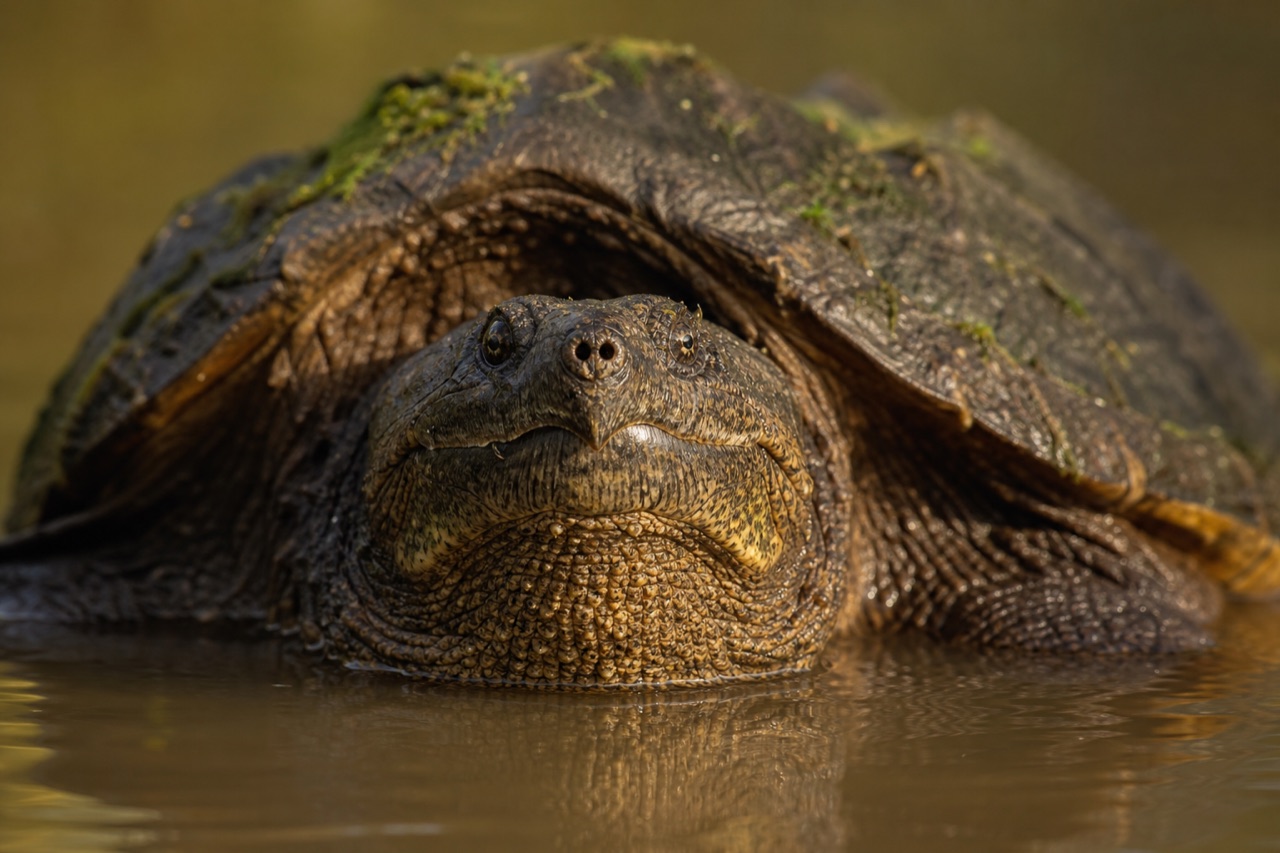
AI-generated educational wildlife portrait — World Animal Rescue Network · AI visualisation, not a photograph
In brief
Snapping turtles are two North American freshwater species — the common snapping turtle and the larger alligator snapping turtle, which lures fish with a worm-shaped appendage on its tongue; both are far less dangerous than their reputation, with bite forces well below those of a large dog.
Also in Animals A to Z · Animals that start with S
By WARN Research & Conservation Team Last updated
Two North American turtles share the name. The common snapping turtle is widespread across eastern and central North America, aggressive on land and largely inoffensive in water. The alligator snapping turtle is a much larger, heavily armoured animal of southern rivers, and one of the few reptiles anywhere that fishes with a lure — a pink, worm-shaped appendage on its tongue that it wriggles inside an open mouth. Both are surrounded by exaggeration. The claim that a snapping turtle can bite through a broom handle or sever fingers has been tested and is false: measured bite forces are substantial for a turtle and unremarkable compared to a large dog. The bites that do happen almost always occur on land, where a turtle out of its element and unable to retreat into its shell has nothing else to defend itself with.
~100 kg
Largest verified wild alligator snapping turtle
~209 N
Measured common snapper bite force — a large dog exceeds 1,000 N
Lingual lure
The alligator snapper's worm-shaped tongue appendage
80–100+ yr
Estimated alligator snapping turtle lifespan
Figures sourced from IUCN Red List — Macrochelys temminckii, IUCN Red List — Chelydra serpentina .
Snapping Turtle: Quick Facts
| Common snapper weight | Typically 8–16 kg |
|---|---|
| Alligator snapper weight | Verified wild animals around 100 kg |
| Measured bite force | About 209 N for the common snapping turtle |
| Hunting method | Alligator snapper uses a worm-shaped lingual lure |
| Age at maturity | 15–20 years for the alligator snapping turtle |
| Main threats | Historic harvesting, road mortality, habitat loss |
Scientific Classification
| Kingdom | Animalia |
|---|---|
| Phylum | Chordata |
| Class | Reptilia |
| Order | Testudines |
| Family | Chelydridae |
| Genus | Chelydra and Macrochelys |
| Species | Chelydra serpentina, Macrochelys temminckii |
Conservation Status
- IUCN Status
- Common snapping turtle Least Concern; alligator snapping turtle Vulnerable
- Population
- Common snapper abundant; alligator snapper much reduced across its range
- Trend
- Stable for the common snapper; decreasing for the alligator snapper
- Assessed
- 2011 and later
- CITES
- Macrochelys temminckii on Appendix III (United States)
Road mortality falls disproportionately on adult females travelling to nest sites — the individuals a slow-maturing population can least afford to lose.
Did you know?
An alligator snapping turtle lying on a river bottom is so thoroughly overgrown with algae that fish swim up to inspect the wriggling pink worm in its mouth without ever registering that the rock around it is an animal.
Key Facts: Snapping Turtle
- Two species share the name: the common snapping turtle (Chelydra serpentina) and the much larger alligator snapping turtle (Macrochelys temminckii).
- The alligator snapping turtle is among the heaviest freshwater turtles in the world, with verified wild animals around 100 kg.
- It hunts using a lingual lure — a pink, worm-like appendage on the tongue that it wriggles while lying motionless with its mouth open.
- Measured bite force for a common snapping turtle is around 209 newtons. A large dog exceeds 1,000. The broom-handle claim is false.
- Snapping turtles are aggressive on land because they cannot withdraw fully into their small plastron; in water they almost always retreat.
- The common snapping turtle is Least Concern and widespread. The alligator snapping turtle is Vulnerable, hit by decades of commercial harvesting for meat.
- Road mortality is a major pressure. Females crossing roads to reach nest sites are killed disproportionately, which removes exactly the animals a slow-breeding population cannot spare.
Fishing with a tongue
The alligator snapping turtle is one of very few reptiles that uses a lure to hunt. It rests motionless on the river bottom, algae-covered and effectively indistinguishable from a rock, and holds its mouth wide open. On the floor of the mouth sits a small pink appendage on the tongue that the turtle wriggles in a convincing imitation of a worm.
A fish that comes to investigate is taken by a strike fast enough that high-speed footage is needed to follow it. The behaviour lets an extremely heavy, slow animal catch fast prey without pursuing anything, and it is the same evolutionary solution reached independently by anglerfish and some snakes. Alligator snappers also actively forage at night, taking fish, molluscs, carrion and occasionally other turtles, so the lure is one tactic rather than the whole strategy.
The bite force myth
Snapping turtles are widely believed capable of severing fingers or biting through a broom handle. This has been measured, and it is not true. Published work on Chelydra serpentina found bite forces around 209 newtons, and alligator snapping turtles produce more but remain well within the range of a large dog, which exceeds 1,000 newtons. A snapping turtle bite is a serious injury that can require stitches; it is not an amputation.
The reputation comes from behaviour rather than power. On land a snapping turtle is genuinely aggressive, and the reason is structural: its plastron — the underside of the shell — is small and cross-shaped, leaving the limbs, neck and tail exposed. It cannot pull itself into its shell the way a box turtle can. Threatened out of water, its only options are to lunge or be eaten. In water, the same animal will almost always swim away.
Why moving one off a road matters
Road mortality is one of the most significant pressures on both species, and it falls disproportionately on adult females. Females leave the water in early summer to find nest sites, sometimes travelling considerable distances overland, and roads intersect those routes.
The demographic effect is severe. Snapping turtles mature slowly — around 15 to 20 years for alligator snappers — and lay small clutches with very high egg and hatchling mortality. A population depends on adult females surviving for decades to produce enough successful nests. Removing them at road crossings takes out precisely the individuals the population cannot replace. Helping a turtle across in the direction it was already heading is genuinely useful conservation, and for a large snapper the safe method is to lift by the back of the shell above the rear legs, or slide it onto a car mat and drag it — never by the tail, which can dislocate its vertebrae.
The alligator snapping turtle's decline
Commercial harvesting through the twentieth century removed alligator snapping turtles from much of their range. They were taken in large numbers for meat, particularly for soup, and the scale of the take was possible because the animals are long-lived, slow to mature and easy to trap. Populations that took decades to build were removed in years.
Most US states now prohibit or tightly restrict harvest, and the species is listed as Vulnerable. Recovery is slow by necessity: an animal that first breeds at 15 to 20 years old and lays a modest clutch cannot rebound quickly no matter how well it is protected. Habitat loss, river channelisation, hook-and-line bycatch and road mortality continue alongside. The common snapping turtle, which matures faster and tolerates degraded and urban water bodies well, remains Least Concern and abundant.
What WARN Does
WARN publishes free, sourced species education, including corrections to the myths that shape how people treat animals. Snapping turtles are killed on sight because of a reputation the measurements do not support, and knowing that a turtle on a road is a breeding female worth helping across is a change anyone can act on immediately.
If this guide helps you understand wildlife and the pressures it faces, a gift to WARN supports habitat protection and free public education in our partner countries.
Snapping Turtle: Frequently Asked Questions
Can a snapping turtle bite your finger off?
Why are snapping turtles aggressive on land?
How does an alligator snapping turtle catch fish?
How big do snapping turtles get?
Are snapping turtles endangered?
How should you move a snapping turtle off a road?
Where do snapping turtles live?
How long do snapping turtles live?
What do snapping turtles eat?
Sources & References
Population figures, conservation status and biological facts on this page are drawn from authoritative scientific and intergovernmental sources.
Terms used on this page
Plain-English definitions, from our wildlife and conservation glossary.
Explore more animals
Discover more animals, their habitats and their conservation status in the WARN wildlife-guide library.
Enjoyed this Snapping Turtle guide?
Receive appeal updates, animal-welfare news and published funding reports. Unsubscribe any time.
We only use your address for WARN updates. See our privacy policy.