Wildlife Guide · Worldwide — land, freshwater and marine & Greatest land-snail diversity on oceanic islands and limestone hills
Snail
Class Gastropoda (shelled members) — tens of thousands of land, freshwater and marine species
A single muscular foot, a tongue with thousands of teeth, and the group with more recorded extinctions than any other.
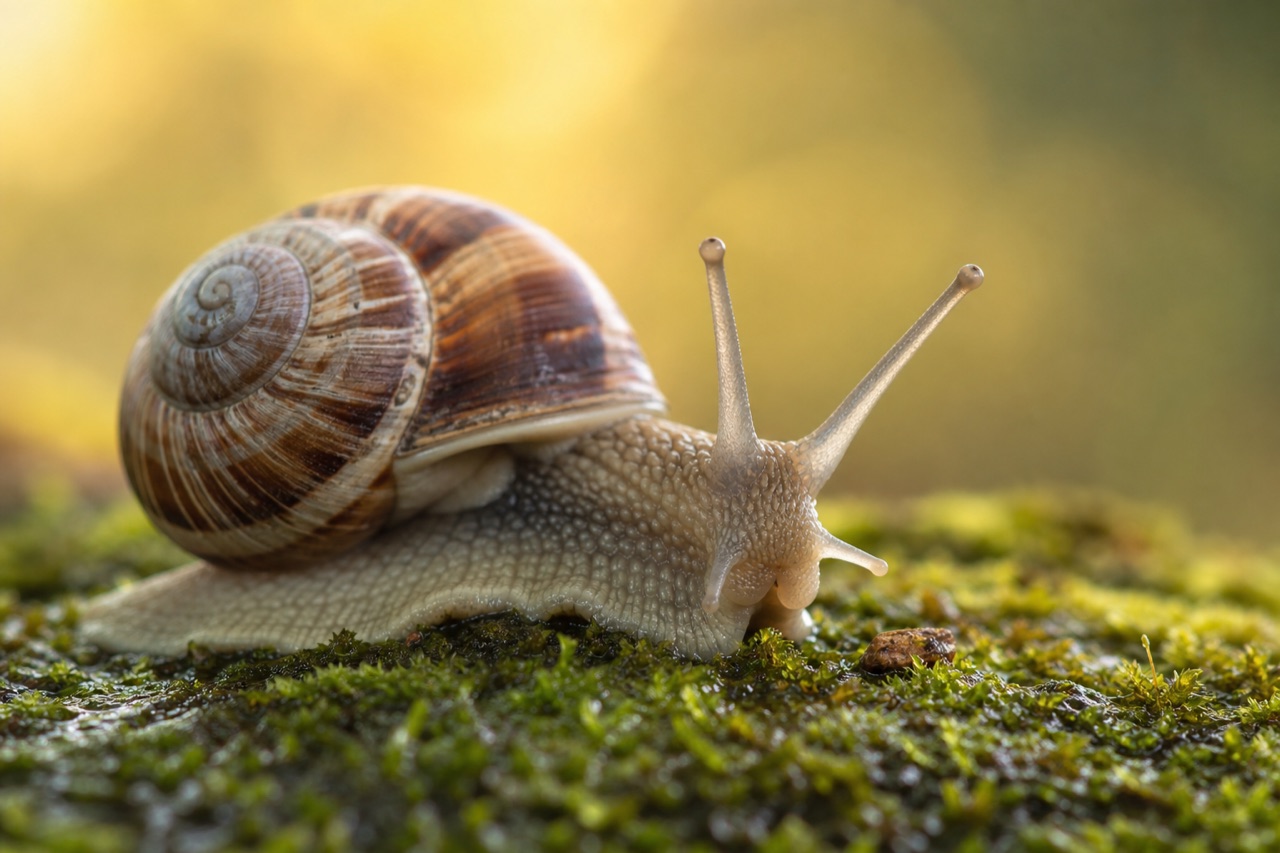
AI-generated educational wildlife portrait — World Animal Rescue Network · AI visualisation, not a photograph
In brief
Snails are shelled gastropod molluscs living on land, in fresh water and in the sea; they move on a single muscular foot, feed with a toothed radula, and land snails account for more documented modern extinctions than any other animal group.
Also in Animals A to Z · Animals that start with S
By WARN Research & Conservation Team Last updated
Snails are shelled gastropod molluscs, found on land, in fresh water and throughout the sea. The body plan is simple and effective: a coiled calcium-carbonate shell, a single muscular foot that glides on secreted mucus, eyes on retractable stalks in land species, and a radula — a ribbon of chitinous teeth used to rasp food. They are also, quietly, the group hit hardest by modern extinction. Land snails on oceanic islands and isolated limestone outcrops evolve into narrow-range endemics, and introduced rats, ants and predatory snails have wiped out enormous numbers of them. More recorded animal extinctions since 1500 involve molluscs than any other group.
~40%
Share of documented modern animal extinctions that are molluscs
1,000s
Teeth on a single radula, replaced continuously
1 foot
Muscular waves on one foot produce all movement
Hermaphrodite
Most land snails are both male and female
Figures sourced from IUCN Red List, CITES Appendices .
Snail: Quick Facts
| Habitat | Land, fresh water and marine |
|---|---|
| Locomotion | Muscular waves on a single foot, on mucus |
| Feeding | Radula — a ribbon of thousands of teeth |
| Shell | Calcium carbonate, secreted by the mantle |
| Dormancy | Aestivation and hibernation behind an epiphragm |
| Conservation | ~40% of documented modern animal extinctions |
Scientific Classification
| Kingdom | Animalia |
|---|---|
| Phylum | Mollusca |
| Class | Gastropoda |
| Note | 'Snail' is a body-form term, not a single taxonomic group |
| Familiar species | Cornu aspersum (garden snail), Helix pomatia (Roman snail) |
Conservation Status
- IUCN Status
- Varies enormously by species — group page
- Population
- Not applicable at group level
- Trend
- Severe declines and extinctions among island and limestone endemics
- Assessed
- Assessed species-by-species
- CITES
- Appendix I for Achatinella spp. (Hawaiian tree snails); other listings apply to some marine species
Introduced predators — rats, ants, flatworms and the rosy wolfsnail introduced as failed biological control — are the dominant driver of land snail extinctions.
Did you know?
Several Partula tree snail species exist today only because captive colonies were established in zoos before introduced predatory snails overran their home islands.
Key Facts: Snail
- Snails and slugs are both gastropods — slugs are essentially snails whose shell has been reduced or lost.
- The radula is a toothed ribbon; a garden snail may carry thousands of teeth, continuously replaced.
- Most land snails are hermaphrodites, and each individual can produce eggs.
- Shells are built from dietary calcium, so snails are scarce on calcium-poor soils.
- Molluscs account for a disproportionate share of documented modern extinctions, mostly island land snails.
- Slug pellets containing metaldehyde poison predators up the chain; barriers, timing and tolerance work better.
How a snail is built
The shell is secreted by the mantle from calcium carbonate and grows with the animal, adding material at the aperture in a logarithmic spiral. Because the shell is made from dietary calcium, land snails are abundant on chalk and limestone and scarce on acidic, calcium-poor ground.
Movement comes from waves of muscular contraction running along the single foot, lubricated by mucus that also seals moisture in and helps the animal cross rough or sharp surfaces. Land snails carry eyes at the tips of the upper tentacles and chemosensory organs on the lower pair; aquatic snails generally have eyes at the tentacle bases.
The radula
Instead of jaws, gastropods feed with a radula — a flexible ribbon carrying rows of chitinous teeth that rasps material into the mouth. Tooth number runs into the thousands in some species, and the ribbon is continuously produced at the back as the front wears away.
Radula shape tracks diet, and gastropod diets are extraordinarily varied: algae grazers, leaf eaters, detritivores, filter feeders, and predators. Cone snails have modified the radula into a hollow, harpoon-like tooth used to inject venom into fish — venom now studied intensively for pain medicine.
Reproduction and dormancy
Most land snails are simultaneous hermaphrodites, carrying both male and female organs. Courtship can be elaborate, and in some species includes firing a calcareous 'love dart' into the partner, which improves the sender's sperm survival. After mating, both individuals may lay eggs, usually in a shallow chamber in damp soil.
When conditions turn hostile, land snails seal the shell aperture with a mucus membrane — an epiphragm — and go dormant: aestivation in heat and drought, hibernation in cold. Some species can hold that state for months or, in desert species, far longer.
The extinction record nobody talks about
Land snails are extremely prone to becoming narrow-range endemics: poor dispersers, tied to specific microhabitats, isolated on islands and limestone hills. That makes them exceptionally vulnerable. Introduced rats, ants and flatworms, habitat clearance, limestone quarrying and — notoriously — the deliberate introduction of the predatory rosy wolfsnail as a failed biological control, have driven very large numbers of species to extinction, particularly in Hawai'i and French Polynesia.
Molluscs make up roughly 40% of documented animal extinctions since 1500, overwhelmingly land snails, and the true figure is almost certainly higher because many species were never described before disappearing. A handful of Partula tree snails survive only because captive populations were established in zoos before their islands were overrun.
What WARN Does
WARN publishes free, sourced species education across the whole of animal life. The animals that carry the heaviest extinction burden are rarely the ones that attract attention, and land snails are the clearest example: enormous losses, almost no public profile, and a well-documented history of harm caused by badly assessed biological control.
If this guide helps you understand wildlife and the pressures it faces, a gift to WARN supports habitat protection and free public education in our partner countries.
Snail: Frequently Asked Questions
What is the difference between a snail and a slug?
Do snails have teeth?
How long do snails live?
Are snails male or female?
Are snails dangerous?
How big is a snail?
Sources & References
Population figures, conservation status and biological facts on this page are drawn from authoritative scientific and intergovernmental sources.
Terms used on this page
Plain-English definitions, from our wildlife and conservation glossary.
Explore more animals
Discover more animals, their habitats and their conservation status in the WARN wildlife-guide library.
Enjoyed this Snail guide?
Receive appeal updates, animal-welfare news and published funding reports. Unsubscribe any time.
We only use your address for WARN updates. See our privacy policy.